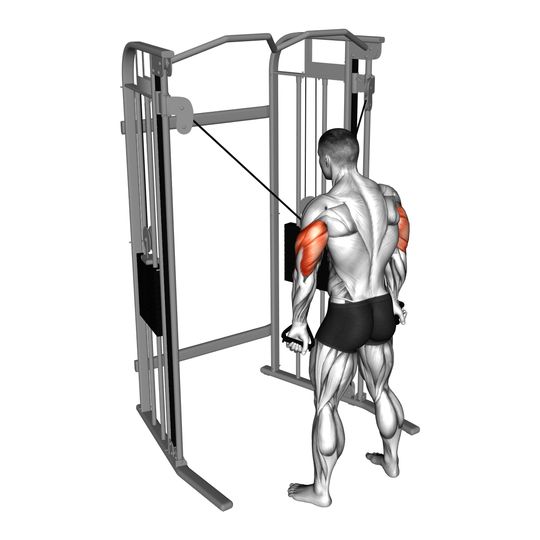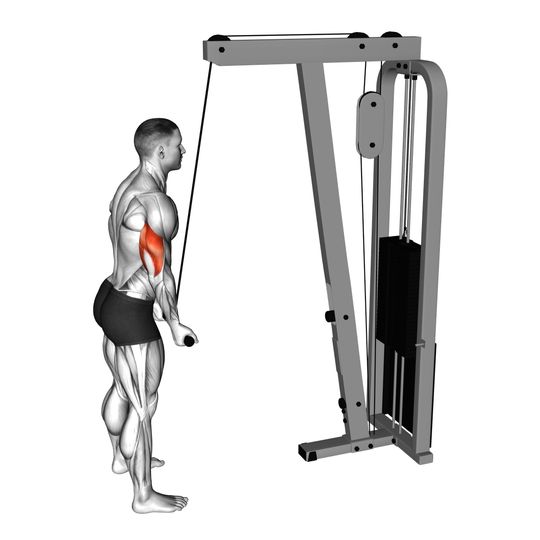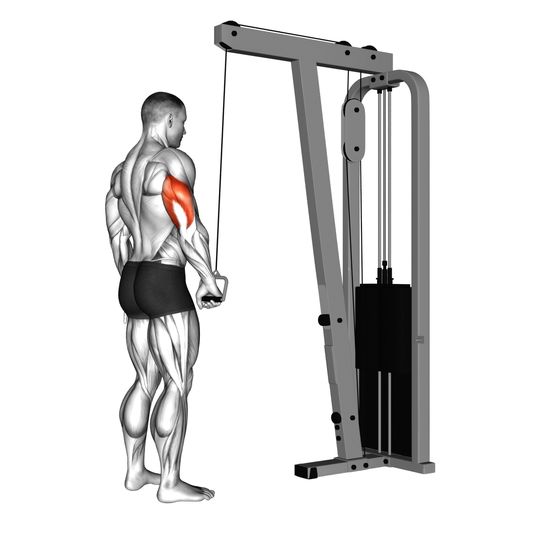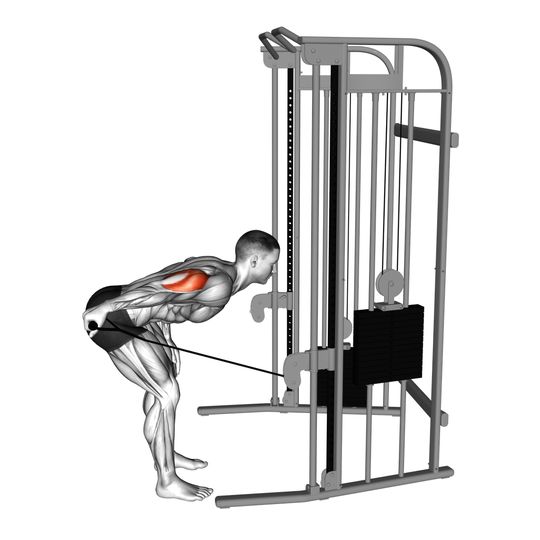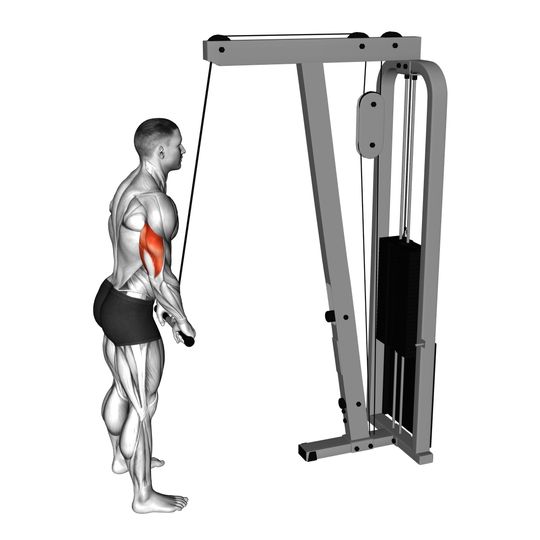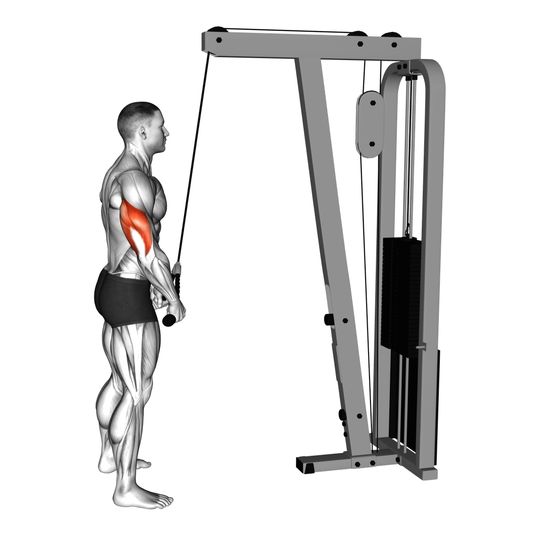


Perform elbow extensions on a cable machine using a V-bar to isolate and work the triceps through a controlled pushing motion.
How to do the V Bar Triceps Pushdown#
- Set the pulley to a high position and stand facing the machine with feet about hip-width apart.
- Grasp the V-bar with a neutral grip and tuck your elbows close to your sides so your forearms start vertical.
- Brace your core and keep an upright torso throughout the movement.
- Extend your elbows to push the bar down until your arms are fully straight, contracting the triceps at the bottom.
- Slowly return the bar to the starting position under control, stopping when your forearms are vertical.
Muscles worked#
The V bar triceps pushdown trains all three heads of the triceps brachii, favouring the lateral and medial heads because the upper arm stays tucked against the body. The angled handles of the V bar place the wrists in a semi-pronated position, part way between the fully pronated straight bar and the neutral rope, which many lifters find is the most natural angle for pushing hard into a full lockout without the wrists complaining.
The long head contributes less than in an overhead extension, since the arm never leaves the side and the muscle is not stretched over the shoulder. The anconeus finishes the last few degrees of extension, the forearms hold the bar and keep the wrists firm, and the lats and abs work to pin the elbows to the ribs and hold the torso still against a load that wants to pull it forward and up.
- Primary: Triceps (Triceps Brachii)
Common mistakes#
- Letting the elbows drift away from your sides.
- Using torso lean or momentum to move the weight.
- Bending the wrists and driving with the hands instead of extending at the elbows.
- Allowing the weight to drop quickly on the return phase.
Why it works#
The V bar sits in a useful middle ground. It is a rigid attachment, so both hands are locked into the same position and the set is repeatable, which makes it as easy to progress as the straight bar. At the same time the angled grips take the wrists out of the extended position the straight bar forces, so most people can lock the elbows fully and push heavier without forearm or wrist discomfort.
As a cable movement it keeps tension on the triceps from the top of the rep to the bottom, and it does so without loading the elbow joint the way skull crushers do. There is nothing to stabilise and recovery is fast, so it slots easily into the end of a push day or an arm session and can be repeated twice a week without the elbows objecting.
Sets, reps and setup#
Three to four sets of 8-12 reps with 60-90 seconds of rest, twice a week after your pressing. The V bar tolerates loads close to the straight bar, so use it for your heavier pushdown sets and hold the lockout for a second on every rep.
- Setup
- Set the pulley high, grip the V bar with the thumbs over the top of the handles, and step back so the cable runs at a slight angle. Lean forward a few degrees from the hips, pin the elbows to the ribs with the forearms parallel to the floor, and extend until the arms are straight and the bar touches the thighs. Return only until the forearms reach parallel.
- Progression
- Move up a plate when you complete 12 reps with a full lockout on all sets. Elbows floating forward on the way up or shoulders rounding to push down mean the load is too heavy; drop back and add a two-second pause at the bottom instead. Rotate between the V bar, rope and straight bar every few weeks to keep the movement productive.
Variations#
- Triceps Rope Pushdown Free hands that spread at the bottom for a fuller squeeze, with a bit less load.
- Straight Bar Triceps Pushdown Fully pronated grip on a rigid bar, the heaviest pushdown but hardest on the wrists.
- Reverse Grip Triceps Pushdown Palms facing up, a lighter variation that many lifters feel more in the medial head.
- Cable Single Arm Triceps Pushdown One arm at a time with a D handle, useful for a full lockout and evening out sides.
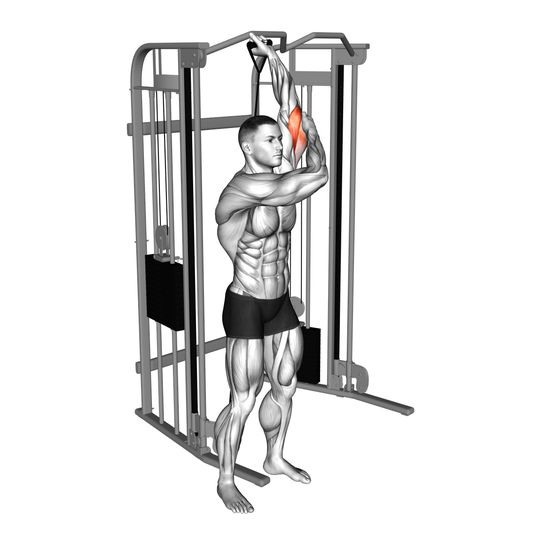
- Cable Triceps Extension Overhead with the arms raised, shifting the work to the long head.
V bar vs rope triceps pushdown#
The V bar is rigid, so the hands stay fixed and the path is identical every rep. That makes it the better tool for loading heavier and tracking progress, and its angled handles are kinder to the wrists than a straight bar. The limitation is that the hands cannot separate at the bottom, so the very end of the contraction is slightly less complete than on a rope.
The rope allows the hands to spread and the palms to turn down at lockout, which gives a stronger squeeze and a little more freedom for the elbows. It is usually the more comfortable attachment but the less loadable one. The practical answer is to use the V bar for heavier sets of 8-12 and the rope for higher-rep finishing work, or to alternate them between sessions.
Common questions#
What muscles does the V bar triceps pushdown work?
All three heads of the triceps, with the lateral and medial heads doing most of the work because the upper arm stays by the side. The anconeus assists at lockout, the forearms hold the semi-pronated grip, and the lats and abs keep the elbows and torso fixed.
Is the V bar better than a straight bar for triceps pushdowns?
For most people, yes. The angled handles put the wrists in a more neutral position, so it is easier to lock out fully and push heavy without wrist or forearm discomfort. The straight bar allows marginally more load for lifters whose wrists tolerate it, but the difference in triceps stimulus is small.
V bar or rope for tricep pushdowns?
The V bar for heavier, lower-rep sets where a fixed hand position helps you progress, the rope for higher-rep sets where spreading the hands gives a fuller contraction. Both train the same muscle; using them in different roles is better than picking one.
How heavy should V bar pushdowns be?
Heavy enough that 8-12 reps with a one-second lockout is hard, but light enough that the elbows stay against the ribs and the torso does not move. For most lifters that is 20-45 kg on a standard cable stack. Momentum from the shoulders means the weight is too high.
Should my elbows move during a triceps pushdown?
No. The upper arm should stay pinned to the side for the whole set, with only the forearm moving. If the elbows drift forward at the top or flare out at the bottom, the load is too heavy or the return is going too high; stop the forearms at parallel and lower the weight.