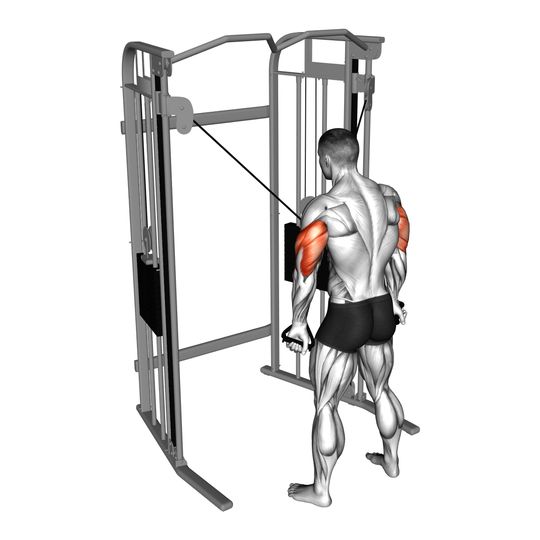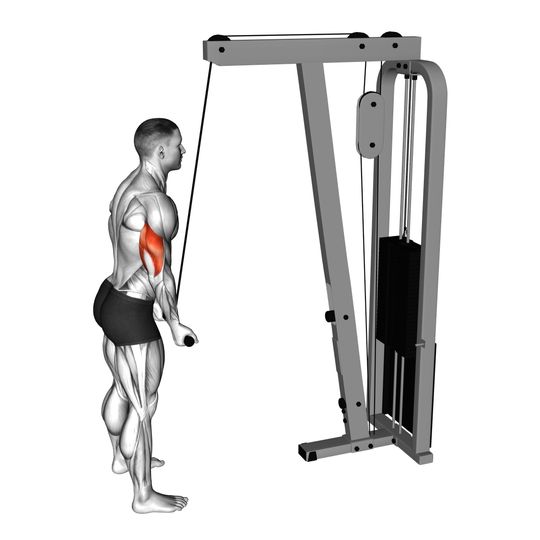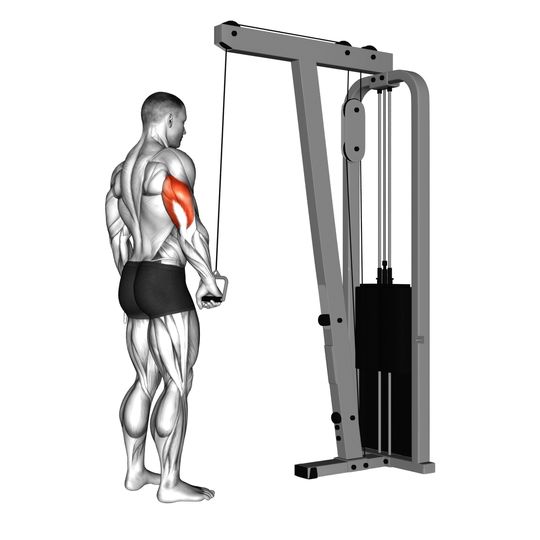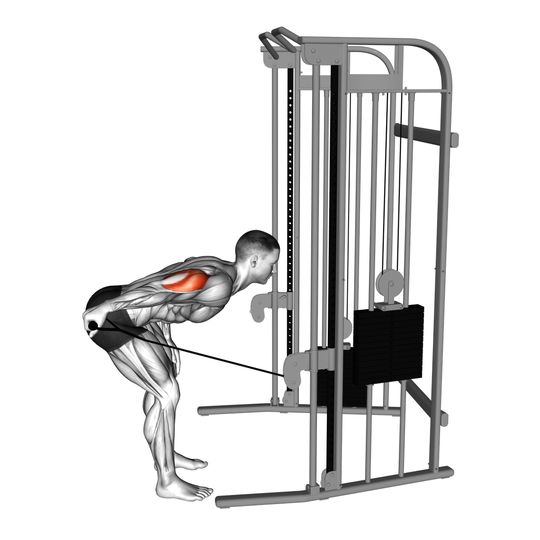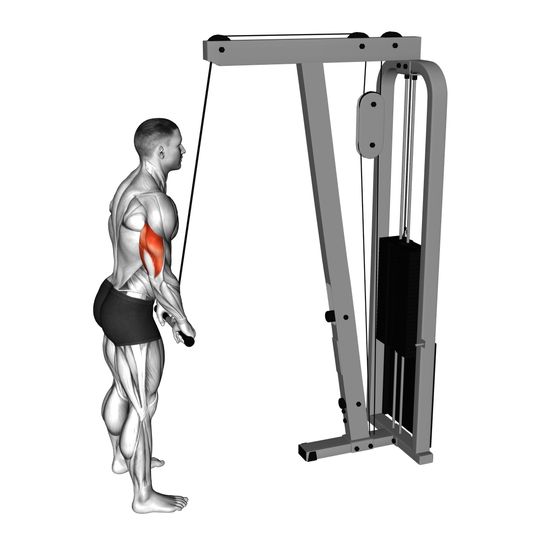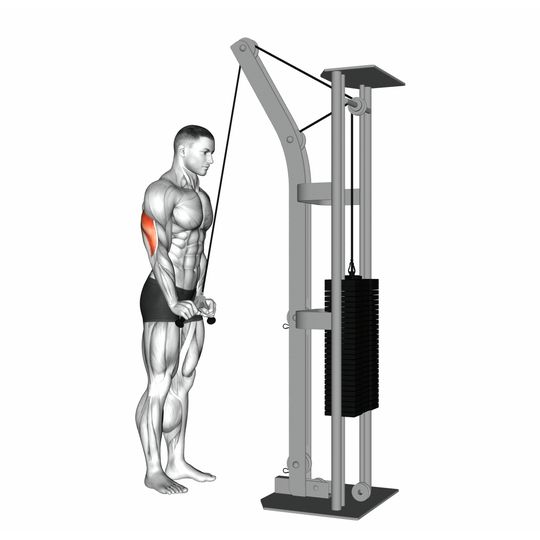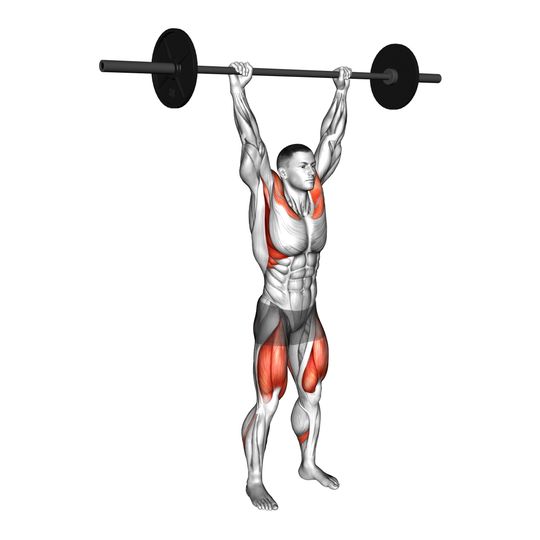


Stand at a high cable and push a rope attachment downward by extending your elbows, focusing tension on the triceps. Maintain a stable torso and control the return to the start position.
How to do the Triceps Rope Pushdown#
- Set the pulley high and grasp the rope with a neutral (palms-facing) grip, feet about hip-width apart.
- Tuck your elbows at your sides and hold your forearms roughly parallel to the floor to establish the start position.
- Keep your upper arms stationary and core braced, then extend your elbows to drive the rope downward until your arms are straight.
- At full extension, spread the rope ends slightly and pause to emphasize the triceps contraction.
- Slowly allow your forearms to rise back to the start while keeping your elbows pinned to your sides.
Muscles worked#
The triceps rope pushdown trains all three heads of the triceps brachii, but it favours the lateral and medial heads because the upper arm stays down by the side. The lateral head is the one that gives the arm its horseshoe shape from the outside, and it works hardest as you drive toward full extension. Spreading the rope at the bottom and turning the palms down adds a small amount of extra work in that final, fully contracted position.
The long head of the triceps runs over the shoulder joint and is at a mechanical disadvantage when the arm is by the side, so it contributes less here than in an overhead extension. The anconeus, a small muscle at the back of the elbow, assists lockout. The forearms and grip hold the rope, and the lats and abs brace to keep the elbows pinned and the torso still.
- Primary: Triceps (Triceps Brachii)
Common mistakes#
- Letting the elbows flare away from the sides.
- Using excessive torso lean to generate momentum.
- Allowing the wrists to collapse or bend sharply.
- Choosing a weight that prevents full elbow extension.
- Rushing the return and losing tension on the eccentric phase.
Why it works#
The rope is the most versatile pushdown attachment because the hands are free to move. You can spread the ends at the bottom, rotate the palms, or let the hands drift slightly outward, all of which lets the elbow fully extend without the wrists getting in the way. That freedom means more people can reach a hard, complete contraction on the rope than on a fixed bar.
Pushdowns in general are the best way to add triceps volume without loading the elbow the way skull crushers and close grip presses do. The cable keeps tension on the muscle from the top of the rep to the bottom, there is nothing to balance, and recovery is fast. That makes it easy to run twice a week alongside heavy pressing without the elbows complaining.
Sets, reps and setup#
Three to four sets of 10-15 reps with 60 seconds of rest, twice a week after pressing. Hold the bottom for a full second with the rope spread, then take two seconds to return. Heavy rope pushdowns with a torso lean are a lat exercise, not a triceps one.
- Setup
- Set the pulley high, grab the rope with the knuckles touching the stoppers, and step back so the cable runs at a slight angle. Lean forward a few degrees from the hips, pin the elbows to the ribs, and extend until the arms are straight with the hands pulled apart and slightly behind the hips. Return only to the point where the forearms are parallel to the floor or a little above.
- Progression
- Add one rep per set until 15 is comfortable, then take the next pin on the stack. The signal to stop adding weight is the elbows floating forward at the top or the shoulders rounding to push. When that happens, drop a plate and add a pause at full extension instead.
Variations#
- Straight Bar Triceps Pushdown Fixed pronated grip that lets you load heavier but limits how far the hands can spread.
- V Bar Triceps Pushdown Angled handles that sit between a rope and a straight bar for wrist comfort.
- Cable Single Arm Triceps Pushdown One arm at a time, useful for evening out a weaker side and getting a full lockout.
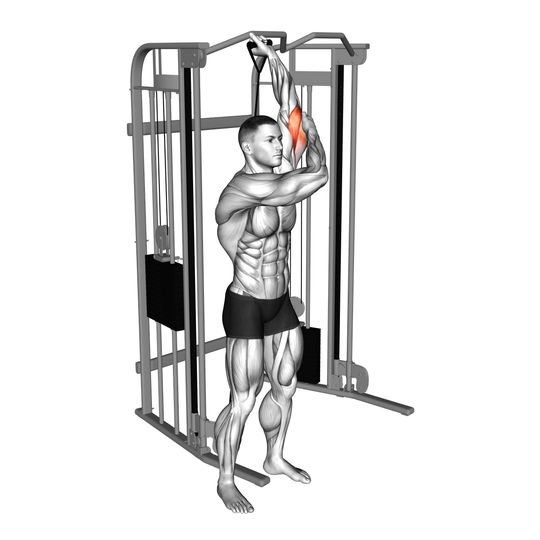
- Cable Triceps Extension Overhead with the arm raised, which shifts the emphasis to the long head.
- Reverse Grip Triceps Pushdown Supinated grip on a bar, a lighter variation that some lifters feel more in the medial head.
Rope vs straight bar triceps pushdown#
The straight bar locks the hands into a pronated grip. That makes it more stable, lets you push heavier weight, and is the better tool when the goal is to progress load over time. The downside is that many lifters cannot reach full extension without the wrists bending, and the bar can irritate the elbows or wrists at higher loads.
The rope frees the hands so you can spread them at the bottom and finish the contraction completely. It usually feels better on the joints and gives a stronger squeeze, at the cost of a bit less load. Most people do well running the rope as the main pushdown and the bar for heavier sets in a separate block, or simply alternating attachments between sessions.
Common questions#
What muscles does the triceps rope pushdown work?
All three heads of the triceps, with the lateral and medial heads taking the most work because the upper arm stays down by the side. The anconeus assists at lockout, and the forearms, lats and abs work to hold the rope and keep the torso and elbows still.
Rope vs straight bar tricep pushdown: which is better?
The rope gives a fuller contraction because the hands can spread apart at the bottom, and it is gentler on the wrists. The straight bar is more stable and allows heavier loads. For most lifters the rope is the better everyday choice, with the bar used when heavier progression is the aim.
Should I spread the rope at the bottom of a pushdown?
Yes. Pulling the ends apart and turning the palms down at full extension lets the elbow lock out completely and adds a little extra contraction in the shortened position. It should be a controlled finish, not a flick; if you need momentum to spread the rope, the weight is too heavy.
How heavy should rope pushdowns be?
Light enough to lock the elbows out fully on every rep with the elbows fixed by the ribs. For most people that is 15-35 kg on a standard stack for sets of 10-15. Once the torso starts pushing down or the shoulders round, you have gone past the useful range.
Why do I feel rope pushdowns in my shoulders or lats?
The elbows are drifting forward at the top and the torso is helping on the way down, which turns the movement into a shoulder extension. Keep the elbows glued to your sides, stop the return when the forearms reach parallel, and lower the weight until the triceps are the only thing that moves.