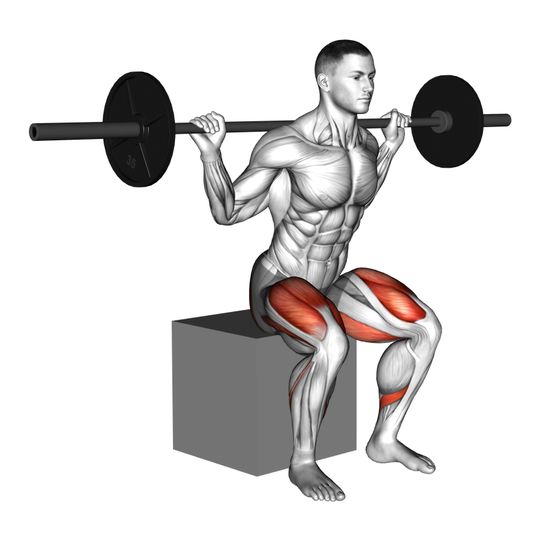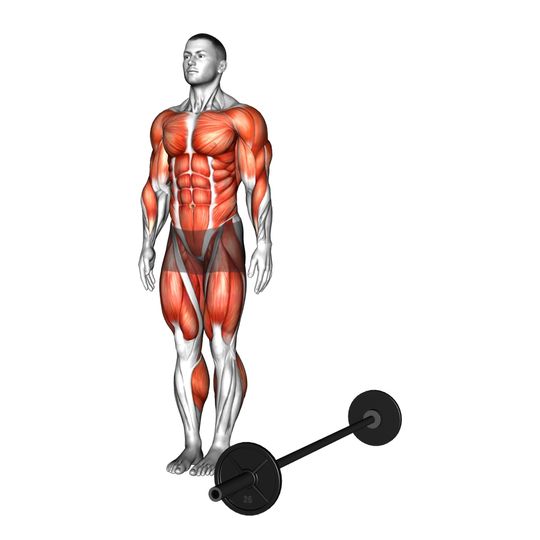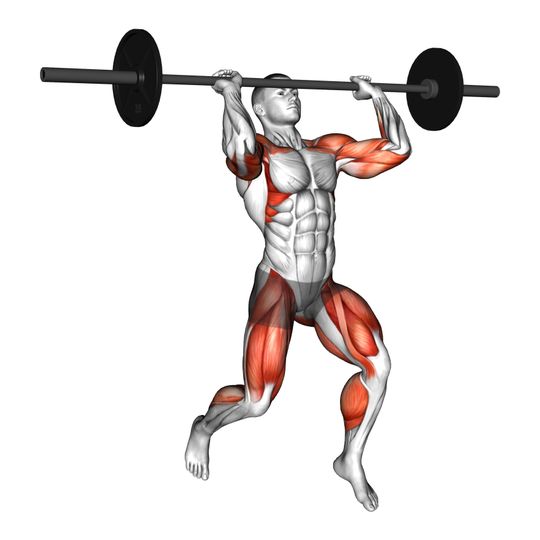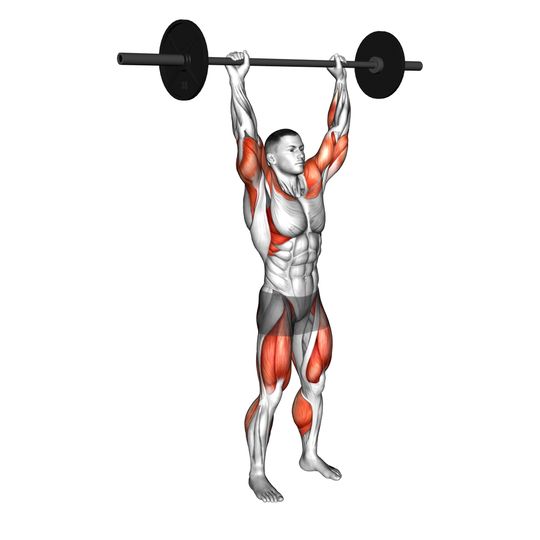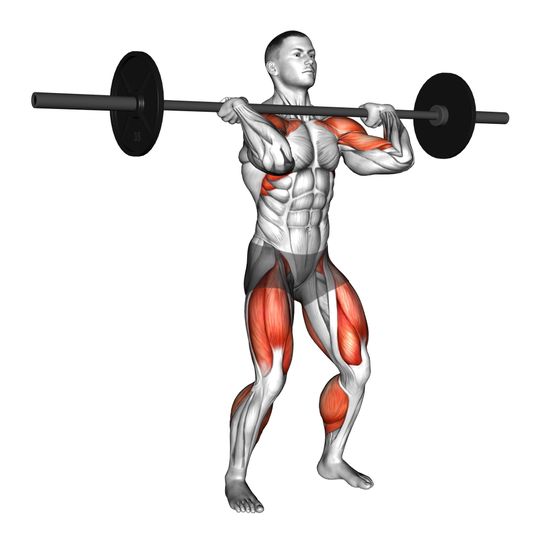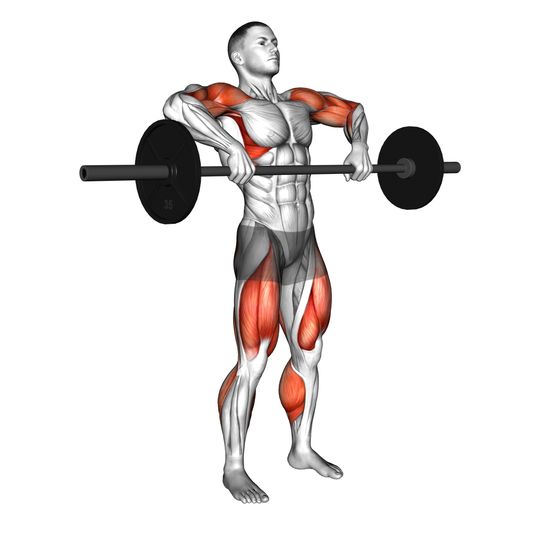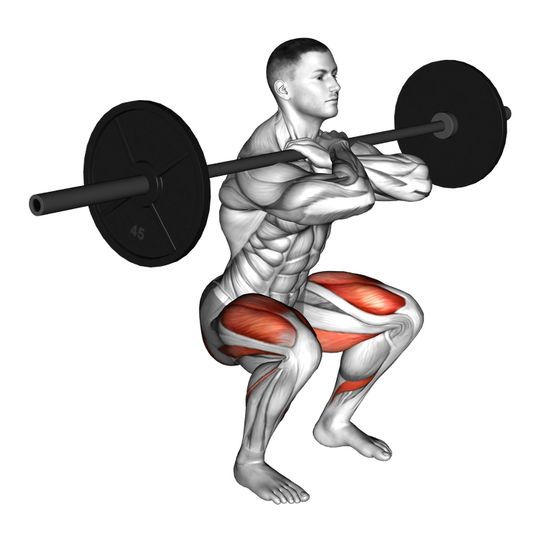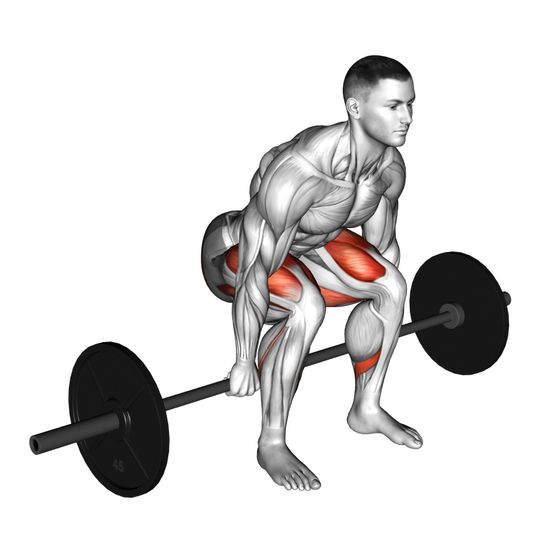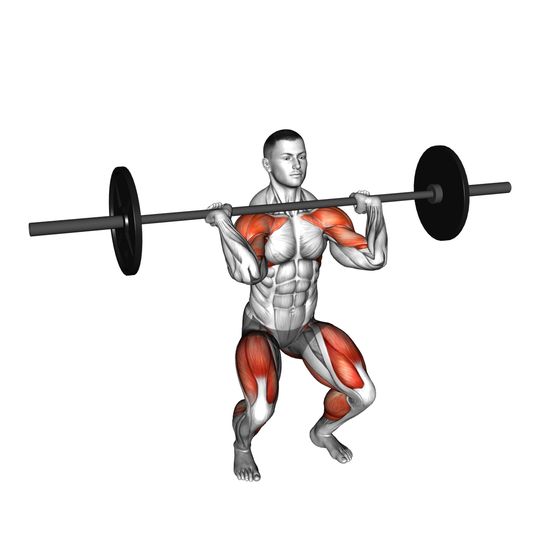


A front-loaded squat where you cradle a barbell in the crook of your elbows and perform a hip-and-knee descent that primarily targets the quadriceps.
How to do the Zercher Squat#
- Set the bar on the rack at lower-chest height, step under it, and support the bar in the bends of your elbows with your forearms holding the load.
- Stand up to lift the bar from the rack and take a step or two back to clear the rack area.
- Position your feet about shoulder-width apart and settle into a stable stance.
- Brace your core, keep a neutral spine and an upright chest, and hold your elbows up so the bar stays secure.
- Push your hips back and bend your knees to lower until your thighs are roughly parallel to the floor.
- Drive through your heels to return to standing while maintaining elbow support and core tension.
Muscles worked#
The Zercher squat is a quad and glute exercise first. Holding the bar in the crook of the elbows puts the load in front of the body, so you stay upright and the knees travel forward, which keeps tension on the quads (quadriceps) through the whole descent. The glutes and adductors take over at the bottom and drive the hips forward as you stand, much like a front squat with the bar carried a little lower.
What makes the Zercher different is the amount of upper-body work. The upper back and spinal erectors fight hard to stop the bar from pulling you into a forward fold, the abs brace against the load resting on your midsection, and the biceps and forearms hold the bar in place isometrically for the entire set. It feels like a squat and a heavy carry at the same time.
- Primary: Quads (Quadriceps Femoris), Glutes (Gluteus Maximus)
- Secondary: Adductors (Adductor Magnus, Longus & Brevis (Hip Adductors)), Hamstrings (Biceps Femoris, Semitendinosus & Semimembranosus), Abs (Rectus Abdominis), Upper back (Rhomboids & Middle Trapezius), Lower back (Erector Spinae)
Common mistakes#
- Allowing the lower back to round during the descent.
- Dropping the elbows so the bar rolls forward.
- Letting the knees collapse inward.
- Shifting weight onto the toes instead of driving through the heels.
How much should you squat?#
What the average squat actually is, and what counts as beginner, intermediate, advanced, or elite at your bodyweight — for men and women, in kg and lbs.
See squat strength standards →
Zercher Squat vs other exercises#
Head-to-head breakdowns of muscles worked, loading, joint stress, and which one to pick for your goal.
Why it works#
The Zercher squat trains the trunk harder than any other squat variation. Because the bar sits in front of you at roughly the height of your sternum, every rep is a fight to stay tall, which builds the upper back and core strength that carries over to front squats, deadlifts, and any strongman-style carry. Lifters who round on heavy pulls often find the Zercher fixes the problem faster than direct core work.
It is also practical. You do not need a rack: the bar can be deadlifted, rested on the thighs, and hooked into the elbows from the floor, which is how many strongman competitors train it. It suits lifters with shoulder or wrist issues who cannot hold a front rack, and it sits the load lower than a front squat, which is easier on the neck and thoracic spine.
Sets, reps and setup#
Three or four sets of 5-8 reps with two minutes of rest, once a week. Most lifters can handle around 70-80 percent of their back squat here, but the limiting factor is often how long the arms and upper back can hold the bar rather than the legs, so keep sets under ten reps.
- Setup
- Set the bar in a rack just below your elbows when standing. Hook the bar into the crook of both elbows, clasp your hands or grab one fist with the other hand, and pull the bar tight against your body. Stand up, step back, and squat with an upright chest. Elbows stay high and close together the whole way.
- Progression
- Add 2.5 kg a week until you cannot keep the elbows up at the bottom, then hold the weight and add a rep per set. Wrap a towel or pad around the bar if bruising limits your loading.
Variations#
- Barbell Front Squat The bar on the front of the shoulders instead of in the elbows, allowing heavier loads with the same upright squat pattern.
- Barbell Squat The back squat lets you move the most weight and shifts more work to the hips and lower back.
- Goblet Squat A dumbbell or kettlebell held at the chest gives the same front-loaded feel with a much lighter, friendlier load.
- Hatfield Squat Hands on the rack for support so you can overload the legs without the upper body being the limit.
- Box Squat Squatting to a box teaches sitting back and gives a consistent depth marker.
Zercher squat vs front squat#
Both are front-loaded, upright squats that favour the quads. The front squat rests the bar on the shoulders, which is closer to your centre of mass and lets you go heavier, so it is the better choice for maximal leg strength and for anyone who trains the Olympic lifts.
The Zercher carries the bar lower and further forward, which limits the load but forces the upper back and abs to work far harder. Choose it if you want a squat that doubles as a trunk exercise, if your wrists or shoulders cannot tolerate a front rack, or if you train without a rack. Many strongman athletes use both in the same week.
Common questions#
What muscles does the Zercher squat work?
The quads and glutes drive the squat, the adductors and hamstrings assist, and the upper back, spinal erectors, and abs hold you upright against the bar in front of you. The biceps and forearms work hard isometrically to keep the bar in the elbows.
Why is it called a Zercher squat?
It is named after Ed Zercher, a strongman from St. Louis who trained in the 1930s in a basement gym without a squat rack. He lifted the bar from the floor into his elbows and squatted it, which is why the rack-free version is still called the Zercher lift.
How do I stop the Zercher squat hurting my arms?
Wrap a towel or a bar pad around the bar, wear a long-sleeved shirt, and pull the bar tight into your body rather than letting it rest loosely in the elbow joint. The bruising usually stops after two or three weeks as the tissue adapts.
Is the Zercher squat good for building legs?
Yes, particularly the quads, but the upper body will limit how much you can load before the legs are truly challenged. It works best as a second squat variation or in the 5-8 rep range rather than as your sole heavy leg exercise.
How much should I Zercher squat?
Most lifters manage roughly 70-80 percent of their back squat once technique is settled. If you can Zercher squat your bodyweight for five clean reps, your trunk and upper back are in good shape.