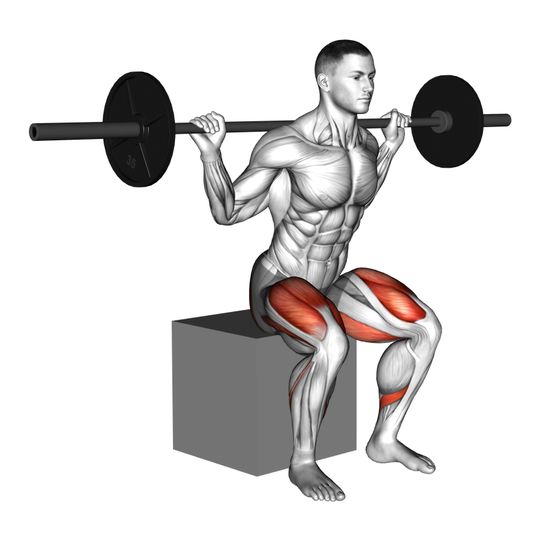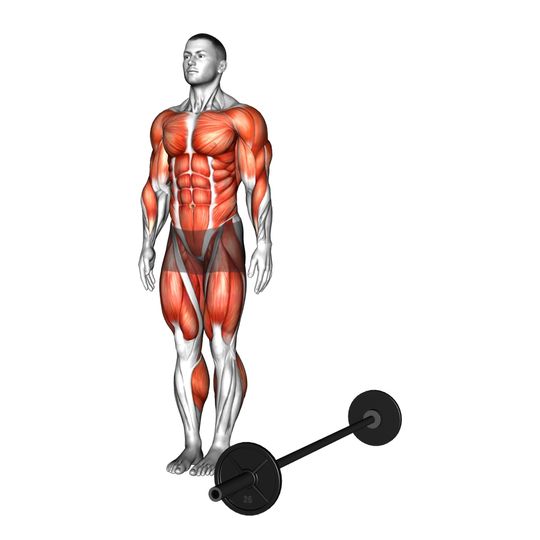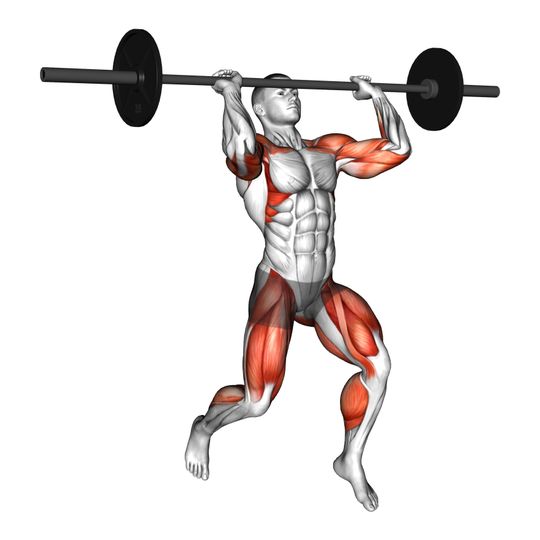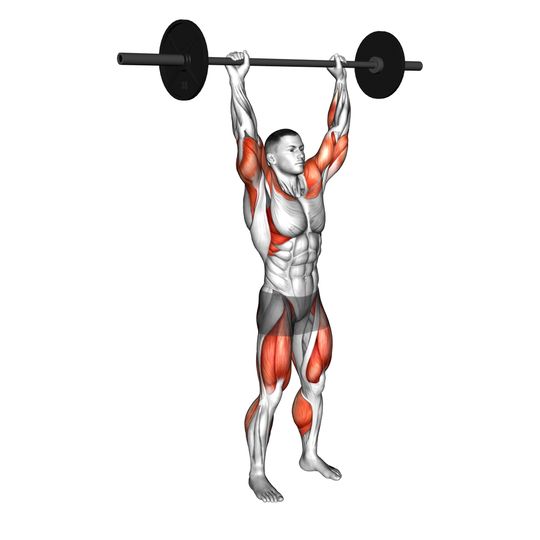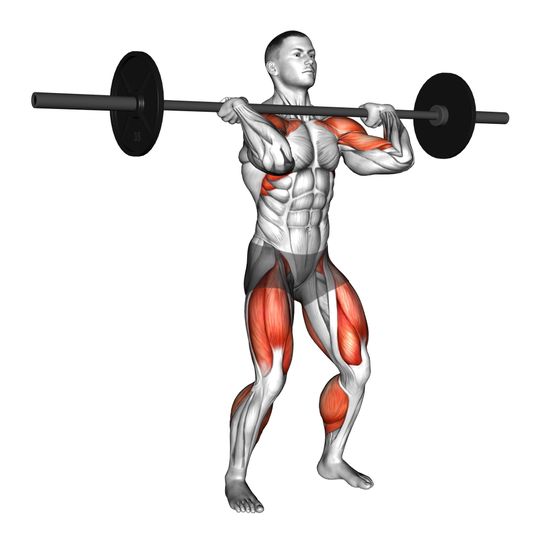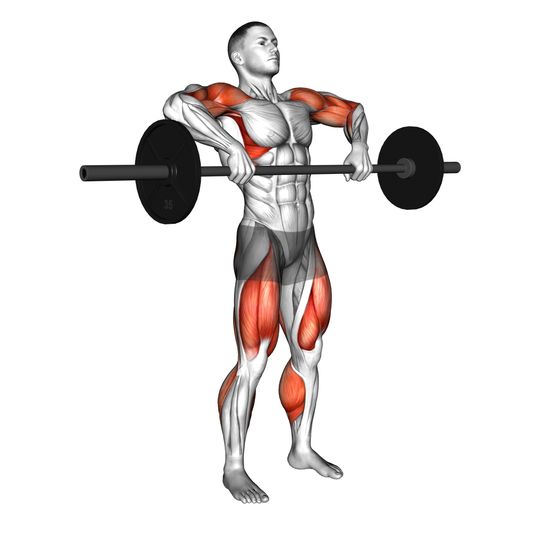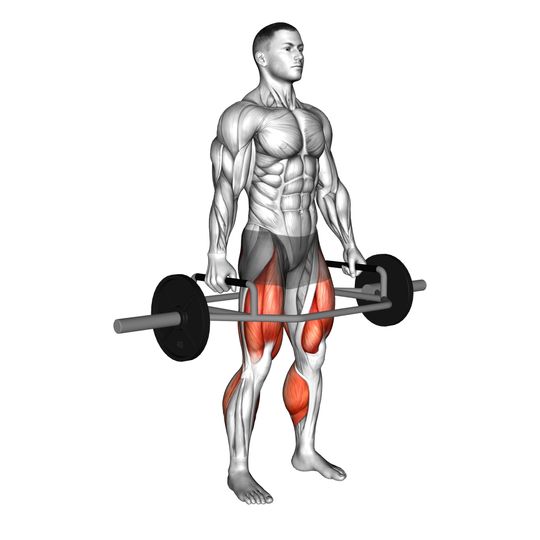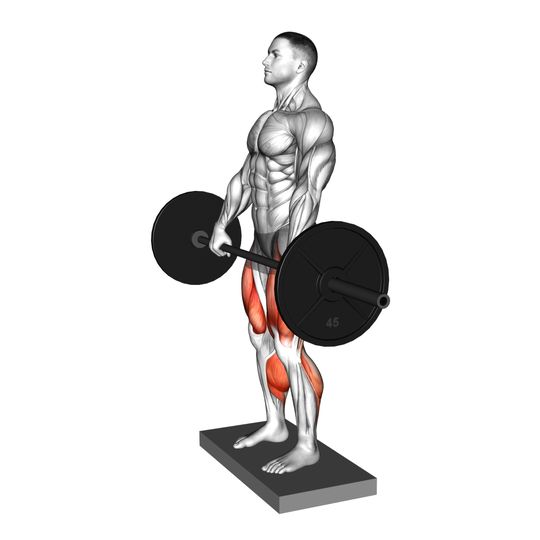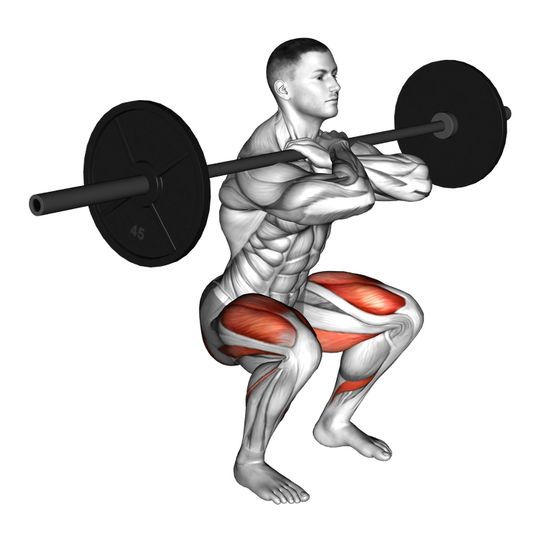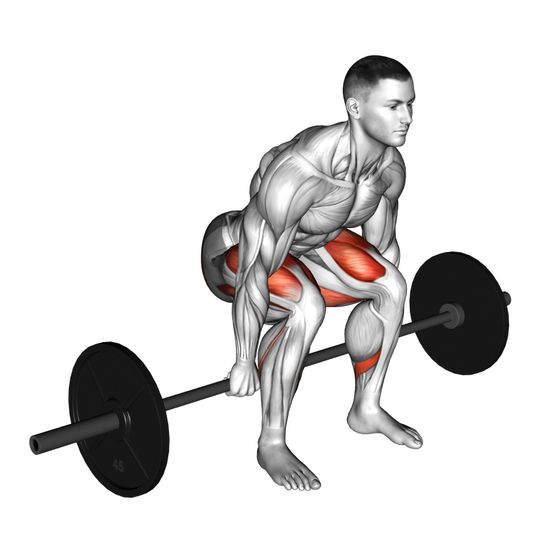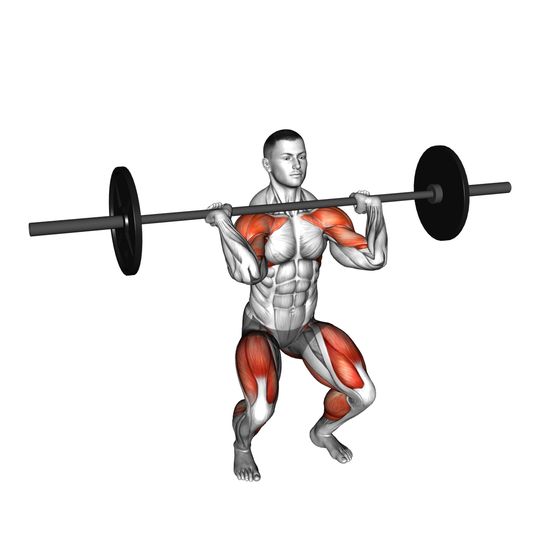


Step forward and lower your body into a single-leg lunge, primarily working the quadriceps. You hold a barbell across your upper back and drive back to standing using the front leg.
How to do the Barbell Lunge#
- Place a barbell across your upper back with feet about shoulder-width apart and brace your core.
- Take a controlled step forward with one leg to create a medium-length stride.
- Bend the front knee and hips to lower until the back knee is just above the floor and the front thigh is near parallel to the ground.
- Keep weight on the front foot and ensure the front knee tracks over the foot without moving far past the toes.
- Press through the front heel to return to the start position and repeat with the other leg.
Muscles worked#
The barbell lunge is a quad and glute exercise on the front leg. As you step out and sink, the front knee bends deeply and the quadriceps control the descent and drive you back up, while the gluteus maximus extends the hip against a torso that stays relatively upright. A longer stride shifts more load to the glutes and hamstrings; a shorter stride keeps the knee further forward and biases the quads.
The hamstrings assist the glutes in hip extension and the adductors on the inner thigh work hard to keep the front knee tracking straight. The rear leg's hip flexors and quads get a stretch at the bottom and a small stabilising job. Because the bar sits on your back and the base is narrow, the abs, obliques and lower back work continuously to keep the trunk from tipping sideways or folding forward, and the calves steady the ankles.
- Primary: Quads (Quadriceps Femoris), Glutes (Gluteus Maximus)
- Secondary: Hamstrings (Biceps Femoris, Semitendinosus & Semimembranosus), Adductors (Adductor Magnus, Longus & Brevis (Hip Adductors)), Calves (Gastrocnemius & Soleus), Abs (Rectus Abdominis), Lower back (Erector Spinae)
Common mistakes#
- Letting the front knee travel far past the toes.
- Leaning the torso forward instead of keeping the chest upright.
- Taking too short a step so the front thigh never reaches near-parallel.
- Pushing off primarily with the rear leg instead of driving through the front heel.
Why it works#
The lunge trains each leg on its own with a load that would be impossible to hold in the hands. Bilateral squats let a stronger leg quietly do more; a lunge cannot. Any difference in quad strength, hip stability or ankle mobility shows up immediately as a wobble or a shortened stride on one side, which tells you exactly where to spend your accessory work.
The barbell version also loads the pattern more aggressively than dumbbells allow, since grip is no longer the limit. The stepping motion demands balance under load, trains the hip and knee through a long range, and stretches the hip flexors of the trailing leg on every rep. Few exercises deliver that much leg development and athletic carryover in a single movement.
Sets, reps and setup#
Three sets of 8-10 reps per leg with 90 seconds to two minutes of rest, once or twice a week after your main squat or hinge. Alternate legs within a set or complete all reps on one side before switching; the latter is harder on balance and easier to log.
- Setup
- Take the bar from a rack as you would for a high-bar squat, brace, and step back into open space. Take a stride long enough that the front shin is roughly vertical at the bottom, lower until the rear knee is a few centimetres off the floor, and drive through the front heel to return to standing. Keep the torso tall and the bar still throughout.
- Progression
- Add 2.5-5 kg when you can complete 10 reps per leg with the torso upright and the rear knee kissing the same spot on every rep. If your stride shortens or the front knee caves inward as the set continues, the load is too high. Progress from alternating to consecutive reps on one leg before adding weight.
Variations#
- Barbell Reverse Lunge Stepping back instead of forward, which is easier on the knees and slightly more glute-focused.
- Dumbbell Lunge Weight in the hands, lower centre of mass and easier to balance, but limited by grip.
- Walking Lunge Continuous forward steps that add a balance and conditioning component.
- Barbell Bulgarian Split Squat The rear foot rests on a bench, removing the step and letting you load the front leg harder.
- Barbell Split Squat Feet stay fixed in the lunge position, so every rep is the same and balance is less of a limit.
Barbell lunge vs Bulgarian split squat#
The Bulgarian split squat elevates the rear foot and removes the stepping motion, so the front leg is loaded harder through a deeper range and balance is less of a concern. It is the better choice when the goal is pure single-leg strength or size, and it is easier to take close to failure.
The barbell lunge keeps the step, which adds a dynamic balance demand and a hip flexor stretch on the trailing leg, and it trains the deceleration of landing on one leg. That makes it more athletic but slightly less efficient as a hypertrophy tool. Both are unilateral exercises for the quads and glutes; use the split squat for strength blocks and the lunge when carryover to movement matters.
Common questions#
What muscles does the barbell lunge work?
The quads and glutes of the front leg do most of the work, with the hamstrings and adductors assisting. The trailing leg's hip flexors and quads stabilise and stretch, while the abs, obliques and lower back keep the torso upright under the bar and the calves steady the ankles.
Are barbell lunges better than dumbbell lunges?
They allow heavier loading because grip is no longer the limit, and the bar on the back trains the trunk harder. Dumbbells are easier to balance and safer to bail from. Start with dumbbells until the movement is stable, then move to the bar when your legs outgrow the dumbbells you can hold.
How long should my lunge stride be?
Long enough that the front shin is close to vertical at the bottom and the rear knee is under or slightly behind the hip. A shorter stride puts more work into the quads and the knee; a longer one shifts it toward the glutes and hamstrings. Adjust for your goal, but keep it consistent within a set.
Should I alternate legs or do all reps on one side?
Alternating gives each leg a short rest and lets you use slightly more weight. Doing all reps on one leg first is harder on balance and stamina and makes the set easier to track in your log. Both build the same muscles; choose the one you will do consistently.
Why does my front knee hurt during lunges?
Usually because the stride is too short and the knee is travelling far past the toes under load, or the knee is caving inward. Lengthen the stride so the shin stays closer to vertical, push the knee out over the little toe, and reduce the weight until the knee tracks cleanly. Reverse lunges are an easier alternative for sore knees.