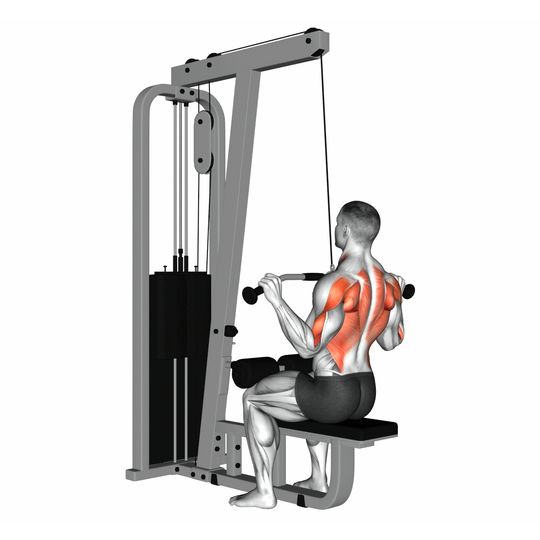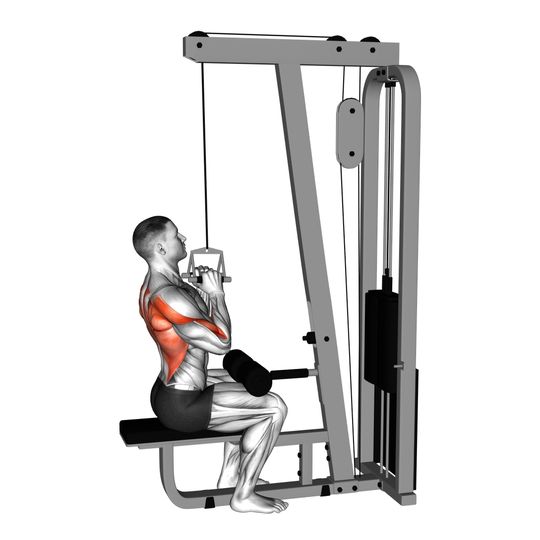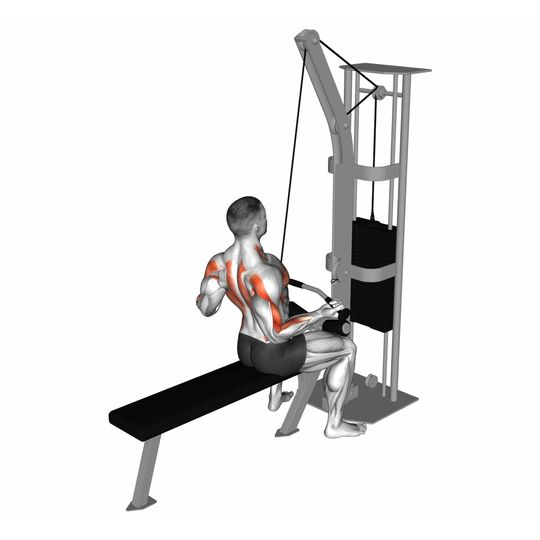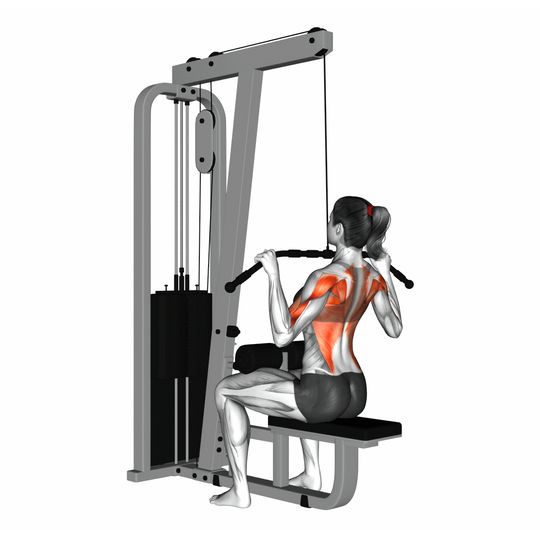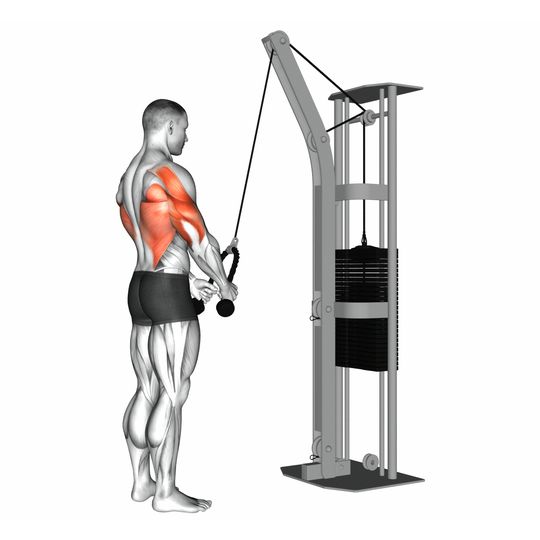


Stand facing a high cable and pull a straight bar down with mostly straight arms, using shoulder extension to load the latissimus dorsi (lats). The movement emphasizes long, controlled vertical motion of the arms to engage the lats.
How to do the Straight Arm Pulldown#
- Attach a straight bar to the high pulley and grasp it with an overhand grip about shoulder-width; step back until the cable is under light tension.
- Stand feet hip-width, hinge slightly at the hips, keep your chest upright, and extend your arms overhead so they are straight.
- Initiate the movement by driving your shoulders into extension and pull the bar down in a controlled arc while keeping the elbows largely straight.
- Pause briefly with the bar near your thighs while squeezing the lats, then slowly return the bar to the start position under control without losing tension.
Muscles worked#
The straight arm pulldown isolates the lats. With the elbows nearly locked, the arms cannot bend to help, so the only way to bring the bar from overhead to the thighs is shoulder extension, and the latissimus dorsi is the biggest muscle that does that. The lats are stretched at the top with the arms overhead and fully shortened at the bottom with the hands at the hips, and unlike a row or a pulldown, there is no point where the biceps can take over.
The teres major, a small muscle beside the lat that works as its assistant, and the long head of the triceps, which extends the shoulder as well as the elbow, share the work. The rear delts contribute in the top half. The abs brace to stop the torso swinging back, and the lower traps keep the shoulder blades down. If the traps and neck are burning, the shoulders are shrugging and the lats are not doing the job.
- Primary: Lats (Latissimus Dorsi)
- Secondary: Triceps (Triceps Brachii), Rear delts (Posterior Deltoid), Abs (Rectus Abdominis)
Common mistakes#
- Bending the elbows too much and turning it into a pulldown.
- Leaning the torso back and using momentum to move the weight.
- Elevating the shoulders and letting the traps dominate.
- Allowing the bar to snap back on the return instead of controlling it.
Why it works#
Most lifters cannot feel their lats on rows and pulldowns because the arms and upper back get there first. The straight arm pulldown removes them from the equation, so it is the fastest way to learn what a lat contraction actually feels like, and that awareness carries into every other pull. Coaches use it as a primer before heavy back work for exactly this reason.
It also loads the lats through a range nothing else covers. Shoulder extension from fully overhead to the hip is the movement the lats are built for, and the cable keeps tension through the whole arc, including the squeeze at the bottom a dumbbell pullover loses. It adds lat volume without taxing the biceps or the lower back.
Sets, reps and setup#
Three sets of 12-15 reps with 60 seconds of rest, once or twice a week, as a warm-up before rows and pulldowns or as a finisher. When the weight gets heavy the elbows bend and the torso rocks, and the lats stop being the limit. Pause for a second at the bottom with the lats fully squeezed on every rep.
- Setup
- Straight bar on a high pulley, overhand grip about shoulder-width, and step back until the arms are stretched overhead with the cable taut. Hinge slightly at the hips, chest up, elbows soft but nearly straight. Pull the bar in a wide arc to the thighs by driving the upper arms back, hold the squeeze, and return slowly until the lats stretch overhead without the shoulders rising.
- Progression
- Add one increment on the stack when fifteen reps are clean on every set, and work back from twelve. If the elbows bend or the torso pitches back to finish the rep, drop a plate. Slower eccentrics and a longer pause at the bottom beat added weight on this exercise.
Variations#
- Rope Straight Arm Pulldown Rope instead of a bar, letting the hands separate at the bottom for a stronger lat contraction.
- Lat Pulldown Bent-arm vertical pull with heavier loads, bringing the biceps and upper back into the movement.
- Machine Pullover Seated with the upper arms on pads, the same arc in a fixed path that can be loaded harder.
- Lat Prayer Kneeling straight arm pulldown facing the stack, a deeper stretch with no torso help.
Straight arm pulldown vs lat pulldown#
The lat pulldown is the heavier exercise and the better one for overall back size and strength. Bending the elbows lets you use several times the weight, and the biceps, rear delts, and upper back all contribute. If you have time for only one vertical pull, it is the lat pulldown, and the same goes for pull-ups.
The straight arm pulldown is an isolation exercise. It uses far less weight and trains the lats alone through their full arc, including the overhead stretch and the squeeze at the hips. Use it to learn to feel the lats, to warm them up before heavy pulling, or to add lat volume when the arms are tired.
Common questions#
What muscles does the straight arm pulldown work?
The lats are the target, with the teres major and the long head of the triceps assisting shoulder extension. The rear delts help in the top half of the rep and the abs brace the torso.
Is the straight arm pulldown good for lats?
It is one of the best isolation exercises for the lats because the straight arms remove the biceps and force the lats to do all the work through their full range. It is not a mass builder on its own; combine it with rows and pulldowns.
Should the arms be completely straight?
Nearly straight with a soft elbow. Locking the joint strains it, and bending the elbows noticeably turns the movement into a pulldown. Set the elbow angle at the start and keep it fixed for the whole rep.
Where should you feel the straight arm pulldown?
Down the sides of the back under the armpits, with a stretch at the top and a hard squeeze at the bottom. Feeling it in the triceps means the elbows are bending; in the traps or neck means the shoulders are shrugging.