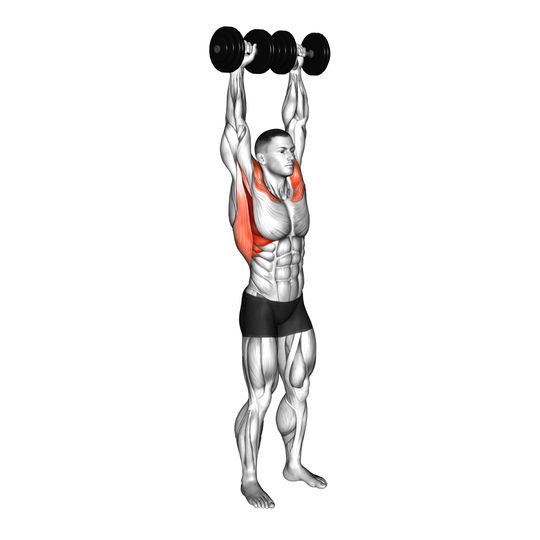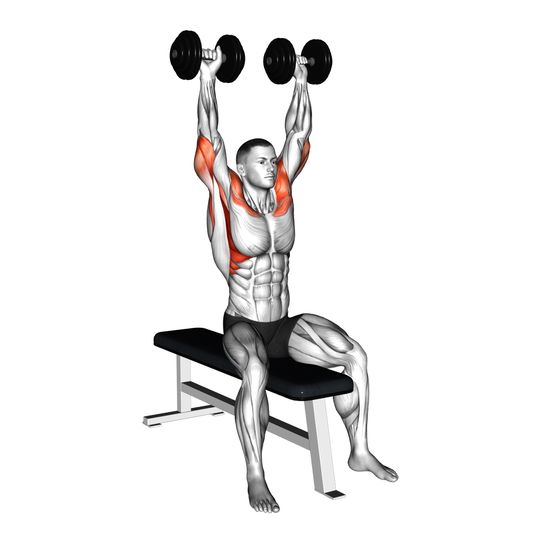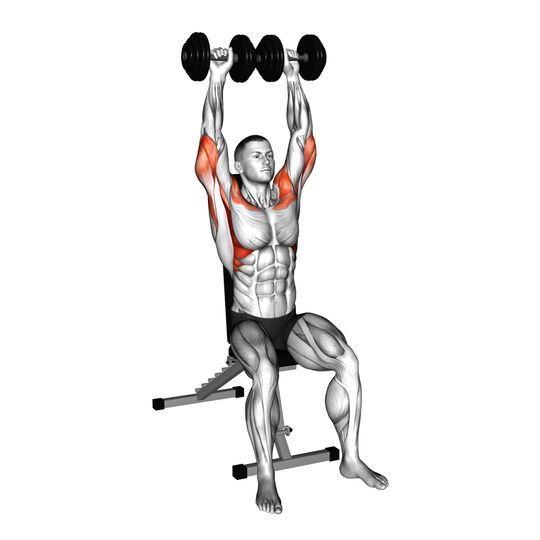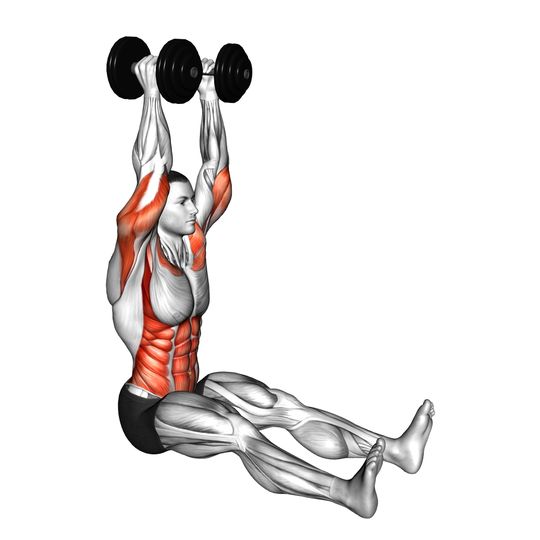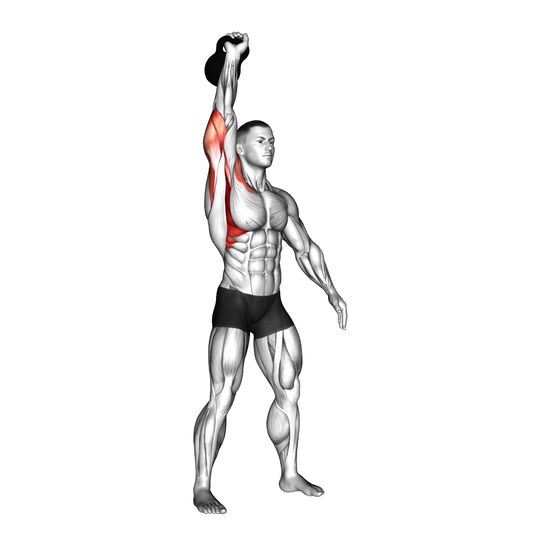


A vertical pressing movement that raises dumbbells from shoulder level to overhead, primarily working the shoulder muscles with assistance from the triceps.
How to do the Dumbbell Overhead Press#
- Stand tall with feet about hip-width apart and hold a dumbbell in each hand at shoulder height.
- Position your elbows roughly beneath the weights, lift your chest, and brace your core while squeezing your glutes.
- Press the dumbbells upward in a straight line until your arms are nearly extended overhead.
- Lower the dumbbells back down to shoulder height under control.
- Perform the desired number of repetitions while keeping the motion smooth and even on both sides.
Muscles worked#
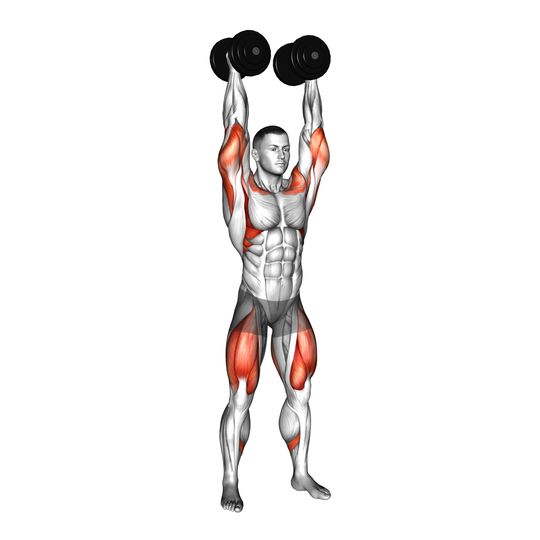
The dumbbell overhead press is a shoulder exercise first. The front delts (anterior deltoid) lift the arms from shoulder height to overhead, and the side delts join in strongly because the dumbbells sit slightly outside the shoulders and travel up and in, which is a wider path than a barbell allows. The triceps straighten the elbows to finish each rep and take over the lockout, so heavy sets are felt in the back of the arms as much as the shoulders.
Standing turns the press into a whole-body exercise. The upper traps and serratus anterior rotate the shoulder blades upward so the arms can reach overhead safely, the abs and glutes stop the lower back from arching as the weight goes up, and the forearms have to keep two independent weights from drifting. That independence means each shoulder has to do its own work, which is why the dumbbell press exposes a weaker side that a barbell hides.
- Primary: Front delts (Anterior Deltoid), Side delts (Lateral Deltoid)
- Secondary: Triceps (Triceps Brachii), Traps (Trapezius), Abs (Rectus Abdominis)
Common mistakes#
- Overarching the lower back during the press.
- Allowing the elbows to drift too far forward or flare widely to the sides.
- Using leg drive or excessive body momentum to help lift the weights.
- Lowering the dumbbells too quickly instead of controlling the descent.
- Letting the wrists collapse backward under load.
Why it works#
Dumbbells let the shoulders move the way they were built to. The hands can start in a neutral or slightly turned-in position and finish overhead in a natural arc, and there is no bar to clear the chin, so the path is more comfortable for most people than a barbell press. That freedom lets lifters with shoulder irritation keep pressing, and the wider path gives the side delts more work, which matters for shoulder width.
The press also carries over well. Strong overhead pressing supports a stronger bench, more resilient shoulders in contact sports, and the ability to put things above your head without thinking about it. Because each arm works alone, it corrects imbalances that would otherwise show up as a crooked barbell press or a shoulder that hurts on one side.
Sets, reps and setup#
Three or four sets of 6-10 reps with two minutes of rest, once or twice a week. Press both dumbbells together, lower over two seconds to the shoulders, and reset the brace before each rep.
- Setup
- Clean or kick the dumbbells to shoulder height and stand with the feet hip width, glutes squeezed and ribs pulled down. Start with the dumbbells just outside the shoulders, palms forward or slightly turned in, and press them up and slightly together until the arms are straight overhead with the biceps by the ears. Lower under control to the shoulders.
- Progression
- Add 2 kg per hand when 10 reps are clean on all sets. If the lower back starts arching to get the weight moving, that is a core failure rather than a shoulder one; go back a step and slow the eccentric.
Variations#
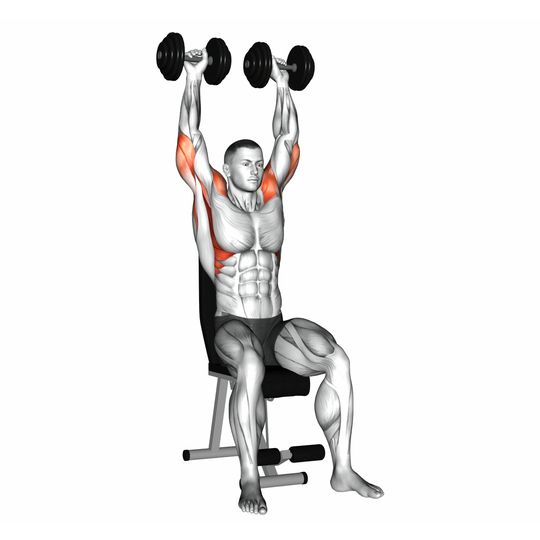
- Seated Dumbbell Overhead Press The back supported on a bench, which removes the core demand and lets you press heavier.
- Arnold Press Starts with the palms facing you and rotates through the press for a longer range and more front delt work.
- Barbell Overhead Press Both hands on one bar, the heaviest version of the pattern and the standard for measuring pressing strength.
- Dumbbell Push Press A dip and drive from the legs helps launch the weight, allowing heavier loads and a slower controlled lowering.
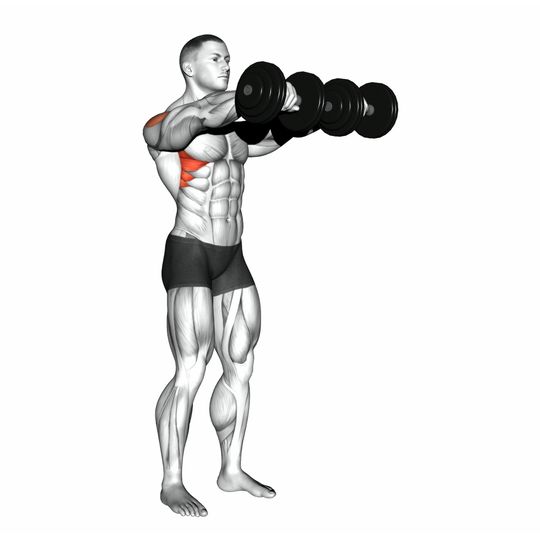
- Dumbbell Lateral Raise An isolation movement for the side delts that pairs well after pressing.
Dumbbell overhead press vs barbell overhead press#
The barbell allows more total weight and smaller jumps in load, which makes it the better choice for maximal pressing strength. The fixed bar also means the stronger arm can help the weaker one, so you can push the load higher, and it is the version used in strength standards and competition.
Dumbbells give each shoulder its own load and a freer path, which is more comfortable for many people and works the side delts a little more. They also expose imbalances rather than hiding them. If shoulder size and health are the priority, press dumbbells; if strength numbers are the goal, press the barbell and use dumbbells as a second movement.
Common questions#
What muscles does the dumbbell overhead press work?
The front and side delts do the pressing, the triceps finish the lockout, and the upper traps and serratus anterior rotate the shoulder blades. Standing, the abs, glutes, and lower back work to hold the torso still under the load.
Is the dumbbell overhead press better standing or seated?
Standing trains the core and transfers better to sport and everyday strength. Seated with back support lets you press about 10 percent more and isolates the shoulders. Beginners should learn standing; use seated when you want to chase load or when your lower back is tired.
How much should I dumbbell overhead press?
Pressing half your bodyweight in each hand for a few reps is strong for a man; a quarter of bodyweight per hand for ten reps is a solid intermediate target. For women, dumbbells of 10-12 kg each for ten reps is a good milestone and 15-20 kg is strong.
Should my palms face forward or in during the press?
Either is fine. Palms forward matches a barbell press and gives the side delts slightly more work. A slight inward turn is more comfortable for many shoulders and puts the joint in a more neutral position. Pick the one that lets you press pain-free through a full range.
Should I lock out my elbows at the top?
Yes. A full lockout with the biceps by the ears is the safe finishing position and gives the triceps and upper traps their share of the work. Stopping short does not protect the joints; it just shortens the rep.