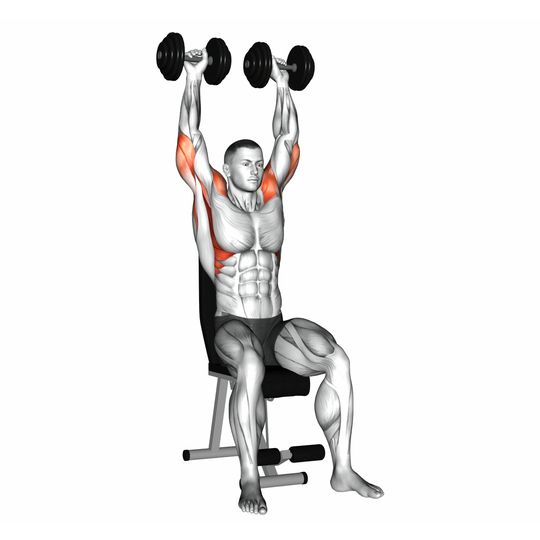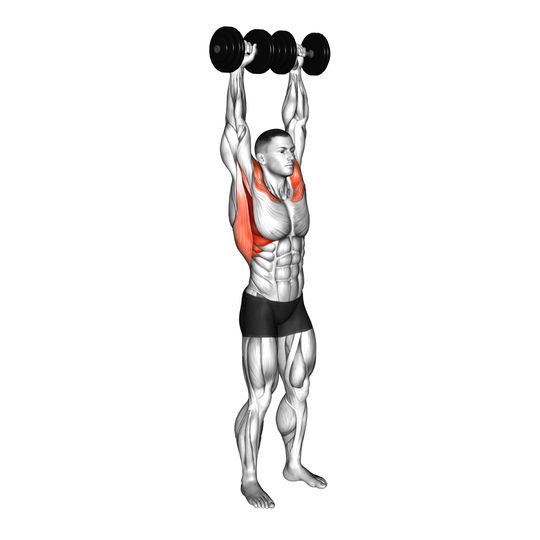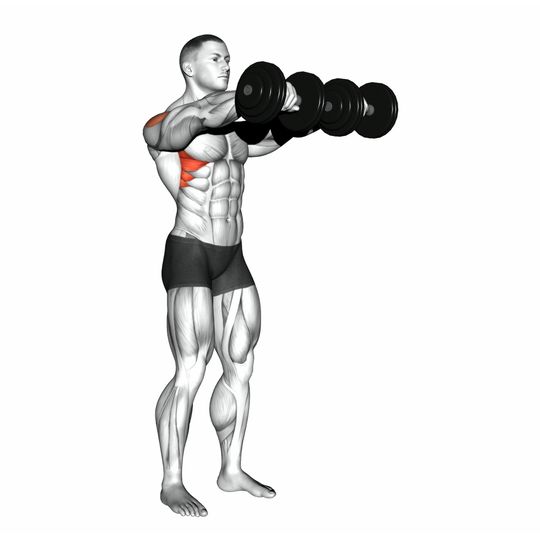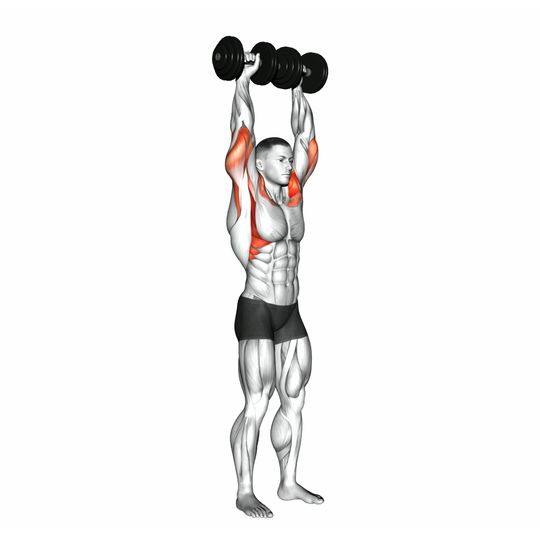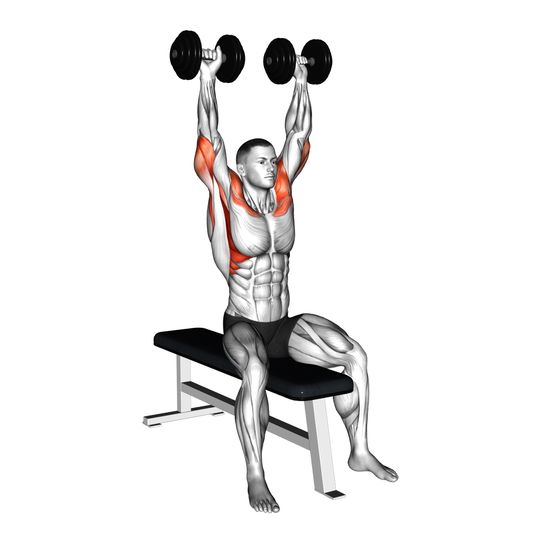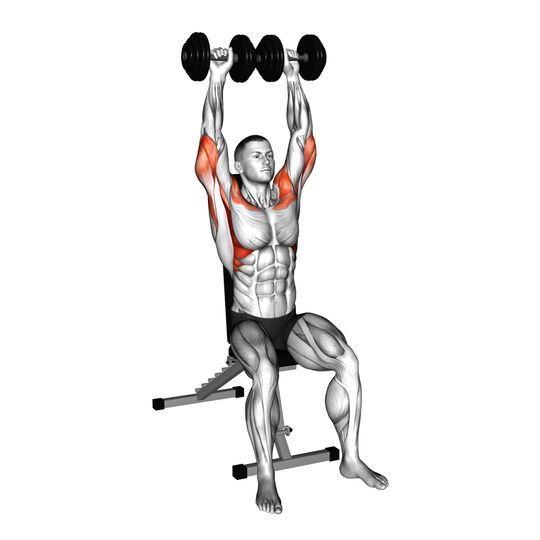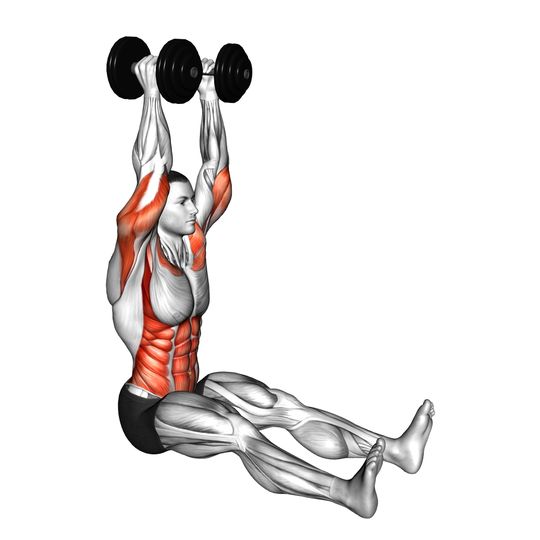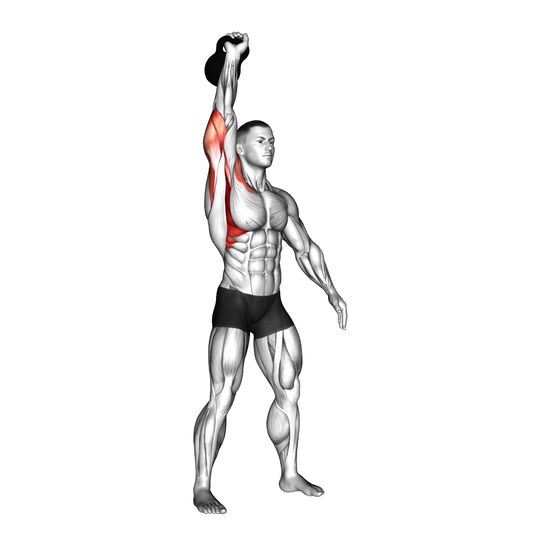


Stand with dumbbells at shoulder level and use a short leg dip and hip drive to press them overhead. The movement primarily works the shoulder deltoids.
How to do the Dumbbell Push Press#
- Stand tall with feet about hip-width and hold a dumbbell at each shoulder with elbows under the weights.
- Bend your knees slightly into a quick dip while keeping your torso upright.
- Explosively extend your hips and knees to transfer force into the arms and drive the dumbbells upward.
- Finish by pressing the dumbbells to full arm extension overhead and briefly lock out the elbows.
- Lower the weights back to the shoulder rack position under control.
Muscles worked#
- Primary: Front delts (Anterior Deltoid), Side delts (Lateral Deltoid), Triceps (Triceps Brachii)
- Secondary: Quads (Quadriceps Femoris), Glutes (Gluteus Maximus), Traps (Trapezius), Abs (Rectus Abdominis)
Common mistakes#
- Using only the arms instead of initiating with a leg drive.
- Taking too deep a squat-like dip rather than a quick, shallow drive.
- Overarching the lower back during the drive.
- Allowing the dumbbells to travel too far forward instead of staying over the midline.
- Not fully extending the arms at the top.
Why it works#
The dip and drive gets the dumbbells moving before your shoulders have to do anything, which means the delts and triceps take over above the hardest part of a strict press and finish the rep with a load they could never start. That is the point of a push press: it overloads the top half of the pressing range, which is exactly where a stalled strict press usually needs the work.
Dumbbells add what a barbell push press cannot. Each arm finds its own path so the elbows stay slightly in front of the body rather than flared under a bar, you need no rack to start, and a rep that goes wrong can be dumped to the side. For lifters whose shoulders complain about a barbell front rack, this is often the version that keeps overhead work in the program.
Sets, reps and setup#
For strength, four to five sets of 3-5 reps with 2-3 minutes of rest. For hypertrophy or general athletic work, three to four sets of 6-8 reps with 90 seconds. Either way, stop the set when the leg drive starts doing all of the work — this is not a lift to grind out.
- Setup
- Dumbbells at shoulder height, elbows slightly in front, feet hip-width. Dip four to six inches by bending the knees with the torso upright, reverse it hard, and let the momentum carry the dumbbells past your head before pressing them to a lockout with your biceps beside your ears.
- Progression
- Add reps within the range first — 6 up to 8, or 3 up to 5 — then take the next pair of dumbbells. Because the legs contribute, this lift progresses faster than a strict press, so expect to add load more often.
Variations#
- Push Press The barbell version. Heavier loading and smaller jumps, at the cost of a fixed grip and a rack.
- Overhead Press (Dumbbell) The strict version with no leg drive. Slower to progress but the honest measure of shoulder strength.
- Thruster (Barbell) A full front squat into the press, which turns the movement into a conditioning tool as much as a lift.
- Behind the Neck Push Press Starts behind the head, which shortens the path overhead. Requires good shoulder mobility.
Dumbbell push press vs strict dumbbell overhead press#
The push press lets you handle more weight than you can strictly press, so it builds the lockout and gives the delts and triceps a heavier stimulus in the top half of the range. It is also more athletic — the dip and drive is a coordinated whole-body action, and it trains the legs and core to transmit force.
The strict press is the better diagnostic. Nothing helps you, so it tells you what your shoulders can actually do and it keeps the bottom of the range under tension. Most programs want both: strict pressing for the honest number, push pressing to overload above it.
Common questions#
What muscles does the dumbbell push press work?
The front and side delts and the triceps do the pressing. The quads, glutes and calves generate the drive, and the core and upper traps stabilise the load overhead — which is why it feels like a whole-body lift.
Is the push press cheating on an overhead press?
No, it is a different exercise. The leg drive is the intended technique, not a form breakdown. It exists so you can load the top half of the press heavier than a strict press allows.
How many sets and reps should I do?
Four to five sets of 3-5 reps for strength, or three to four sets of 6-8 for muscle. Keep every rep explosive; once the dumbbells slow down, the set is over.
Push press or overhead press for building strength?
Run both. Test and build with the strict press, then use the push press to move heavier weight through the lockout. If you only have room for one, the strict press builds more raw shoulder strength.