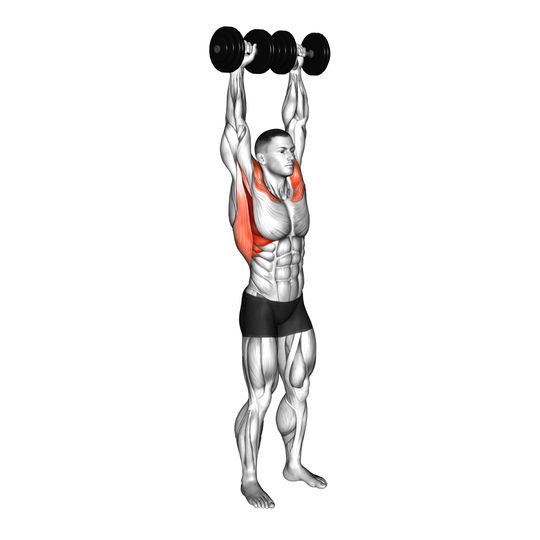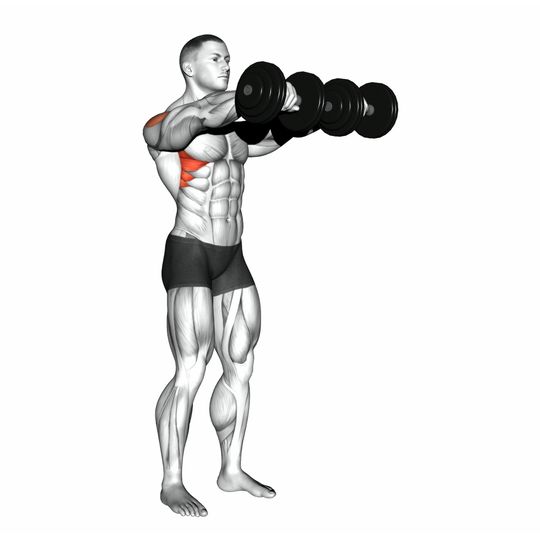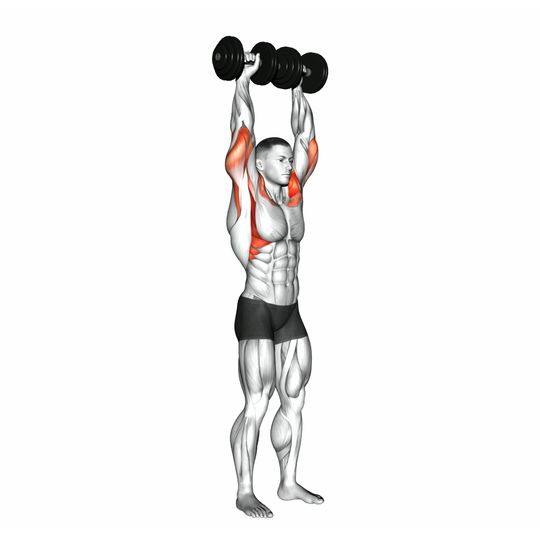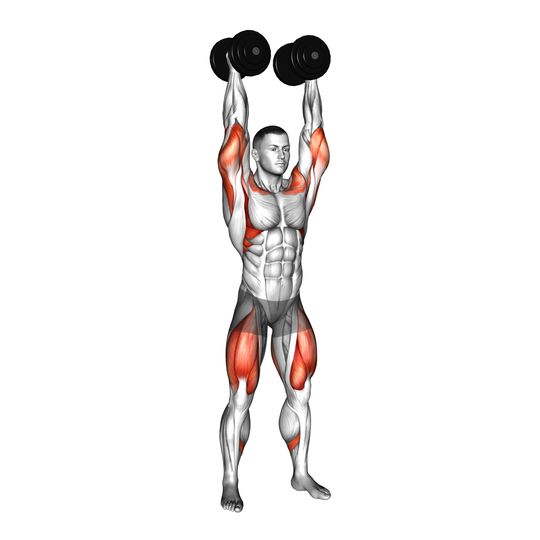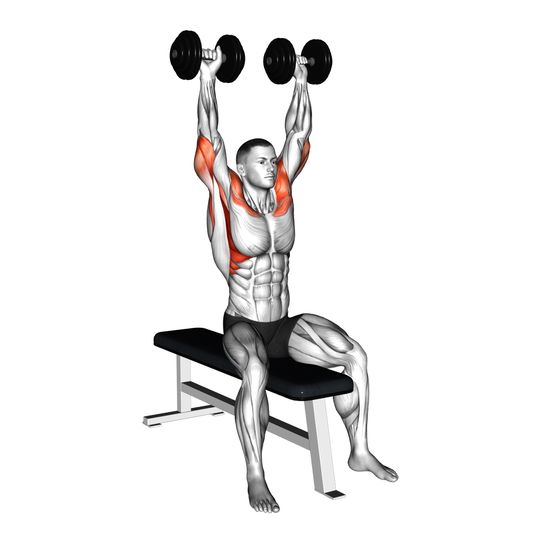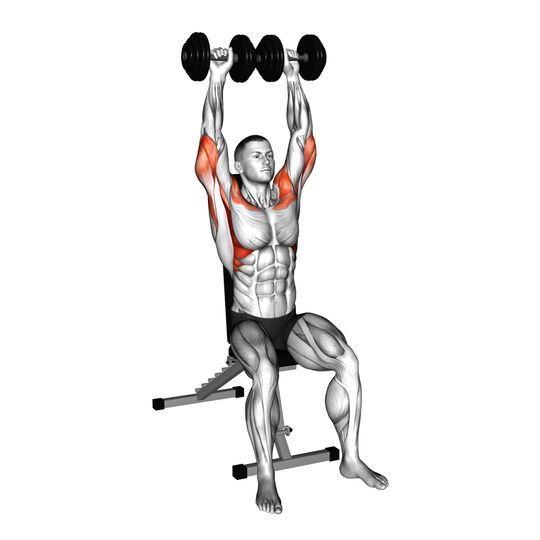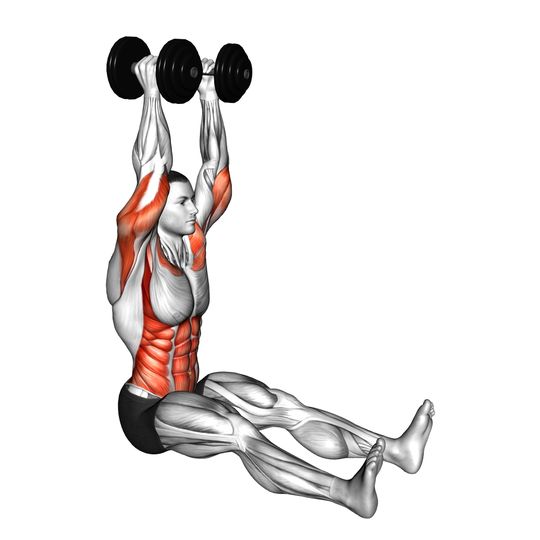


A seated rotational overhead press that moves dumbbells from chest level to overhead while turning the palms; primarily works the shoulder muscles.
How to do the Arnold Press#
- Sit tall on a bench with a dumbbell in each hand, elbows bent and weights held at chest height, palms facing you.
- Press the dumbbells upward while rotating your hands so the palms face forward as your arms extend overhead.
- Pause briefly with your arms extended (avoid hyperextending the elbows), then reverse the motion and rotate the palms back as you lower the weights to chest level.
- Keep a neutral spine and brace your core; let the elbows track under the wrists throughout the movement.
Muscles worked#
The Arnold press is a dumbbell shoulder press with a rotation added. You start with the palms facing you and the dumbbells in front of the shoulders, then rotate the hands outward as you press so they face forward at the top. That rotation drags the front delts through a longer arc than a normal press, and the side delts still take over as the elbows move out and up, so both heads of the deltoid work through a greater range.
The triceps finish the lockout and the upper traps and serratus anterior rotate the shoulder blades so the arms can reach overhead. The rotator cuff is busier than in any other press because it has to control the rotation of the dumbbells as well as their balance. It feels like a longer, slower set than a shoulder press with the same weight, with a burn that starts in the front of the shoulder and spreads to the side.
- Primary: Front delts (Anterior Deltoid), Side delts (Lateral Deltoid)
- Secondary: Triceps (Triceps Brachii), Traps (Trapezius)
Common mistakes#
- Using trunk momentum or driving with the hips to lift the weights.
- Overarching the lower back at the top of the press.
- Flaring the elbows excessively out to the sides.
- Not completing the palm rotation during the press.
Arnold Press vs other exercises#
Head-to-head breakdowns of muscles worked, loading, joint stress, and which one to pick for your goal.
Why it works#
It gives the front delts a stretch and a range of motion that a straight press does not. Starting with the dumbbells in front of the chest puts the anterior delt in a lengthened position, and the rotation means it works through most of the rep instead of handing off to the side delts early. For lifters chasing shoulder size rather than a pressing number, that extra time under tension is exactly what they want.
It also forces you to use lighter weights and control them, which is a feature. The rotation makes it hard to bounce or use momentum, the rotator cuff gets real work, and you cannot load it heavily enough to grind, so it is a productive shoulder builder that is easy to recover from. It slots well into a program as the second press of the session after a heavy barbell or dumbbell press.
Sets, reps and setup#
Three sets of 8-12 reps with 90 seconds of rest, once or twice a week. This is not a movement for heavy fives; the rotation rewards moderate loads and a controlled three-second lowering phase. Sets of 12-15 with a light pair are a good shoulder finisher.
- Setup
- Seated with the bench set upright or one notch back, feet planted. Hold the dumbbells in front of the shoulders at roughly chin height with the palms facing you and the elbows tucked in front of the body. Press up while rotating the palms outward so they face forward as the elbows move out and the arms extend overhead. Lower and rotate back to the start under control.
- Progression
- Go up a dumbbell increment when every set reaches the top of the range with a full rotation and no lower-back arch. Because the movement punishes heavy loads, progress mainly by reps and tempo: add a two-second pause at the bottom, slow the lowering to three or four seconds, or finish the last set with a few straight presses once the rotation fails.
Variations#
- Dumbbell Shoulder Press The same press without the rotation, which lets you load heavier and keeps the side delts more involved.
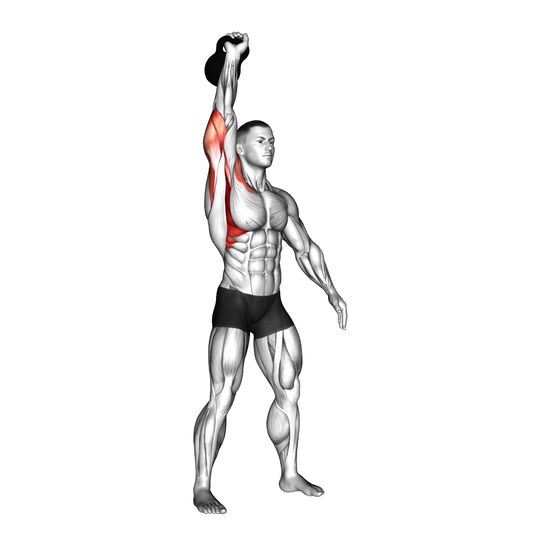
- Kettlebell Arnold Press The bell sitting behind the wrist shifts the load and asks more of the grip and rotator cuff.
- Seated Dumbbell Shoulder Press The back-supported strict press to use for heavier sets before Arnold presses.
- Dumbbell Front Raise A straight-arm isolation for the front delts that the Arnold press already emphasises.
- Dumbbell Lateral Raise The isolation movement for the side delts, which pairs well with any overhead press.
Arnold press vs dumbbell shoulder press#
The Arnold press trains the front delts through a longer range and keeps the shoulders working for more of each rep, so for the same weight it produces more fatigue in the deltoids and more work for the rotator cuff. If shoulder size is the goal and you already have a heavy press in the program, it is the better second exercise.
The standard dumbbell shoulder press lets you use more weight, which makes it the better strength builder and the better main press. The rotation in the Arnold press also bothers some people's shoulders, particularly at the bottom where the arms are internally rotated in front of the chest. If that is you, press normally and get your front delt work elsewhere.
Common questions#
What muscles does the Arnold press work?
The front and side delts are the main movers, with the front delts getting more range than in a normal press because of the rotation. The triceps lock out the elbows, the upper traps and serratus anterior move the shoulder blades, and the rotator cuff controls the rotation of the dumbbells.
Is the Arnold press better than the shoulder press?
For working the front delts through a long range with moderate weight, yes. For building overhead strength, no, because the rotation limits how heavy you can go. Most lifters do best with a standard press as the main movement and the Arnold press as a secondary one.
How heavy should the Arnold press be?
Lighter than your normal dumbbell shoulder press, usually by 20-30 percent. A pair you can press for 10-12 controlled reps with a full rotation is right; for most beginners that is 6-10 kg per hand.
Should I do the Arnold press seated or standing?
Seated is the standard and the better choice because it isolates the shoulders and stops the lower back arching to help. Standing is fine if you brace hard and keep the weight light, but it adds little to the movement.
Is the Arnold press bad for your shoulders?
Not for most people, and the rotation is good training for the rotator cuff. Some lifters find the internally rotated start position uncomfortable, especially with heavy dumbbells. If that is the case, start with the palms half turned rather than fully facing you, or use the standard press.