

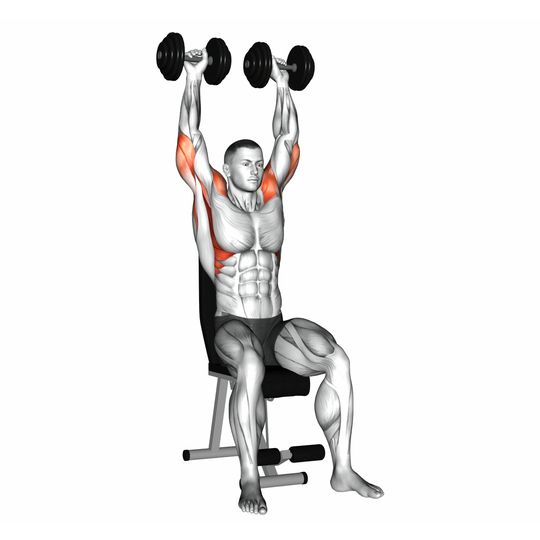
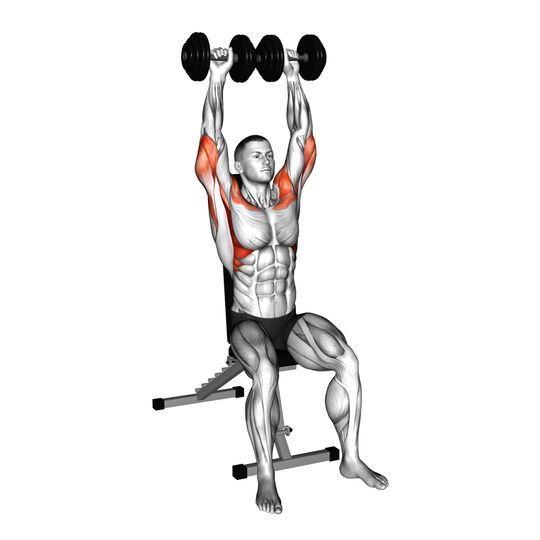
The Arnold press and the dumbbell shoulder press look almost identical: sit upright, press a pair of dumbbells overhead, lower and repeat. The difference is the start position and the rotation. A shoulder press starts with the palms facing forward and the dumbbells beside the shoulders and moves in a straight line. An Arnold press starts with the palms facing you and the dumbbells in front of the chest, then rotates the hands outward as you press.
That rotation changes the range of motion, the muscle that starts the rep, how much weight you can move, and how the shoulder joint feels. The same comparison applies when people search arnold press vs overhead press, since overhead press usually means the barbell version — a straight, heavier press with no rotation.
| Factor | Arnold Press | Dumbbell Shoulder Press |
|---|---|---|
| Main target | Front delts, side delts through a longer arc | Front and side delts, straight line |
| Range of motion | Longer — starts in front of the chest, palms in | Standard — starts beside the shoulders |
| Typical load | About 10–20% lighter than a shoulder press | Heaviest dumbbell shoulder movement |
| Shoulder stress | More rotator cuff work, rotation can irritate some shoulders | Lower, predictable path |
| Best rep range | 8–15, controlled tempo | 6–12, progressive loading |
| Best for | Front delt size, time under tension | Pressing strength, overload, beginners |
Arnold Press vs Dumbbell Shoulder Press: muscles worked#
Arnold Press
- Primary: Front delts, Side delts
- Secondary: Triceps, Traps
Dumbbell Shoulder Press
- Primary: Front delts, Side delts
- Secondary: Triceps, Traps
Muscles worked#
Both presses train the front delts and side delts as the primary movers, with the triceps finishing lockout and the upper traps rotating the shoulder blades so the arms can travel overhead. The dumbbell shoulder press splits the work fairly evenly: the front delts drive the first half, the side delts take over as the elbows move out and up, and the triceps close the rep.
The Arnold press shifts that balance toward the front delt. Starting with the dumbbells in front of the chest and the palms facing you puts the anterior deltoid in a lengthened position, and rotating outward keeps it working through most of the rep instead of handing off to the side delts early. The little EMG research comparing the two finds slightly higher front delt activity in the Arnold press and roughly equal side delt activity. The rotator cuff is also busier, because it has to control the turning dumbbells as well as balance them.
Range of motion and the rotation#
The Arnold press adds range at the bottom. Bringing the dumbbells in front of the chest lowers the start by several inches, and the front delt is stretched under load in that position, which is the part of the range most associated with growth. The rotation also slows the rep down: it is hard to bounce or use momentum when the hands have to turn, so each set delivers more time under tension at the same weight.
The shoulder press moves in a straight line from beside the shoulders to overhead, a shorter and more efficient path. That is a feature when the goal is strength — a predictable path lets you press more and progress faster — and a limitation when the goal is stretching the front delt, because the muscle never reaches the lengthened position the Arnold press starts from.
Loading and shoulder health#
You will press less on an Arnold press, typically 10–20 percent less than your shoulder press, because the rotation and the longer range make every rep harder and the weight spends time in a weak position in front of the body. That makes it a productive shoulder builder that is easy to recover from and almost impossible to grind, and a poor choice for chasing a heavy pressing number.
The rotation is also what makes the Arnold press disagree with some shoulders. The bottom position puts the arm in internal rotation with the elbow in front of the body, and lifters with impingement symptoms or a cranky rotator cuff often feel it there. The straight shoulder press keeps the arm on a more neutral path and is the better choice if the front of your shoulder complains.
Programming and how to use both#
Treat the shoulder press as the strength press. Program it first in the session, in the 6–12 rep range for 3–4 sets, and progress it by adding a dumbbell increment when every set reaches the top of the range. It also suits beginners, who need to learn a simple press before adding a rotation to it.
Treat the Arnold press as the size press. Slot it second, after a heavy barbell or dumbbell press, for 3 sets of 8–15 with a controlled three-second lowering phase. Running both in one session works well. If you only have room for one, keep the shoulder press as the staple and rotate the Arnold press in for a block when front delt growth is the priority.
The verdict#
Pick the Arnold press if shoulder size is the goal, your shoulders are healthy, and you already have a heavy press in the program. The longer range, the stretched start position, and the slower rep give the front delt a stimulus the straight press does not, at a load that recovers easily.
Pick the shoulder press if you want to press heavier and progress it, if you are new to overhead pressing, or if the rotation irritates the front of your shoulder. It is the simpler, stronger movement and the one to build a program around; the Arnold press is the accessory you add to it, not the other way round.
Frequently asked questions#
Is the Arnold press better than the shoulder press?
For front delt development, slightly. The Arnold press takes the anterior deltoid through a longer range and the rotation forces a slower, more controlled set. For pressing strength and simple progression, the shoulder press is better because you can load it heavier in a straight, predictable path. They do different jobs rather than one being superior.
What is the difference between an Arnold press and an overhead press?
An overhead press usually means the barbell press: a straight line from the front of the shoulders to lockout with both hands on one bar. The Arnold press uses dumbbells, starts with the palms facing you in front of the chest, and rotates the hands outward as you press. The overhead press is heavier and better for strength; the Arnold press is lighter and better for front delt range of motion.
Why is the Arnold press so much harder than a shoulder press?
The start position in front of the chest is a mechanically weak spot, the rotation stops you from bouncing out of the bottom or using momentum, and the range of motion is longer, so each rep is more work. Expect to use 10–20 percent less weight than your dumbbell shoulder press for the same reps.
Can I do Arnold press and shoulder press in the same workout?
Yes, and it is a sensible pairing. Do the shoulder press first while you are fresh, in the 6–12 rep range, then follow with the Arnold press for 8–15 reps with a slow lowering phase. Together they usually remove the need for a third pressing movement on shoulder day.
Is the Arnold press bad for your shoulders?
Not for healthy shoulders, but the bottom position puts the arm in internal rotation with the elbow in front of the body, which can aggravate impingement or a sore rotator cuff. If it hurts, reduce the rotation so the palms only turn partway, keep the elbows from drifting too far forward, or swap to the straight shoulder press.