

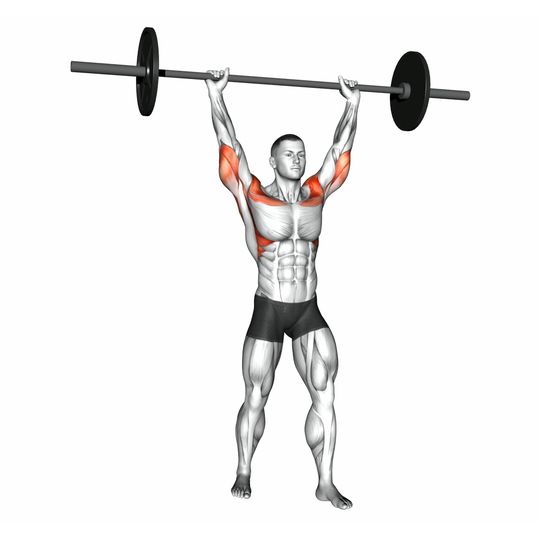
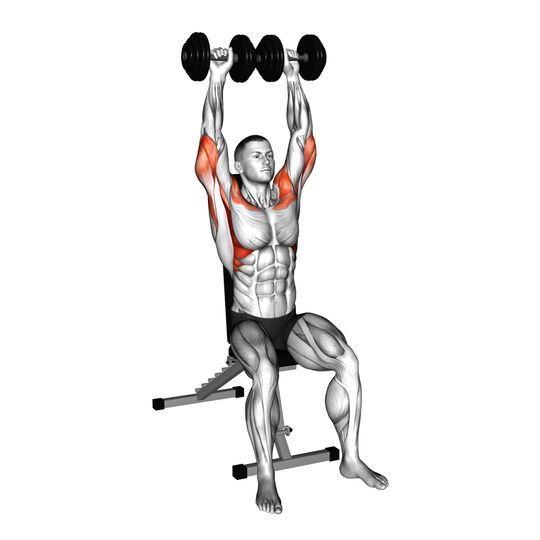
Ask ten lifters the difference between the overhead press and the shoulder press and you will get ten answers, because the names describe the same movement: pushing a weight from the shoulders to lockout above the head. In practice, and in most training logs, overhead press means the standing barbell press and shoulder press means the dumbbell version, usually seated.
The barbell fixes both hands to one implement, so the bar has to travel around your face and the whole body works to keep it there. Dumbbells free each arm to find its own path, let the weights drop lower at the bottom, and force each shoulder to do its own work. Those differences change how much you can lift, which parts of the delt do most of the work, and how the exercise feels on a cranky shoulder.
| Factor | Barbell Overhead Press | Dumbbell Shoulder Press |
|---|---|---|
| Main target | Front and side delts, triceps, upper traps | Front and side delts, triceps |
| Typical setup | Standing, barbell from the rack | Seated or standing, one dumbbell per hand |
| Load | Heaviest overhead press you can do | Roughly 80–85% of the barbell total across both hands |
| Range of motion | Bar stops at the collarbones | Dumbbells drop below shoulder height |
| Stability demand | High — core, upper back and legs all brace | Lower with a bench, moderate standing |
| Weak-side fix | Strong side can take over | Each arm lifts its own weight |
| Best for | Strength, progressive overload in small jumps | Delt growth, shoulder comfort, fixing imbalances |
Barbell Overhead Press vs Dumbbell Shoulder Press: muscles worked#
Barbell Overhead Press
- Primary: Front delts, Side delts
- Secondary: Triceps, Traps, Upper back, Abs
Dumbbell Shoulder Press
- Primary: Front delts, Side delts
- Secondary: Triceps, Traps
Muscles worked#
Both presses are built on the front delts, with the side delts, triceps and upper traps assisting. The barbell overhead press recruits the most muscle in total: because you stand and hold one bar, the core braces hard against the load, the upper back keeps the bar stacked over the spine, and the upper traps finish the lockout with a shrug.
The dumbbell shoulder press shifts a little more of the job onto the delts themselves. The elbows can travel slightly out to the side rather than straight forward, which brings the side delts in more at the start of the rep, and the longer range at the bottom stretches the front delt under load. With a bench behind you the core and legs drop out almost entirely, so the shoulders and triceps are what fails, not your bracing.
Load and range of motion#
The barbell is the heavier tool. Total dumbbell load usually comes to about 80–85 percent of what the same lifter can press with a bar, because each arm has to stabilise its own weight and there is no way to use leg drive or a slight layback to grind through a sticking point. Barbells also load in 2.5 kg steps, which makes steady progression far easier than jumping between fixed dumbbells.
The dumbbells win on range. A bar stops when it meets your collarbones; dumbbells can sink to shoulder height or below, so the delts work through a longer arc and get a stretch at the bottom the bar never provides. That extra range is why dumbbells feel harder for the weight and why they grow delts well with lighter loads.
Shoulder comfort and imbalances#
The fixed bar path is what makes the barbell press feel awkward for some shoulders. The wrists are locked in pronation, the bar has to clear the chin, and if one shoulder is tighter than the other the bar simply tilts. Lifters with a history of impingement often find the barbell press irritating and the dumbbell press fine, because the dumbbells let the hands rotate toward neutral and the elbows find their own line.
Dumbbells also expose asymmetry. If your right arm locks out first on every barbell rep, the barbell is letting the strong side carry the weak one; a pair of dumbbells cannot. A block of dumbbell pressing for 8–12 reps, with the weak side setting the pace, is the standard fix and usually improves the barbell press when you return to it.
Programming and how to use both#
Treat the barbell overhead press as the strength movement. Put it first on a push or upper day, work in the 3–8 rep range for 3–5 sets, and progress it in small jumps like you would a squat or bench. Standing is the default; a seated barbell press removes the leg and core demand and behaves more like a heavy dumbbell press.
Treat the dumbbell shoulder press as the hypertrophy movement. Use it second, or as the main press on a day when your lower back or core is already tired, for 3–4 sets of 8–12 with a full range at the bottom. Many good programs alternate: barbell heavy one session, dumbbells for volume the next, so both the load and the range progress across the week.
The verdict#
Pick the overhead press if strength is the goal, if you want one number to drive up over months, or if you compete in anything that tests a barbell overhead. The standing barbell press trains more total muscle, loads in small increments, and carries over to every other press you do.
Pick the shoulder press if delt size, shoulder comfort or a stubborn left-right imbalance is the priority. The dumbbells give a longer range, a friendlier grip and no way for the strong side to cheat. Most lifters build a shoulder faster with dumbbells and a press faster with a bar, and the best programs give each a slot.
Frequently asked questions#
Is the overhead press the same as the shoulder press?
Strictly, yes: both describe pressing a weight from the shoulders to overhead. In everyday gym use, overhead press means the standing barbell press and shoulder press means the dumbbell version, usually seated.
Is the dumbbell shoulder press or the overhead press better for building shoulders?
For delt growth, the dumbbell shoulder press has a slight edge: longer range at the bottom, more side delt involvement, and each arm working independently. For overall strength and the most total muscle recruited, the barbell overhead press is better. Most lifters get the most from doing both across the week.
How much should I dumbbell press compared to my barbell overhead press?
Expect the two dumbbells combined to add up to roughly 80–85 percent of your barbell press for the same reps. If you press 60 kg with a bar, a pair of 24–26 kg dumbbells is normal. Much lower than that means stability is the limiter and the dumbbells deserve more attention.
Which is safer for the shoulders, barbell or dumbbell press?
Neither is dangerous with sensible loading, but dumbbells are more forgiving. They let the wrists and elbows rotate into a comfortable position and do not force the bar around the face. If the barbell press pinches at the front of the shoulder, switch to dumbbells with a slightly neutral grip for a block rather than pressing through it.
Should I do the overhead press standing or seated?
Standing if you want the most carryover and the most total muscle working, since the core and legs have to brace the load. Seated if you want to isolate the shoulders and triceps or your lower back is fatigued. Seated presses allow slightly more weight, which suits a hypertrophy block but does not transfer directly to a standing max.