

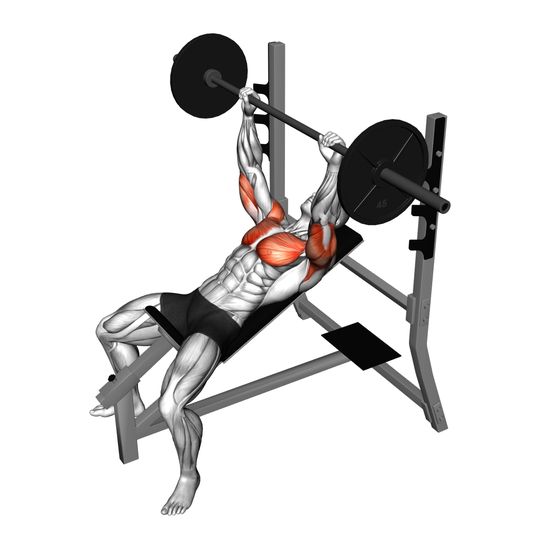
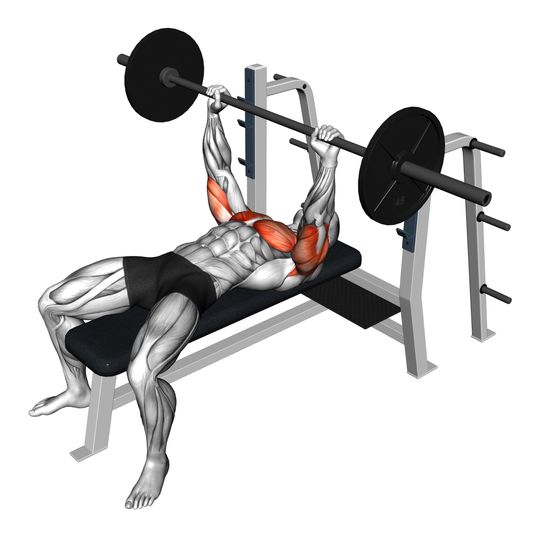
Flat and incline bench press are the two barbell presses every chest program is built around, and the debate about which one is better has run for as long as gyms have had adjustable benches. The honest answer is that they train the same muscle from two angles, and the angle decides which part of the chest and which supporting muscles do the most work.
The flat bench presses straight up against gravity with the shoulders in a neutral position, which is why it is the strongest press and the powerlifting standard. Raising the bench to 30–45 degrees points the line of force toward the collarbones, shifts work to the upper chest and front delts, and costs you weight on the bar.
| Factor | Incline Barbell Bench Press | Barbell Bench Press |
|---|---|---|
| Chest emphasis | Upper chest (clavicular head) | Whole chest, sternal head dominant |
| Front delt involvement | High | Moderate |
| Triceps involvement | Moderate | High at lockout |
| Typical load | About 80–85% of your flat bench | Your heaviest press |
| Shoulder comfort | Often better at 30°, worse at 45°+ | Depends on grip width and arch |
| Best for | Upper chest development, filling out the collarbone line | Overall chest mass and pressing strength |
Incline Barbell Bench Press vs Barbell Bench Press: muscles worked#
Incline Barbell Bench Press
- Primary: Chest
- Secondary: Front delts, Triceps
Barbell Bench Press
- Primary: Chest
- Secondary: Triceps, Front delts
Muscles worked#
Both lifts train the pectoralis major, anterior deltoid, and triceps. The flat bench distributes work across the whole pec with the larger sternal portion doing the most, which is why it builds the most total chest mass per set. The triceps also contribute heavily at lockout because the bar path stays over the lower chest.
The incline shifts emphasis toward the clavicular head — the upper chest that runs under the collarbone — and pulls the front delts in more. Research comparing angles shows upper pec activation rising through about 30 degrees and front delt activation climbing steadily as the bench gets steeper. Past roughly 45 degrees the incline stops being a chest exercise and starts being a shoulder press.
Strength and loading#
Expect to incline press about 80–85 percent of your flat bench. Part of that is leverage — the incline shortens the stroke of the stronger sternal fibres and asks a smaller muscle to lead. Part of it is that you cannot use the leg drive and arch that add weight to a flat bench.
That gap matters for programming. If the goal is maximal pressing strength or a bench press number, the flat bench has to be the primary lift because it is the one you can load the most and progress the longest. The incline is the better choice for a second press where the goal is chest growth rather than the biggest number.
Shoulder stress#
Many lifters find a low incline of 15–30 degrees more comfortable than flat pressing because the shoulder sits in a slightly more open position and the bar path naturally tucks the elbows. Steep inclines reverse that: the higher the bench, the more the front delt and the top of the shoulder take the load.
On the flat bench, shoulder comfort is mostly a grip and setup issue. A grip so wide that the forearms angle outward at the bottom, or a bar touching high on the chest with flared elbows, is what irritates shoulders — not the flat angle itself. Tuck the elbows to roughly 45 degrees, touch just below the nipple line, and most complaints disappear.
Programming: which comes first?#
Put whichever one you want to grow most first, while you are fresh. Lifters with a lagging upper chest usually see the fastest change by leading with a 30-degree incline for a block of 8–12 weeks and moving the flat bench to a second slot or a second day.
In a standard push or upper day the flat bench leads in the 5–8 rep range and the incline follows with 8–12 reps, often with dumbbells to vary the angle further. Over a week, two pressing angles beats one: the chest is a fan-shaped muscle and it grows most evenly when it is loaded along more than one line.
The verdict#
The flat bench press is the better single exercise: it loads the whole chest heaviest, progresses the longest, and is the lift every strength standard is measured on. If you can only do one press, do this one.
The incline bench press is the better second press and the right first press for anyone whose upper chest lags. Keep the angle around 30 degrees, accept the lighter bar, and run both angles across the week rather than picking a side in the argument.
Frequently asked questions#
Is incline or flat bench better for chest?
Flat bench builds more total chest because it lets you load the largest part of the muscle heaviest. Incline bench builds the upper chest better, which is the part most lifters find hardest to develop. For a complete chest, most programs use both, with the priority given to whichever area is lagging.
What angle should the incline bench be?
30 degrees is the sweet spot for most lifters. It shifts work to the upper chest without turning the movement into a shoulder press. 15 degrees is a useful low incline that many find most comfortable; 45 degrees and above puts the front delts in charge and stops being a chest exercise.
How much less should I incline bench than flat bench?
Around 15–20 percent less is typical. If your incline is more than 25 percent below your flat bench, your upper chest and front delts are relatively weak and the incline probably deserves the first slot for a while. If it is within 10 percent, your flat bench setup is likely leaving strength on the table.
Can I skip flat bench and only do incline?
You can build a good chest doing only incline presses, especially with a low angle, but you will give up some lower and middle chest development and some total pressing strength. If flat benching bothers your shoulders and a low incline does not, running incline as your main press is a reasonable trade.
Should I do incline before or after flat bench?
Do the one you want to improve first. For most people that means flat bench first for strength and incline second for upper chest volume. If your upper chest is a clear weak point, lead with incline for a training block and put flat bench second.