
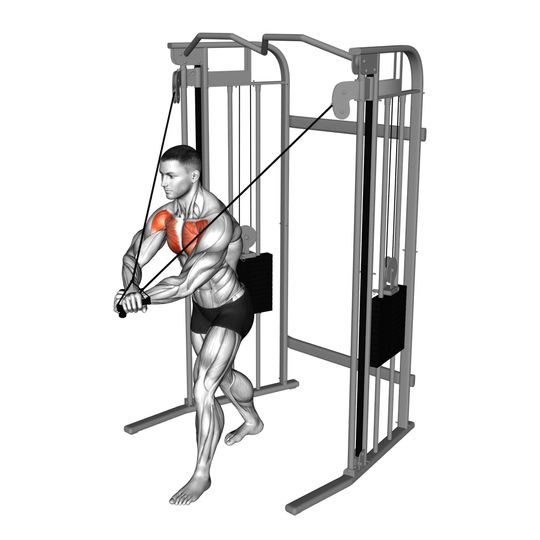
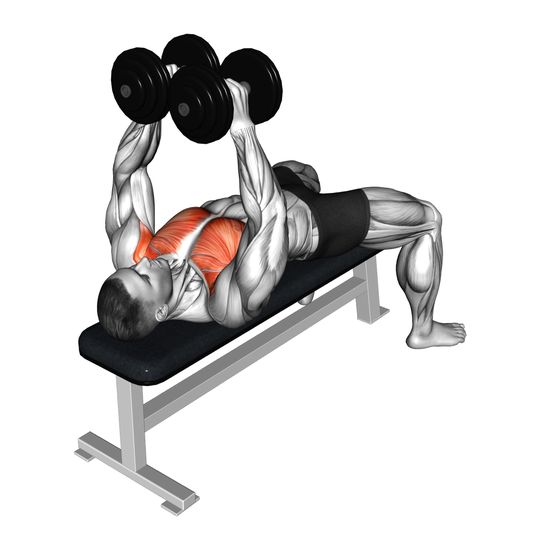
The chest fly is the one chest exercise built on what the pec actually does — bring the arm across the body — rather than on pressing. Dumbbells and cables both do it, but they load the movement in opposite places: a dumbbell is heaviest at the bottom, where the arms are wide and stretched, and nearly weightless at the top; a cable pulls with roughly constant tension through the whole arc and is hardest where the hands meet.
That difference decides what each fly is good at, how safe it is for the shoulders, and where it belongs in a chest workout. Here is how the two compare and which one earns the slot.
| Factor | Cable Crossover | Dumbbell Chest Fly |
|---|---|---|
| Tension curve | Constant through the range, peaks at the squeeze | Peaks at the stretch, disappears at the top |
| Stretch loading | Adjustable, moderate | Maximal — the bottom is the hardest point |
| Shoulder stress | Lower, load is controllable at the bottom | Higher — heavy weight at the most vulnerable angle |
| Angles available | Any — high to low, low to high, standing or seated | Flat, incline, decline on a bench |
| Ease of progression | Small increments on the stack | Dumbbell jumps, and heavy flyes get risky |
| Best for | Peak contraction, constant tension, shoulder-friendly volume | Stretch-focused chest work, home training |
Cable Crossover vs Dumbbell Chest Fly: muscles worked#
Cable Crossover
- Primary: Chest
- Secondary: Front delts
Dumbbell Chest Fly
- Primary: Chest
- Secondary: Front delts, Biceps
Muscles worked#
Both flyes isolate the pectoralis major with the front delts and biceps assisting as stabilisers. Neither involves the triceps in any meaningful way, which is what separates a fly from a press and why flyes are used to add chest volume without more elbow and shoulder pressing fatigue.
The cable lets you change the angle of pull: high to low emphasises the lower chest, low to high the upper chest, and a mid-height crossover the sternal portion. Dumbbells change angle by changing the bench — flat, incline, or decline — which covers the same territory in bigger steps.
Where the tension is#
The dumbbell fly is a stretch exercise. Gravity pulls straight down, so the resistance is greatest when the arms are wide and the pecs are lengthened, and it falls to almost nothing as the hands come together over the chest. Loading a muscle at long length is a potent growth stimulus, which is the dumbbell fly’s main argument.
The cable fly keeps the pec working the whole way. Tension stays high through the middle and peaks as the hands cross, so the shortened position — where the dumbbell fly gives you nothing — becomes the hardest part. Research on partial ranges suggests the stretched position matters most for growth, but constant tension makes cables the more complete and more forgiving version of the movement.
Shoulder safety#
The dumbbell fly is the exercise most likely to hurt a shoulder in the chest workout, because the heaviest load arrives at the deepest, most externally rotated point of the range. Going heavy and going deep at the same time is what causes trouble. Keep the elbows slightly bent, stop the descent at chest level, and treat it as a light, controlled exercise.
The cable fly is far friendlier. The load at the bottom is whatever the stack provides — not a dumbbell accelerated by gravity — and you can adjust the pulley height to a line that suits your shoulders. For lifters with a history of shoulder problems, cables are the fly to keep.
Programming#
Flyes belong after pressing, in the 10–20 rep range, taken close to failure with a controlled lowering. Neither variation should be loaded heavy — the pec is doing the job alone and the leverage is poor, so a fly that requires a swing or a bent arm has become a bad press.
Cable flyes are the default for a gym with a cable station: more angles, smoother progression, and safer at the bottom. Dumbbell flyes are the default for home training and for lifters who want to bias the stretched position deliberately. Rotating between them across blocks covers both ends of the range.
The verdict#
The cable fly is the better all-round chest fly: constant tension, a hard contraction at the top, adjustable angles, and far less shoulder risk at the bottom. If you have a cable station, this is the fly to build around.
The dumbbell fly earns its place as a stretch-focused variation and as the only option at home. Keep it light, stop at chest level, and use it to load the lengthened position that cables under-emphasise. Many lifters run cables as the main fly and dumbbells for a block when they want more stretch.
Frequently asked questions#
Are cable flyes better than dumbbell flyes?
For most lifters, yes. Cables keep tension on the chest through the entire range, let you set any angle, and are much kinder to the shoulders at the bottom. Dumbbells load the stretched position harder, which is a real advantage for growth, but they give you nothing at the top and are the fly most likely to irritate a shoulder.
Do flyes build chest or just shape it?
They build it — muscles do not “shape”, they grow or they do not. Flyes add chest volume through the movement the pec is designed for, without more pressing fatigue on the shoulders and elbows. They are a supplement to presses, not a replacement, because the load they tolerate is small.
How heavy should I go on chest flyes?
Light enough for 10–20 controlled reps with a slight elbow bend and a slow lowering. If you need to bend the elbows sharply or swing the weight up, it is too heavy and you are pressing, not flying. Progress by adding reps and pausing at the squeeze before adding load.
Should I do flyes before or after bench press?
After. Presses need fresh shoulders and triceps and should get your heaviest effort; flyes then add isolated chest volume when the pressing muscles are already tired. Pre-exhausting with flyes before pressing lowers your press numbers without a clear benefit.
What angle should cable flyes be set at?
High to low — pulleys above shoulder height, hands finishing in front of the hips — for the lower chest. Low to high for the upper chest. Shoulder height, crossing in front of the sternum, for the middle. Rotate the angle across sessions rather than picking one forever.