

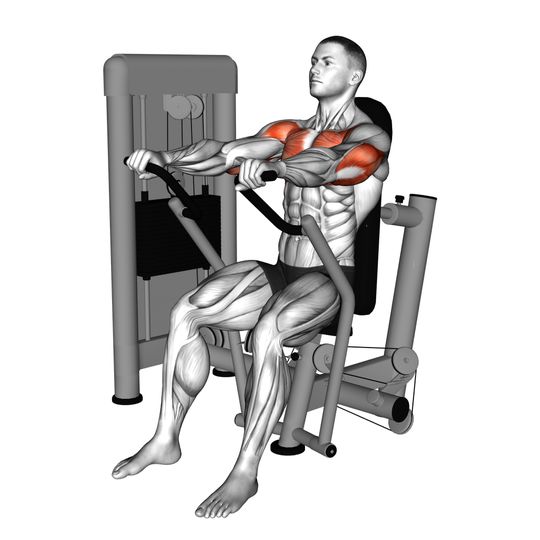
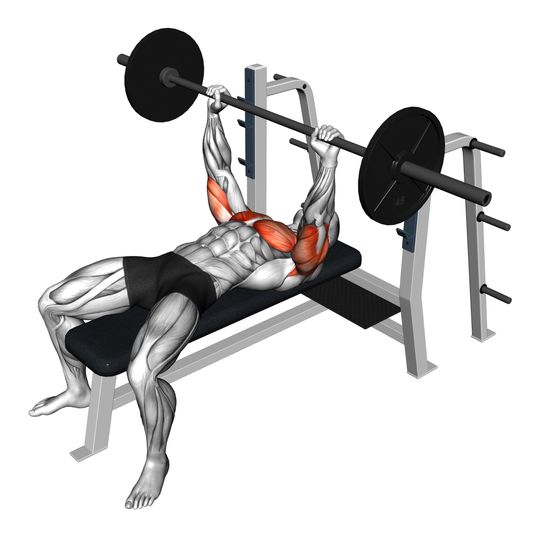
The chest press and the bench press are both horizontal presses that train the chest, front delts and triceps, and on paper they look almost identical. The difference is the tool. Chest press almost always means the seated machine with a fixed handle path and a back pad; bench press means a barbell, a flat bench and nothing holding the weight in line but you.
That single change decides how much weight you can use, how much of your body has to work to keep it stable, how safe it is to push a set to failure, and how well the exercise transfers to anything else. They suit different jobs and different lifters, and most good chest programs find a place for both.
| Factor | Machine Chest Press | Barbell Bench Press |
|---|---|---|
| Main target | Chest, with front delts and triceps assisting | Chest, front delts and triceps, plus shoulder stabilisers |
| Movement path | Fixed by the machine | Free — you control the bar |
| Stability demand | Very low, back and shoulders supported | High — lats, rotator cuff and legs all work |
| How heavy it goes | Depends on the machine's leverage | Your heaviest upper-body lift |
| Training to failure | Safe without a spotter | Needs a spotter or safety pins |
| Learning curve | One session | Weeks to press well |
| Best for | Chest volume, beginners, safe failure sets | Strength, progression in small steps, carryover |
Machine Chest Press vs Barbell Bench Press: muscles worked#
Machine Chest Press
- Primary: Chest
- Secondary: Front delts, Triceps
Barbell Bench Press
- Primary: Chest
- Secondary: Triceps, Front delts
Muscles worked#
Both exercises are chest-dominant. The pectoralis major pulls the upper arms forward and across the body, the front delts help start the press, and the triceps finish the lockout. On a machine chest press with the seat set so the handles sit at mid-chest, the chest takes the largest share of the work and tends to be the muscle that fails first, because the pad and the fixed path remove almost everything else.
The barbell bench press recruits the same three movers plus a long list of stabilisers: the lats and upper back hold the shoulder blades down and back, the rotator cuff keeps the bar path honest, and the legs drive into the floor. Research comparing free-weight and machine presses shows similar chest activation but more stabiliser activity on the barbell. That extra work is useful for strength and irrelevant if the goal is simply to fatigue the chest.
Weight difference#
The most common question about the chest press vs bench press is why the weights do not match, and the answer is leverage. Plate-loaded machines use levers that multiply or reduce the effective load, and selectorised stacks are calibrated differently on every brand. One machine will let you press 20 kg more than your bench, the next will make 80 kg feel like a max. Compare the number only with your own previous sessions on the same machine.
For dumbbells the comparison is more predictable: a pair of dumbbells usually adds up to roughly 80–85 percent of your barbell bench for the same reps, because each arm stabilises its own weight and there is no bar to lock the two sides together. A dumbbell chest press is closer to the barbell in stability demand than a machine is, and sits between them in load.
Safety and going to failure#
The machine chest press is the safest way to take the chest to its limit. Failing a rep means the handles stop where they are; there is no bar over your throat and no need for a spotter. That makes drop sets, rest-pause sets and slow eccentrics straightforward, which is why many chest days end with a machine press pushed for every rep.
The barbell bench press punishes failure. Without a spotter or safety pins, a missed rep is a real problem, and small technique errors — elbows flaring, shoulders rolling forward, the bar drifting toward the face — show up as shoulder pain over time. Most lifters should keep barbell sets one or two reps shy of failure and save the grinding for the machine.
Programming and how to use both#
Use the barbell bench press as the strength movement. Put it first in the session when you are fresh, work in the 4–8 rep range for 3–5 sets, and add weight in 2.5 kg jumps. It is the lift that shows whether your pressing is actually getting stronger and the one that carries over to every other push.
Use the machine chest press for volume after the barbell work, or as the main press if you are a beginner or training without a spotter. Three to four sets of 8–12, with at least one set taken within a rep of failure, is plenty. Alternating them across the week — barbell one session, machine the next — also keeps chest volume high without piling up shoulder fatigue.
The verdict#
Pick the chest press if you want the most chest stimulus per unit of risk: new lifters, anyone training alone, anyone whose shoulders complain under a barbell, and anyone who wants to push the chest to failure at the end of a session.
Pick the bench press if strength is the goal, if you want a lift you can measure and progress for years, or if you care about carryover to sport and other presses. Most well-built chest days use both: barbell first for 4–8 heavy reps, machine second for 8–12 reps taken close to the limit.
Frequently asked questions#
Is the chest press machine as good as the bench press?
For chest growth, yes. The fixed path lets you load the chest hard and safely, and activation of the pecs is similar. For strength, carryover and the stabilising muscles of the shoulder, the barbell bench press is better. They do different jobs rather than one being a lesser copy of the other.
Why can I chest press more than I bench press?
Because the machine is helping. The back pad removes the stability demand, the fixed path removes any balancing, and plate-loaded levers change how much of the weight you actually move. On some machines the opposite happens and your chest press number is lower. Treat machine weights as progress markers for that machine only.
Can the chest press replace the bench press?
If your goal is a bigger chest and you do not care about a barbell number, yes. Plenty of lifters build a full chest on machines and dumbbells alone. If you want a stronger barbell bench, or to compete, you have to bench: the skill of stabilising a heavy bar does not transfer from a machine.
Should I do chest press and bench press in the same workout?
Yes, and it is a common pairing. Bench press first while you are fresh in the 4–8 range, then the machine chest press for 8–12 reps taken close to failure. Together they usually cover everything a chest day needs.
Is the dumbbell chest press closer to the bench press or the machine?
Closer to the bench press. Dumbbells demand stability from each shoulder, allow a slightly longer range at the bottom, and use about 80–85 percent of the barbell load. The machine is the easiest of the three, the barbell the heaviest, and dumbbells sit between them.