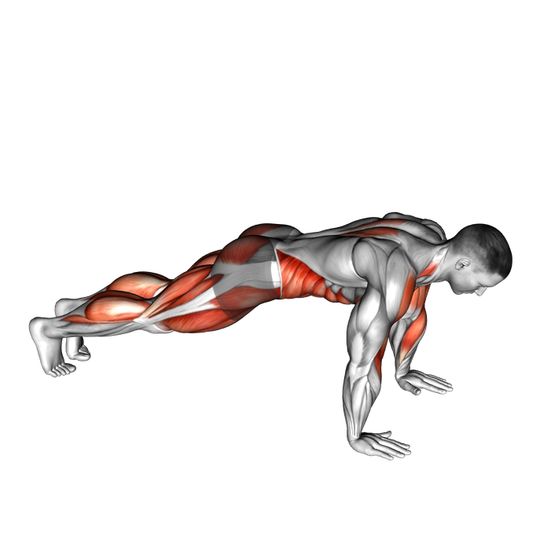


A horizontal pressing movement where you push your body away from the floor, primarily working the chest. The triceps and shoulders act as secondary movers.
How to do the Push Up#
- Begin in a high plank with hands placed just outside shoulder width and feet together or hip-width apart.
- Engage your core and glutes so your body forms a straight line from head to heels.
- Bend your elbows and lower your chest toward the floor until your upper arms are about parallel to the ground or chest nearly touches.
- Press through your palms to straighten the elbows and lift your body back to the start position.
- Repeat for the prescribed reps with controlled tempo and steady breathing.
Muscles worked#
The push up is a horizontal press that moves the body instead of the weight. The chest (pectoralis major) does the most work, pulling the upper arms toward the midline to lift the torso off the floor, with the middle and lower fibres loaded hardest when the body is flat. The triceps straighten the elbows to finish each rep and the front delts assist through the bottom half where the arms are furthest behind the body.
What separates the push up from a bench press is everything else that has to hold still. The abs, obliques, and glutes keep the body rigid in a plank so the hips do not sag, the serratus anterior spreads the shoulder blades at the top of each rep, and the quads keep the knees straight. A good set of push ups is a chest exercise and a core exercise at the same time, which is why the hips usually fail before the arms do.
- Primary: Chest (Pectoralis Major)
- Secondary: Triceps (Triceps Brachii), Front delts (Anterior Deltoid), Abs (Rectus Abdominis)
Common mistakes#
- Hips sag or lift, breaking the straight-line posture.
- Elbows flare excessively out to the sides instead of tracking diagonally.
- Allowing the head to drop or shoulders to shrug toward the ears.
- Not lowering fully or stopping short of elbow bend, reducing range of motion.
Why it works#
The push up trains the whole pressing chain with nothing but a floor, and the shoulder blades are free to move because the hands are fixed and the body travels. That makes it more shoulder-friendly than a heavy bench press and a genuine builder of the serratus and scapular control that pressing from a bench leaves out. It also scales from a wall push up to a weighted, ring, or one-arm version without ever needing a gym.
Because the load is your own body, progress is easy to measure and hard to fake. Going from 5 reps to 30 is a real change in relative strength and endurance, and the movement has almost no injury risk when done through a full range.
Sets, reps and setup#
Three or four sets of 8-20 reps with 60-90 seconds of rest, two or three times a week. Lower over two seconds, touch the chest lightly to the floor, and press up to straight arms with the shoulder blades spread.
- Setup
- Hands just outside shoulder width with the fingers spread and pointing forward, feet together or hip width, body in a straight line from heels to head. Squeeze the glutes, brace the abs, and lower the chest to the floor with the elbows tracking at about 45 degrees to the body. Push the floor away until the arms are straight and the upper back rounds slightly at the top.
- Progression
- Add a rep per set each week until you reach 20, then move on: a weighted vest or a plate on the back, feet elevated for a decline push up, rings for instability, or an archer push up on the way to a one-arm rep.
Variations#
- Incline Push Up Hands on a bench or box to reduce the load while keeping the full-body plank position.
- Knee Push Up Shortens the lever for beginners, though with less core involvement than the incline version.
- Diamond Push Up Hands together under the chest, which shifts the work heavily toward the triceps.
- Decline Push Up Feet raised so more bodyweight is over the hands and the upper chest and shoulders work harder.
- Ring Push Up Unstable hands demand far more from the chest, shoulders, and core at the same rep count.
Push up vs bench press#
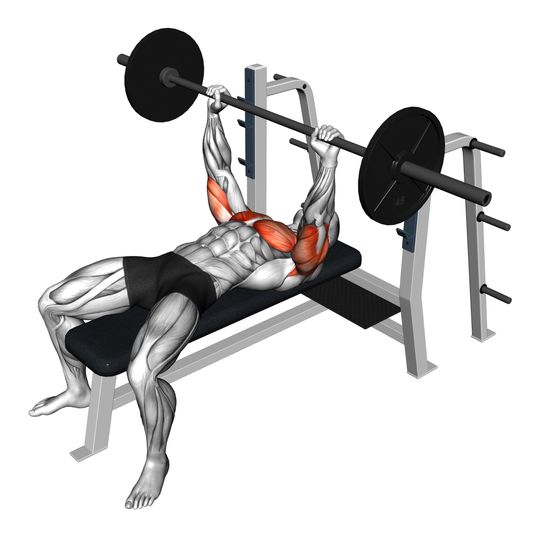
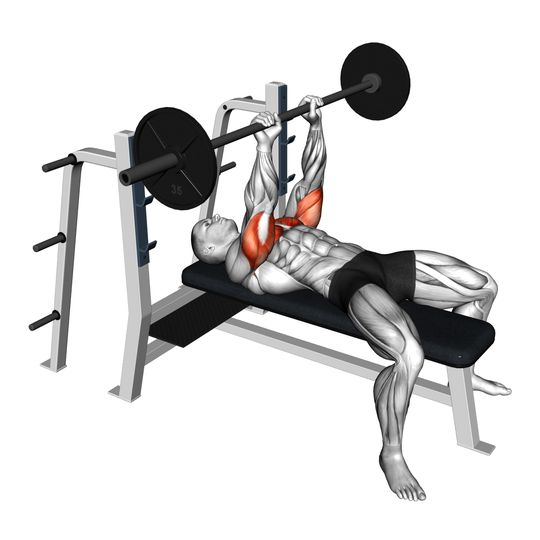
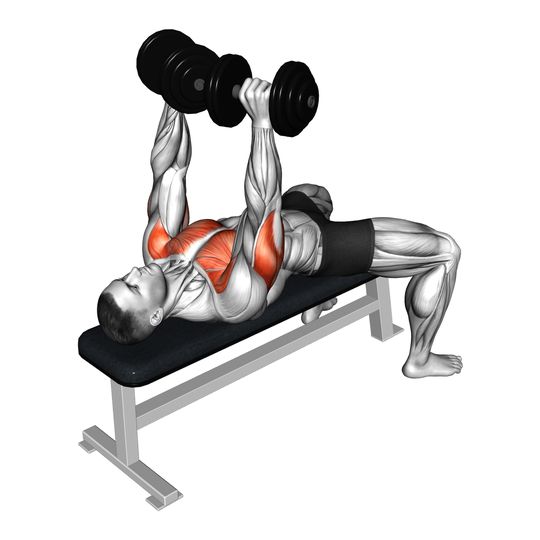
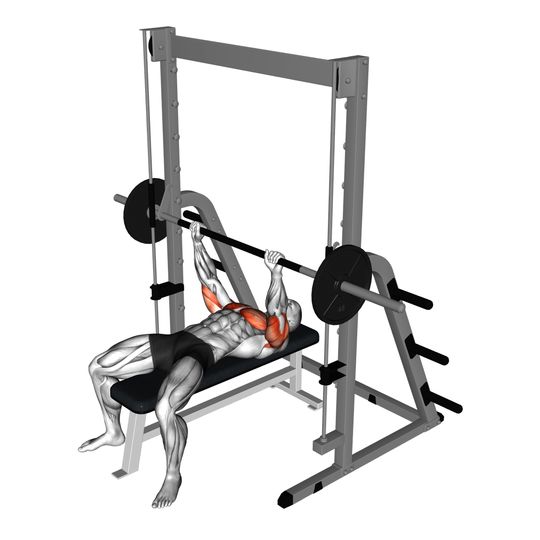
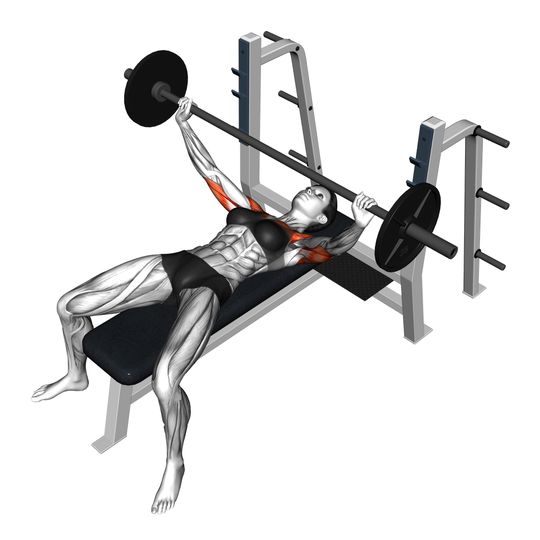
The bench press lets you load the chest with as much weight as you can handle, which makes it the better tool for building maximal strength and adding size once bodyweight is no longer challenging. It also lets you progress in small, precise steps of 2.5 kg.
The push up moves the shoulder blades freely, trains the core and serratus as part of the movement, and can be done anywhere. Research comparing the two finds similar chest and triceps growth when the effort is matched, so the push up is not a lesser exercise. It just runs out of load sooner. Use the bench for heavy work and push ups for volume, warm ups, and shoulder health.
Common questions#
What muscles do push ups work?
The chest is the main mover, with the triceps and front delts assisting. The abs, obliques, glutes, and quads hold the plank, and the serratus anterior controls the shoulder blades at the top of each rep.
How many push ups should I be able to do?
A reasonable benchmark for a fit adult man is 25-35 clean reps and for a woman 15-20. Doing 50 or more in one set is well above average. If you cannot do 10 yet, work from incline push ups and you will get there in a few weeks.
Do push ups build muscle?
Yes, when they are taken close to failure and progressed. Studies show similar chest and arm growth from push ups and bench presses at matched effort. Once you can do more than 20 reps, add a vest, a plate, or a harder variation to keep them building muscle rather than endurance.
Is it okay to do push ups every day?
Moderate daily sets are fine for most people because the load is light and the recovery cost is low. Hard sets to failure every day will eventually irritate the elbows and shoulders. Two to four sessions a week gets most of the benefit.
Why do my wrists hurt during push ups?
Because the wrists are bent to 90 degrees under load. Spread the fingers, grip the floor, and turn the hands slightly outward. Push up handles, parallettes, or making fists keep the wrist neutral and usually solve the problem.