
Fitbod Review (2026): Is It Worth It?
Fitbod writes every workout from a muscle recovery model. What the generator does well, where the paywall bites, and who should pay $79.99 to $95.99 a year.
Updated September 23, 2026 · Facts checked September 8, 2026


Comparing Fitbod review
Fitbod is the biggest strength app on the US App Store: 284,000 ratings at 4.8, an Apple Editor’s Choice badge, and a claimed 15 million downloads. It is also the app most likely to be misunderstood by people arriving from a logger like Strong or Hevy. Fitbod is not a notebook with charts. It is a workout generator, and the logging exists to feed the generator. Here is an honest look at it, with facts taken from Fitbod’s own help center and App Store listing.
What sets Fitbod review apart
Fitbod launched in 2015 as a plan-first app. You open the Workout tab, it shows a session already built for today from your goal, equipment, split, and duration, you log each set, and the next session is shaped by what you logged. There is no program library to browse and no routine to write first. If you want to decide what to lift yourself, that fights the product.
Gript is a logger for iPhone, iPad, Apple Watch, and Android that sits between the two camps: fast logging with previous sets inline, progression suggestions that show their reasoning on any routine, nine exercise chart types, and body measurements free. Its generator is lighter than Fitbod’s, there is no recovery heat map, and there is no Wear OS app.
 How Fitbod stands out
If you want the app to write and adjust every session, Fitbod provides:
- A two-part generator. An Exercise Selector picks from 1,000+ exercises with multi-angle video, scored by recovery, goal, level, your feedback, split, and equipment. A Capability Recommender sets weight, sets, and reps from an estimated one-rep max, recalibrated by Reps in Reserve ratings and Max Effort Days.
- A per-muscle recovery model. Each muscle group gets a 0 to 100 percent recovery score on the Body tab heat map, and fresh muscles get priority. Runs and rides from Apple Health, Health Connect, Strava, or Fitbit count too. It does not read sleep or HRV.
- Saved workouts instead of programs. Create Workout From Scratch, save it, and reload it in one of three modes. There is no weekly planner, Generate new weight only flattens 12, 10, 8 schemes to one rep count, and custom exercises are not progressed.
- A companion Apple Watch app. The watch logs sets, adjusts reps and weight, runs the rest timer, and shows live heart rate, but you start and save on the iPhone, with no cellular and no Always On. Android gets Wear OS.
- No free tier. A seven-day trial starts when you opt into a plan. The App Store shows $12.99 and $15.99 monthly and $79.99 and $95.99 yearly; Fitbod’s FAQ quotes $15.99 and $95.99. No lifetime purchase. HSA and FSA eligible with a letter of medical necessity.
 How Gript stands out
If you would rather run your own program and have the app help you progress it, Gript provides:
- Progression suggestions that explain themselves. The next weight or rep target on any routine you own, with the reason shown (Pro). Fitbod’s recommendations live only inside its generated or saved workouts.
- Unlimited logging free. Previous sets inline, a one-tap RPE and RIR keyboard, nine exercise chart types, and body measurements for every body part without paying. Pro is $4.99 a month or $29.99 a year with a free trial; there is no lifetime plan.
- Your Fitbod history comes with you. Gript reads Fitbod’s CSV export directly, keeping warm-up sets, plus 18 other apps, and AI import reads any written program. Export is free in Gript, Strong, and Hevy formats. See the Fitbod import guide.
- A lighter generator. Three generated workouts free, then Pro, with no recovery heat map and no Strava sync. There is also no social feed, no web app, and the program library is 6 programs and 24 routines.
- No Wear OS. iPhone, iPad, Apple Watch, and Android. Fitbod also runs on Wear OS.
Common questions
Is Fitbod worth it?
It is worth it if you want an app to write and adjust every session and you will follow what it prescribes; the generator and recovery model are the best in the category. It is not worth it if you run your own program or mainly want a logger with charts, because you would pay $79.99 to $95.99 a year for features you keep overriding, with no free tier to fall back on.
Does Fitbod have a free version?
No. Fitbod offers a seven-day free trial that starts when you opt into a monthly or yearly plan. After the trial, Fitbod’s help center says you can log in and view past workouts but cannot log new ones without a subscription. Strong, Hevy, and Gript all keep unlimited logging free.
Can I export Fitbod data?
Yes. Open the Log tab, tap the gear icon, and choose Export Workout Data to get a CSV of every set with date, exercise, reps, weight, duration, and a warm-up flag. Gript reads that file directly; see the Fitbod import guide.
Final verdict: which one should you choose?
- Choose Fitbod ifFitbod
you want to walk into the gym and be told what to do, train with inconsistent equipment or schedule, also run or ride and want lifting to respect that, or are new enough that picking exercises and starting weights is itself the barrier.
- Choose Gript ifGript
you already follow a written program and want fast logging, free body measurements, nine chart types, and next-set suggestions that explain themselves.
Fitbod is the most mature generator in the category, and the recovery model is useful for balancing a week around other sport. It costs roughly three times a logger’s paid tier, and the free version does not let you keep logging. If you follow a fixed program, want a free logger, or care mostly about charts, Hevy, Strong, or Gript fit better, and your Fitbod history imports in minutes.
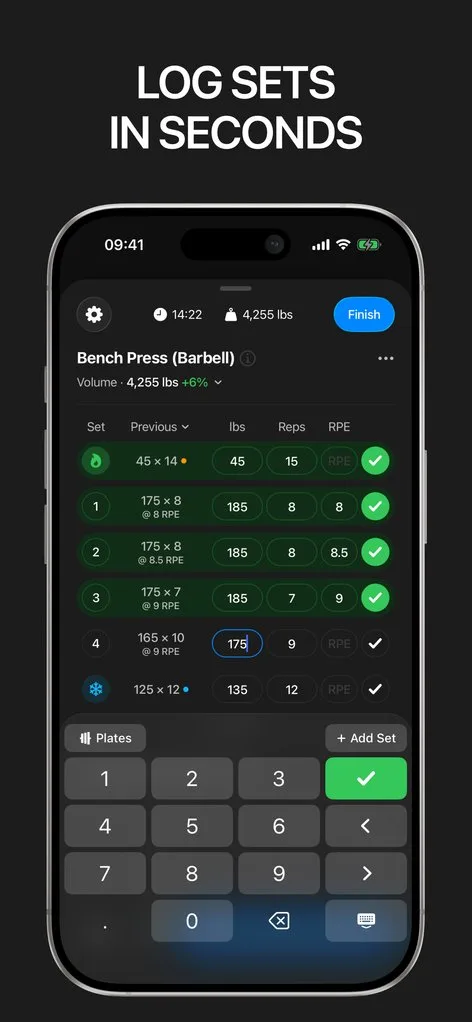
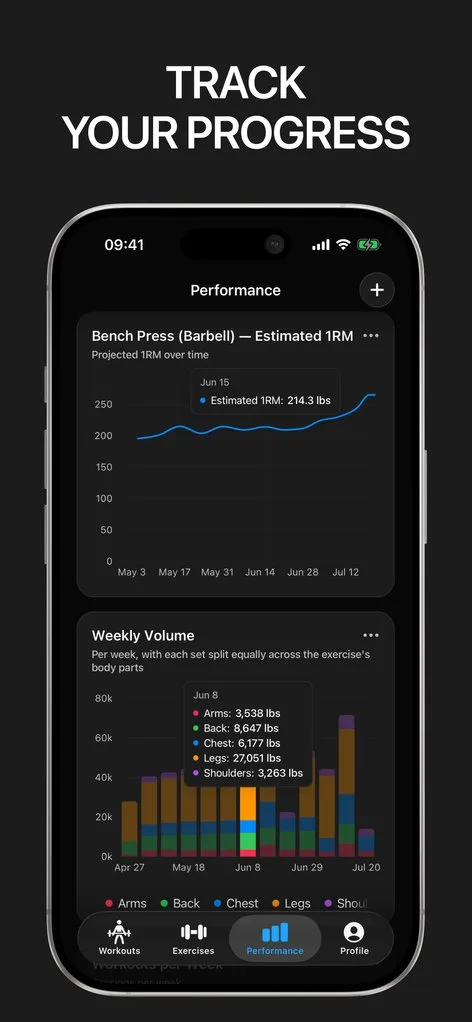
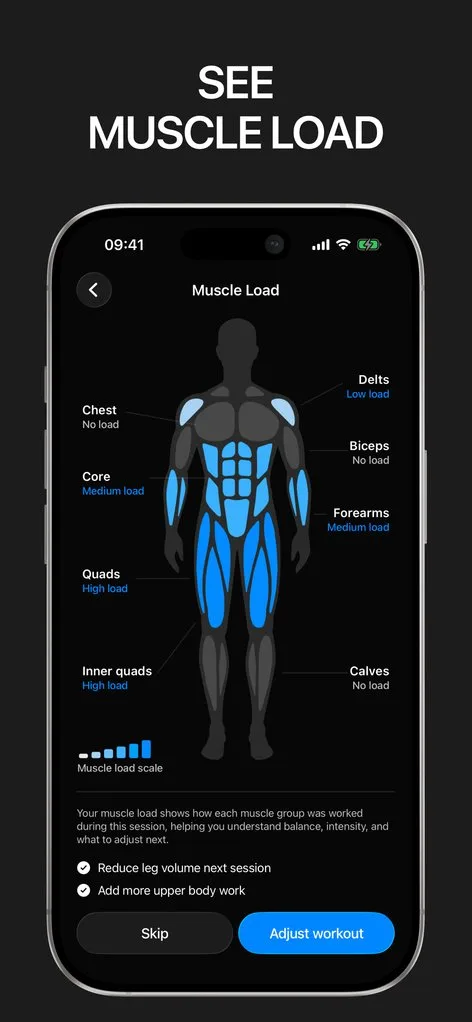
Download Gript free and bring your history with you. If it does not earn its place, your data exports in one tap.
I have tried pretty much every workout tracker out there — Hevy, Strong and many others — and Gript has quickly become my favorite. The UI and overall design are easily the best on the market.
You're already in Gript
Everything on this page is also available inside the app — this article opens from Help, and the calculators live under Tools.
Side by side
| Feature | Fitbod | Gript |
|---|---|---|
| Progress and charts | ||
| Per-exercise charts | Up to 7 metrics | 9 chart types |
| Chart history on the free tier | None (subscription only) | 12 weeks |
| Muscle balance / body map | Yes | Yes |
| Body measurements | Yes | Yes |
| Personal records | Records | Yes |
| Your data | ||
| Import from other apps | No | 22 apps |
| CSV export | Yes | Yes |
| Health sync | Apple Health, Strava, Fitbit | Apple Health, Health Connect |
| Logging | ||
| Unlimited free logging | No | Yes |
| Set types | Warm-up | Warm-up, drop, failure, cool-down |
| RPE / RIR | RIR | RPE and RIR |
| Rest timer | Yes | Yes |
| Lock screen Live Activity | Yes | Yes |
| Previous sets inline | Yes | Yes |
| Plate calculator | Not verified | Yes |
| Home screen widgets | Yes | Coming soon |
| Programs and coaching | ||
| Routines on the free tier | None (trial only) | 3 |
| Program library | None | 6 programs, 24 routines |
| Progression suggestions | Yes | Yes |
| Workout generator | Yes | Yes |
| Human coaching | No | No |
| Exercise library | 1,000+ | 601 |
| Custom exercises | Yes | 10 free |
| Social | ||
| Feed, friends, leaderboards | No | No |
| Platforms | ||
| Apple Watch | Yes | Yes |
| Android | Yes | Yes |
| iPad | No | Yes |
| Web app | No | No |
| Price | ||
| Monthly | $15.99 | $4.99 |
| Yearly | $95.99 | $29.99 |
| Lifetime | No | No |
| Free trial | Yes | Yes |
Facts checked September 8, 2026. US App Store prices; other countries differ. Something wrong? Let us know.