
Fitbod vs Gravl vs Gript: Which Workout Tracker Is Best?
Fitbod and Gravl both write your workout for you. How each builds the session, handles recovery and equipment, prices, Apple Watch, and what to use if you would rather run your own program.
Updated September 8, 2026 · Facts checked September 8, 2026


Comparing Fitbod vs Gravl vs Gript
Fitbod and Gravl are the same kind of app. You tell them your goal, your equipment, and how long you have, and they write the workout, down to a weight for every set. Fitbod generates one session at a time from a per-muscle recovery model; Gravl plans the whole week with a progression engine it documents in detail. Gript is a workout logger with a lighter generator and progression suggestions, not an AI trainer. Here is an honest look at all three, with facts taken from each app’s own help center and App Store listing.
What sets Fitbod vs Gravl vs Gript apart
Fitbod launched in 2015 and has 284,000 US App Store ratings at 4.8. It builds one session at a time from your gym profile and the recovery percentage of each muscle group, with sets, reps, and weights drawn from your history. The reasoning behind a given weight is not shown, and there is no free tier.
Gravl launched in 2023 from an Australian team, with 5,100 US ratings at 4.9. It plans the whole week, recalculates after every session, and opens an Insights sheet explaining every recommended weight. Human coaches in chat are included. The exercise library is a fraction of Fitbod’s, and only 3 workouts are free.
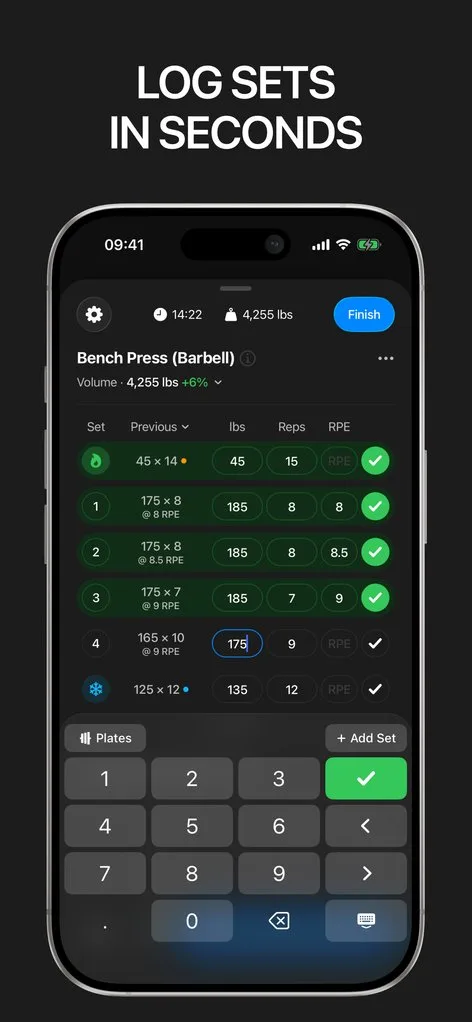
Gript is a logger first: unlimited free logging, routines you build or import, and progression suggestions on any routine with the reason shown. Its generator is lighter than either trainer, with no per-muscle recovery model, and it has no coaching, no social layer, and no web app.
 How Fitbod stands out
If you want the most mature generator and the biggest library, Fitbod provides:
- A per-muscle recovery model. Every muscle group carries a recovery percentage from 0 to 100, shown as a heat map, and workouts from Apple Health, Health Connect, Fitbit, or Strava count toward it.
- The largest exercise library. More than 1,000 exercises with multi-angle video and written cues, including cardio, mobility, and pregnancy-safe categories. Gravl lists 300+. Custom exercises are not programmed by the algorithm.
- Companion watch apps. Apple Watch and Wear OS apps log sets, adjust reps and weight, and run the rest timer, but cannot start or save a workout.
- No free tier. A 7-day trial that requires choosing a plan, then $15.99 a month or $95.99 a year. Subscriptions may be HSA/FSA eligible in the US.
 How Gravl stands out
If you want the whole week planned and the reasoning shown, Gravl provides:
- A weekly plan that recalculates. Nine preset splits, a custom builder, or a recovered-muscles mode, with set counts, rep ranges, supersets, and dropsets yours to predefine.
- Double progression, explained. Rate an exercise Easy, Ideal, or Hard; Hard adds a rep, and when every set hits target the weight moves up one equipment step. Insights shows the 1RM targeted and why.
- Deloads and time off handled. Deload weeks are a split setting kept out of strength calculations, and loads ease about 1 percent a week after two untrained weeks.
- More platforms and a social layer. iPhone, Android, Apple Watch, Wear OS, Garmin, and a web dashboard, plus friends, a feed, and Strength Score rankings. Neither Fitbod nor Gript has social.
- Three free workouts, then Premium. $14.99 a month or $79.99 a year, with other yearly tiers by offer. No documented CSV export; data is reachable through the developer API.
 How Gript stands out
If you would rather run your own program, Gript provides:
- Progression suggestions on any routine. A suggested next weight or rep target per exercise, with the reason shown, applied to the program you already have. See progression suggestions.
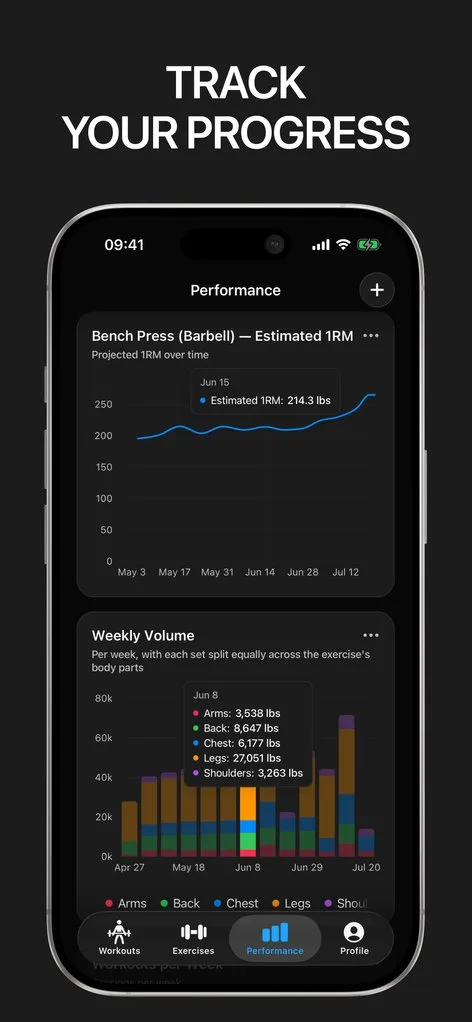
- The most charts of the three. 9 chart types per exercise, including working weight range, plus a training load heatmap, a muscle balance radar, and a body map. Twelve weeks are free; longer ranges are Pro.
- Your Fitbod or Gravl history, imported. Fitbod CSV imports directly with warm-up sets, timed sets, and notes; see import from Fitbod. Gravl has no CSV export, so AI import reads pasted text or screenshots.
- A lighter generator. Three generated workouts are free, then Pro, with no per-muscle recovery model. It is a convenience, not a coach.
- Free unlimited logging. 3 routines, 12 weeks of charts, body measurements, and CSV import and export are free; Pro is $4.99 a month or $29.99 a year. iPhone, iPad, Apple Watch, and Android.
Common questions
Is Gravl free?
Partly. You can log three workouts for free (five in South America), then Gravl asks you to subscribe to Premium at $14.99 a month or $79.99 a year, with other yearly tiers appearing depending on offer. There is no ongoing free tier.
Gravl vs Fitbod: which is better?
Gravl if you want the whole week planned, visible reasoning for every weight, deloads, custom splits, and a lower yearly price. Fitbod if you want the largest exercise library with video, the most mature recovery model, and HSA/FSA eligibility. Both need a few sessions to calibrate.
Can I import my Fitbod history into Gravl or Gript?
Both. Gravl offers to import your Fitbod history if you email support@gravl.ai. Gript reads Fitbod’s CSV export directly: in Fitbod open the Log tab, tap the gear icon, choose Export Workout Data, then import the file in Gript under Profile, Import Workouts; see import from Fitbod.
Final verdict: which one should you choose?
- Choose Fitbod ifFitbod
you want the largest exercise library with video for every movement, a recovery model refined for a decade, or HSA/FSA eligibility, and can live without seeing why each weight is chosen.
- Choose Gravl ifGravl
you want a full week planned, visible reasoning for every weight, deloads and custom splits, coaching in chat, or you train on Android or with a Garmin.
- Choose Gript ifGript
you have a program and want it logged fast with a suggested next weight and deeper charts than either trainer offers.
Gravl and Fitbod do the same job; Gravl exposes more controls and Fitbod has more content, and both need a few sessions to calibrate, so use the whole trial before paying for a year. Gript is for running your own program with suggestions and charts, with Fitbod history carried over by the import guide.
Download Gript free and bring your history with you. If it does not earn its place, your data exports in one tap.
I have tried pretty much every workout tracker out there — Hevy, Strong and many others — and Gript has quickly become my favorite. The UI and overall design are easily the best on the market.
You're already in Gript
Everything on this page is also available inside the app — this article opens from Help, and the calculators live under Tools.
Side by side
| Feature | Fitbod | Gravl | Gript |
|---|---|---|---|
| Progress and charts | |||
| Per-exercise charts | Up to 7 metrics | Estimated 1RM, maxes, Strength Score | 9 chart types |
| Chart history on the free tier | None (subscription only) | None (analytics are Premium) | 12 weeks |
| Muscle balance / body map | Yes | Yes | Yes |
| Body measurements | Yes | Yes | Yes |
| Personal records | Records | Yes | Yes |
| Your data | |||
| Import from other apps | No | Fitbod history via support | 22 apps |
| CSV export | Yes | API only | Yes |
| Health sync | Apple Health, Strava, Fitbit | Apple Health, Strava, Garmin | Apple Health, Health Connect |
| Logging | |||
| Unlimited free logging | No | No | Yes |
| Set types | Warm-up | Warm-up, drop, failure | Warm-up, drop, failure, cool-down |
| RPE / RIR | RIR | RPE | RPE and RIR |
| Rest timer | Yes | Yes | Yes |
| Lock screen Live Activity | Yes | Yes | Yes |
| Previous sets inline | Yes | Yes | Yes |
| Plate calculator | Not verified | Yes | Yes |
| Home screen widgets | Yes | Not verified | Coming soon |
| Programs and coaching | |||
| Routines on the free tier | None (trial only) | None (3 free workouts, then Premium) | 3 |
| Program library | None | 9 preset splits | 6 programs, 24 routines |
| Progression suggestions | Yes | Yes | Yes |
| Workout generator | Yes | Yes | Yes |
| Human coaching | No | Yes | No |
| Exercise library | 1,000+ | 300+ | 601 |
| Custom exercises | Yes | Yes | 10 free |
| Social | |||
| Feed, friends, leaderboards | No | Yes | No |
| Platforms | |||
| Apple Watch | Yes | Yes | Yes |
| Android | Yes | Yes | Yes |
| iPad | No | No | Yes |
| Web app | No | Yes | No |
| Price | |||
| Monthly | $15.99 | $14.99 | $4.99 |
| Yearly | $95.99 | $79.99 | $29.99 |
| Lifetime | No | No | No |
| Free trial | Yes | Yes | Yes |
Facts checked September 8, 2026. US App Store prices; other countries differ. Something wrong? Let us know.