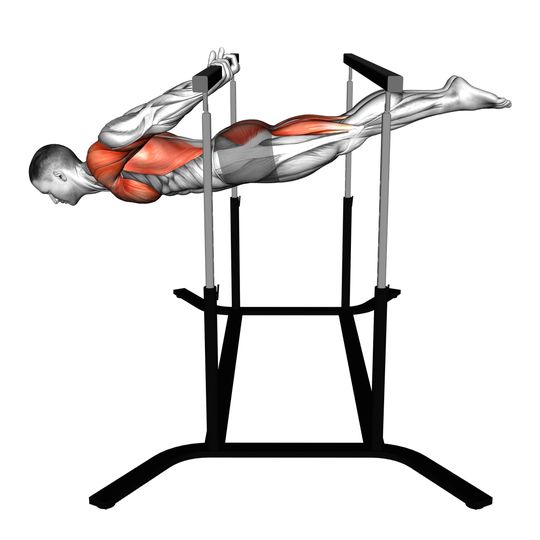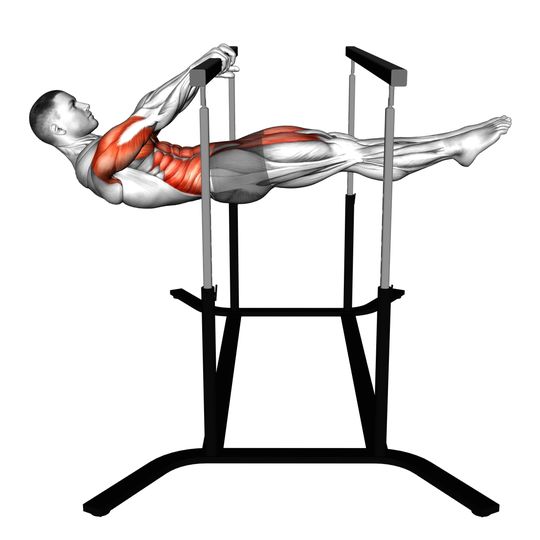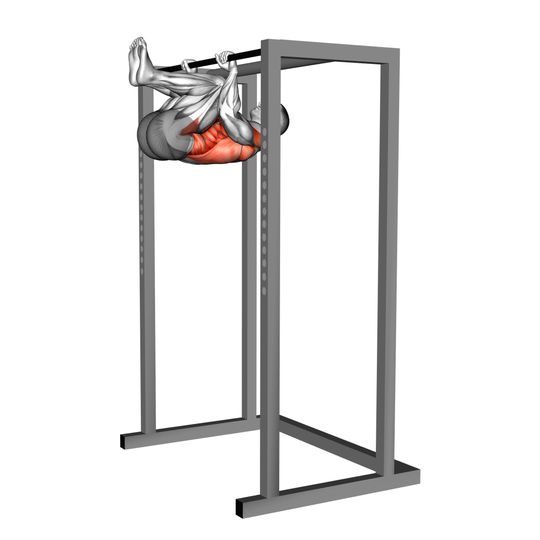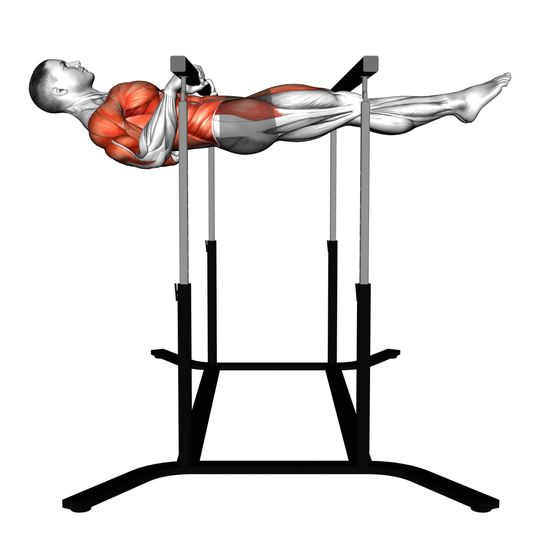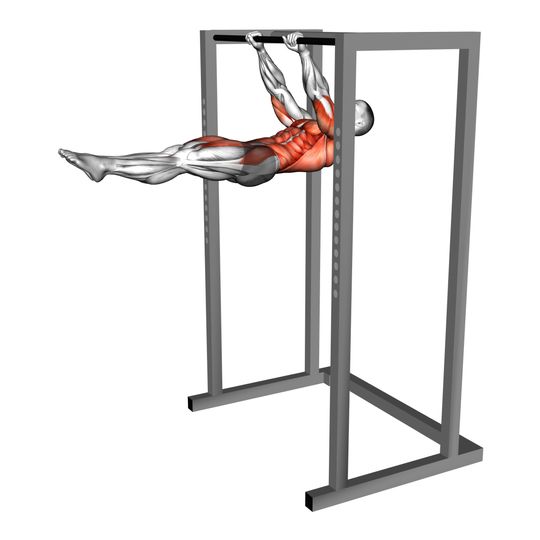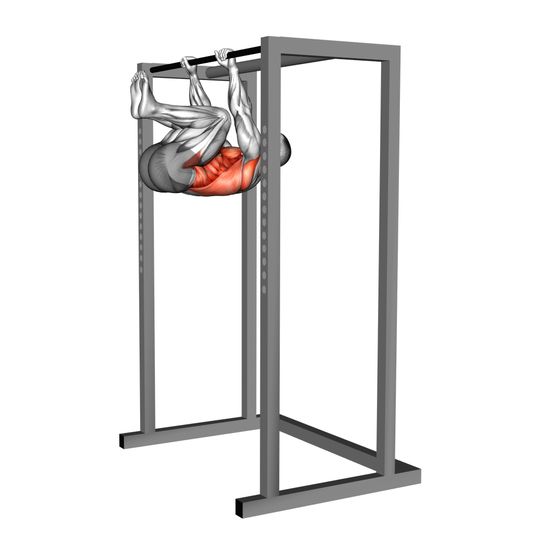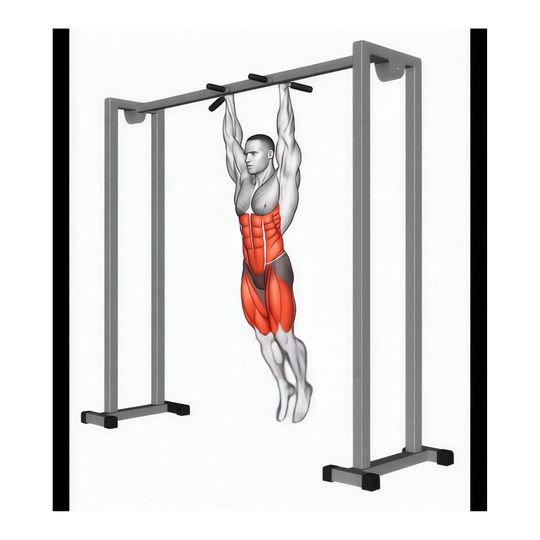


Hang from an overhead bar and lift your straight legs up by flexing the hips and contracting the abdominals. The movement primarily works the abdominal muscles.
How to do the Hanging Leg Raise#
- Reach up and grasp an overhead bar and let your arms extend with your legs hanging straight together.
- Brace your core and keep your torso stable before initiating the lift.
- Raise your legs in a controlled motion until they are roughly level with your torso (about 90°).
- Pause briefly with your abs engaged, then lower your legs slowly back to the hanging start and repeat.
Muscles worked#
Hanging leg raises are an abs exercise only if you make them one. Lifting straight legs from a dead hang is done mainly by the hip flexors, the iliopsoas and rectus femoris, up to the point where the thighs are horizontal. The rectus abdominis comes in when you continue past that point and curl the pelvis up toward the ribs. The abs also work hard throughout as a brake, stopping the lower back from arching under the weight of the legs.
The obliques resist any side-to-side swing and help with the pelvic curl at the top. The forearms and grip hold you on the bar, and the lats and lower traps keep the shoulders packed so the body does not swing like a pendulum. Anyone who quits a set because their hands gave out before their abs did has found the exercise's real bottleneck.
- Primary: Abs (Rectus Abdominis), Hip flexors (Iliopsoas (Hip Flexors))
- Secondary: Forearms (Forearm Flexors & Extensors (incl. Brachioradialis)), Lats (Latissimus Dorsi), Obliques (External & Internal Obliques)
Common mistakes#
- Swinging the body to gain momentum instead of using the abs.
- Bending the knees partway through the movement.
- Letting the lower back arch during the lift.
- Dropping the legs quickly on the descent instead of controlling the lowering.
Why it works#
The hanging leg raise trains the abs to flex the spine against a heavy lever, which is something crunches and planks never do. The weight of two straight legs is a lot of resistance, and the movement is easy to make harder for years: straighten the legs, slow the descent, bring the toes to the bar or add ankle weights. That progression potential is what makes it a serious abs exercise rather than a warm-up.
It also builds grip, shoulder stability and the ability to control the pelvis, which carries over to squats, deadlifts and overhead pressing. Because you hang from a bar, the spine is unloaded rather than compressed, so lifters with a sensitive lower back often tolerate it better than loaded sit-ups.
Sets, reps and setup#
Three to four sets of 8-15 reps with 60-90 seconds of rest, two or three times a week. Slow reps beat many reps; a three-second lowering phase on 8 reps trains the abs harder than 20 fast swings.
- Setup
- Hang from a pull-up bar with a shoulder-width grip, pull the shoulders down away from the ears and let the legs hang together. Tuck the pelvis first, then raise straight legs until they are at least horizontal, and if you can, keep curling until the hips come up toward the ribs. Lower slowly and stop the swing before the next rep.
- Progression
- Start with hanging knee raises, then straight legs to horizontal, then legs above horizontal with the pelvis tucked, then toes to bar. When bodyweight straight-leg raises are easy for 15 clean reps, add a light dumbbell between the feet or ankle weights rather than adding more reps.
Variations#
- Hanging Knee Raise Bent knees shorten the lever, the right starting point for anyone who swings or arches.
- Captain's Chair Knee Raise Elbows on pads take grip out of the equation so the abs can be the limiting factor.
- Toes To Bar Full range to the bar, which demands the pelvic curl that actually trains the abs.
- Lying Leg Raise The floor version, with the lower back supported and no grip involved.
- Hanging Windshield Wiper Legs held high and swept side to side, an oblique-dominant progression.
Hanging leg raise vs hanging knee raise#
The knee raise bends the legs, which shortens the lever and makes the movement two to three times easier. That is exactly why it is the right place to start: most people cannot control straight legs without swinging or arching the lower back, and a swinging leg raise trains nothing but the hip flexors.
The straight-leg raise is the harder and better exercise once you own the knee raise for 15 clean reps. It loads the abs against a longer lever and gives you more room to progress. Move up when the knee raise feels controlled at the bottom, not just possible at the top.
Common questions#
What muscles do hanging leg raises work?
The hip flexors lift the legs to horizontal, and the abs take over when you curl the pelvis up past that point while resisting lower back arch throughout. The obliques control side-to-side swing, and the forearms, lats and shoulders hold you steady on the bar.
Are hanging leg raises good for abs?
Yes, provided you curl the pelvis toward the ribs at the top and lower under control. Raising straight legs only to horizontal is mostly a hip flexor exercise; the abs come in with the pelvic tuck. Done that way it is one of the hardest abs movements available with bodyweight.
Why do I feel hanging leg raises in my hip flexors and not my abs?
Because the hip flexors are what lift straight legs to horizontal. Tuck the pelvis before you start, keep tucking as the legs rise, and bring the hips up toward the ribs at the top. If that is not possible yet, switch to knee raises and work on the tuck first.
How do I stop swinging during hanging leg raises?
Pull the shoulders down and slightly forward so the body forms a shallow hollow, lower the legs slowly rather than dropping them, and pause at the bottom until you are still. Swinging usually means the reps are too fast or the load is too high for your current control.
How many hanging leg raises should I do?
Three to four sets of 8-15 controlled reps, two or three times a week. When 15 slow reps is easy, make the exercise harder with straighter legs, a longer descent or ankle weights instead of adding more reps.