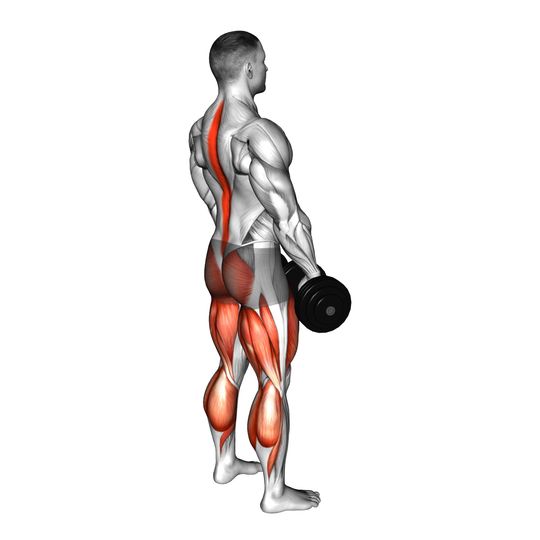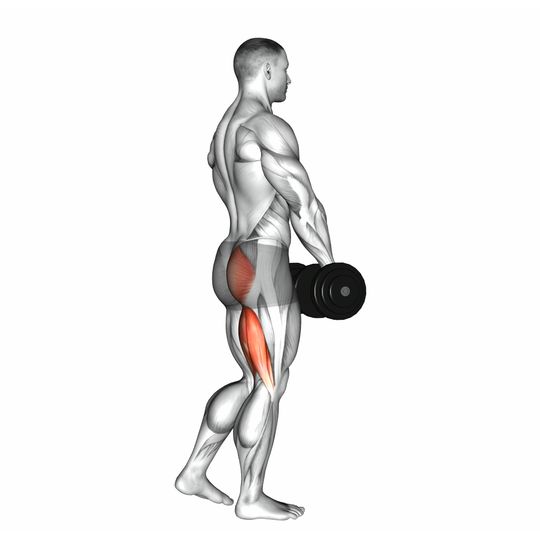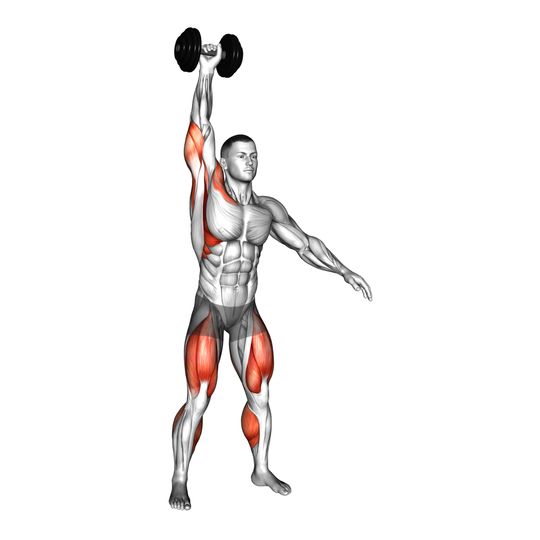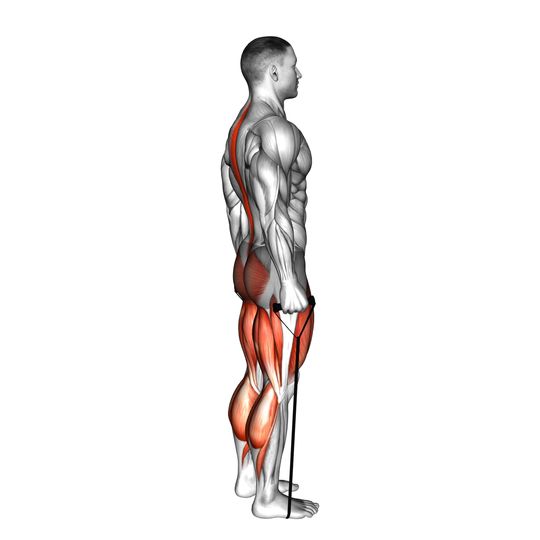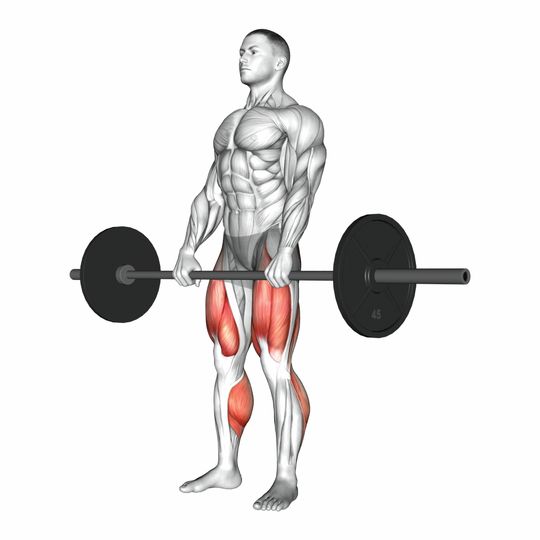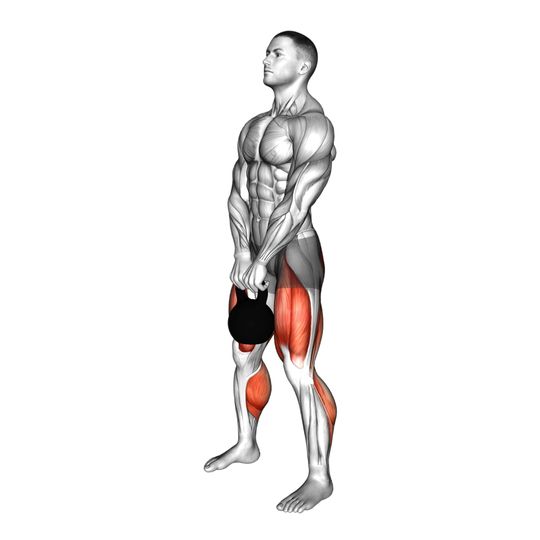


Perform a hip-hinge with dumbbells, lowering the weight along the front of your legs to load the hamstrings and glutes.
How to do the Dumbbell Romanian Deadlift#
- Stand feet about hip-width and hold a dumbbell in each hand in front of your thighs with a neutral grip.
- Slightly bend your knees, brace your core, and keep a flat spine and neutral head position.
- Push your hips back to hinge, sliding the dumbbells down the front of your legs until you feel a hamstring stretch.
- Drive your hips forward to return to standing and squeeze the glutes at the top without overarching the lower back.
- Continue for the planned reps while preserving the hinge pattern and spinal neutrality.
Muscles worked#
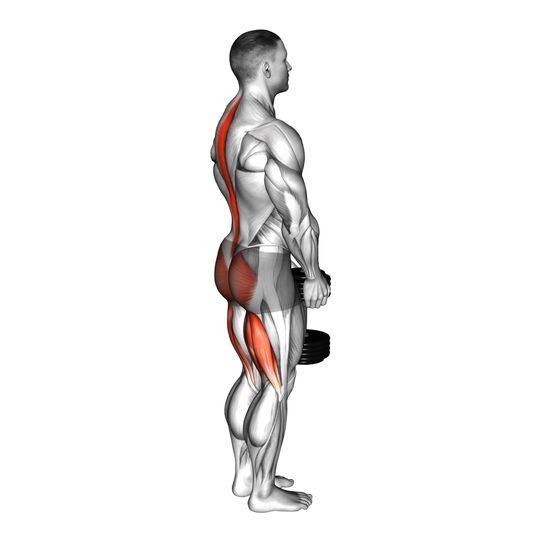
The dumbbell Romanian deadlift is a hamstring and glute exercise built around a hip hinge. With the knees held nearly straight, pushing the hips back stretches the hamstrings (biceps femoris, semitendinosus, semimembranosus) under load, and they are what stop you from folding over. The glutes finish every rep by driving the hips forward to standing, and because the muscles lengthen while working, this is one of the best exercises for both hamstring size and hamstring health.
The lower back works isometrically to hold a neutral spine while the weight travels down the legs, and the upper back and traps keep the shoulders from rounding forward. Grip and forearms carry the dumbbells for the whole set, which becomes the limiting factor once the weights get heavy. You should feel a deep stretch in the back of the thighs, not a pump in the lower back.
- Primary: Hamstrings (Biceps Femoris, Semitendinosus & Semimembranosus), Glutes (Gluteus Maximus)
- Secondary: Lower back (Erector Spinae), Forearms (Forearm Flexors & Extensors (incl. Brachioradialis)), Traps (Trapezius)
Common mistakes#
- Rounding the lower back on the descent.
- Bending the knees excessively so the lift turns into a squat.
- Shifting weight onto the toes instead of keeping pressure through the heels.
- Lowering beyond the point of hamstring tension and losing form.
Why it works#
Dumbbells make the Romanian deadlift more forgiving than a barbell. The weights can hang at your sides or in front of the thighs, which lets you keep them close to the body, and each hand works independently, so you notice if one hip is doing more than the other. Most people learn to feel the hinge faster this way than with a bar.
It also loads the hamstrings where they are weakest, in the stretched position, which is where most hamstring injuries happen in sport. Runners, field athletes, and anyone with a history of pulling a hamstring benefit from two or three months of steady RDL work, and lifters get a glute and hamstring builder that does not fry the lower back the way heavy conventional deadlifts can.
Sets, reps and setup#
Three or four sets of 8-12 reps with 90 seconds to two minutes of rest, once or twice a week. Use a three-second lowering phase; the stretch on the way down is where most of the stimulus comes from. Loads are limited by grip more than by the hamstrings, so straps are worth using for the heavier sets.
- Setup
- Stand tall with a dumbbell in each hand against the front of the thighs and a soft bend in the knees. Push the hips straight back, letting the dumbbells slide down the legs, and keep the chest up and the weights close. Stop when the hamstrings are fully stretched, usually just below the knee, then drive the hips forward to stand.
- Progression
- Add weight in 2 kg steps per hand while you can still feel the stretch and keep a flat back. When the dumbbells at your gym run out, slow the eccentric to four seconds, add a pause at the bottom, or move to a single-leg version. Do not chase depth by rounding the back; the stretch decides the range, not the floor.
Variations#
- Barbell Romanian Deadlift The barbell version allows heavier loads and keeps the weight in a fixed path in front of the body.
- Dumbbell Single Leg Romanian Deadlift One leg at a time, which adds a balance demand and exposes side-to-side strength differences.
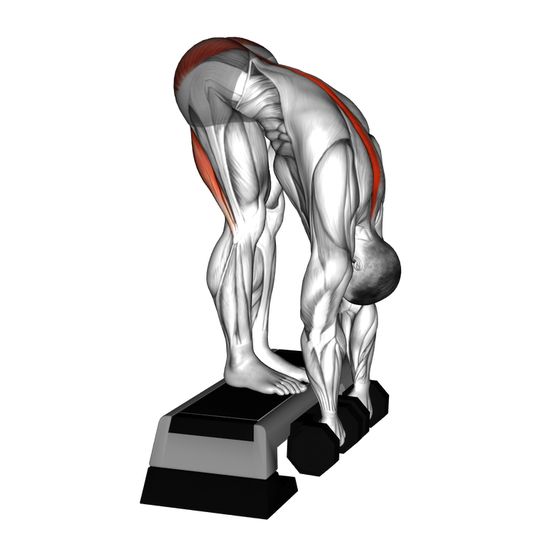
- Dumbbell Stiff Leg Deadlift Straighter knees and a longer range toward the floor, putting even more stretch on the hamstrings.
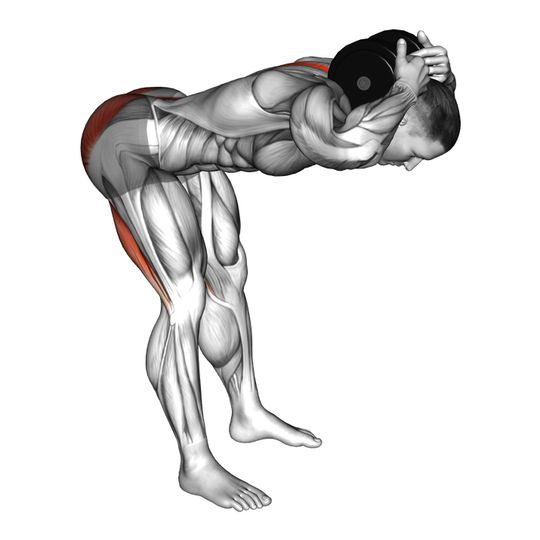
- Dumbbell Good Morning The load is held on the shoulders instead of in the hands, which shifts the challenge to the spinal erectors.
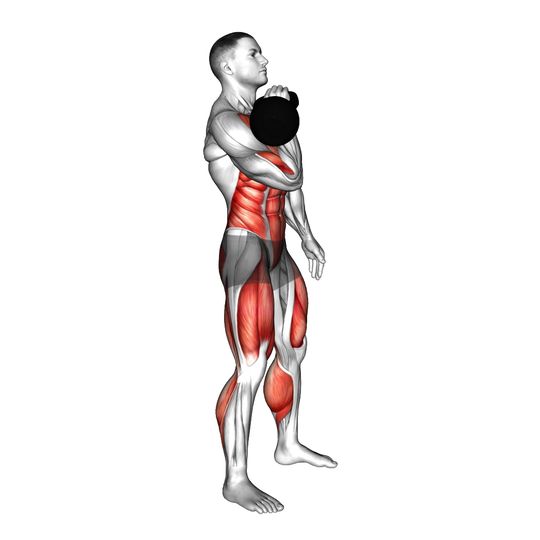
- Kettlebell Romanian Deadlift A single kettlebell held between the legs keeps the weight centred and works well for beginners learning the hinge.
Dumbbell Romanian deadlift vs barbell Romanian deadlift#
The barbell version lets you load heavier, which matters once your hamstrings can handle more than the dumbbell rack offers. The bar also gives a consistent path down the thighs and is easier to hold with a hook grip or straps. If your goal is a strong posterior chain and heavy pulling, the barbell is the long-term home for the RDL.
The dumbbell version is easier to learn, easier to keep close to the body, and kinder to anyone whose shoulders or lower back dislike the bar. It also makes single-arm and single-leg variations possible. Beginners should start with dumbbells and move to the bar when grip or available weight becomes the limit.
Common questions#
What muscles does the dumbbell Romanian deadlift work?
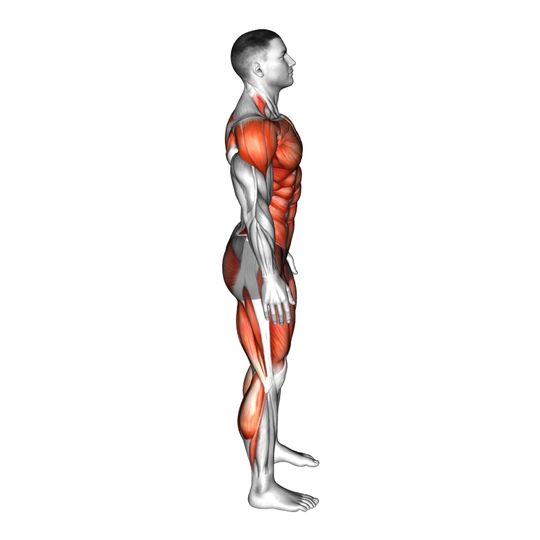
The hamstrings and glutes are the main targets, with the spinal erectors of the lower back holding a neutral spine and the upper back, traps, and forearms keeping the dumbbells in position. It is a posterior chain exercise from the calves to the traps.
How low should I go on a Romanian deadlift?
Lower until the hamstrings are fully stretched and the hips cannot move any further back without the lower back rounding. For most people that is somewhere between just below the knee and mid-shin. The floor is not the target.
Should Romanian deadlifts hurt my lower back?
No. Some fatigue in the erectors is normal because they hold position, but pain or a pump that outlasts the hamstring stretch means you are hinging too low, rounding, or using too much weight. Shorten the range and lighten the load until the hamstrings are what you feel.
Are dumbbell Romanian deadlifts good for glutes?
Yes. The glutes work hardest in the top half of the rep as the hips drive forward, so finish every rep by standing fully tall and squeezing rather than stopping short. Pairing RDLs with hip thrusts covers the glutes through the whole range.
How heavy should dumbbell Romanian deadlifts be?
Heavy enough that 8-12 reps with a three-second lowering phase is genuinely hard, which for many intermediate lifters is 20-35 kg per hand. If grip fails before the hamstrings, use straps rather than lightening the load.