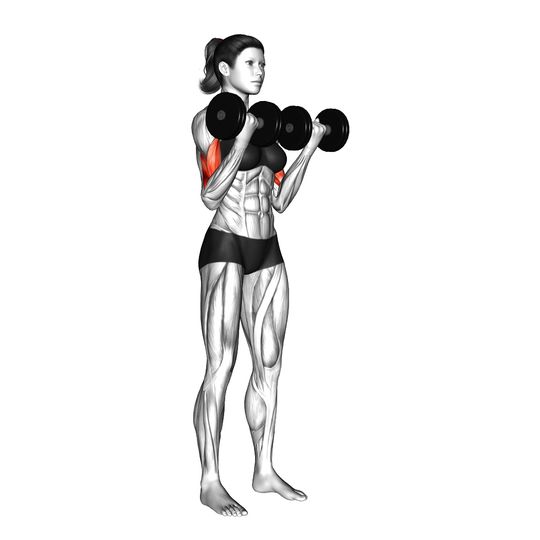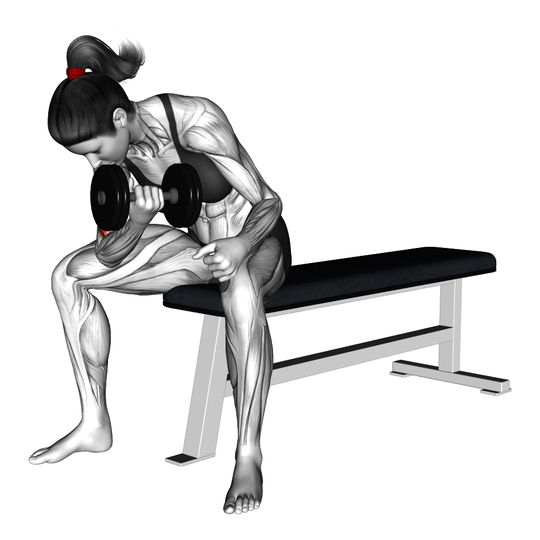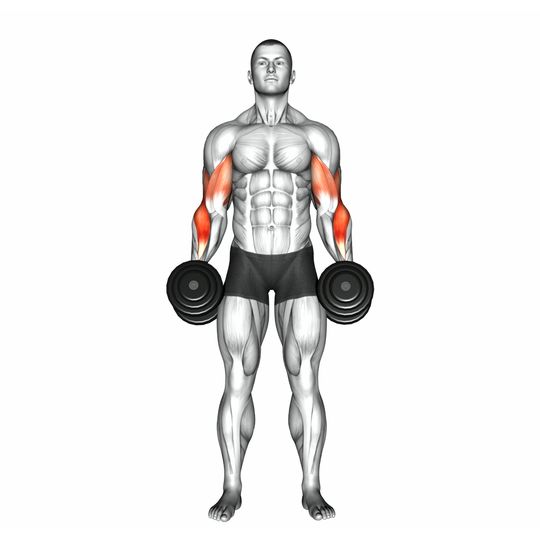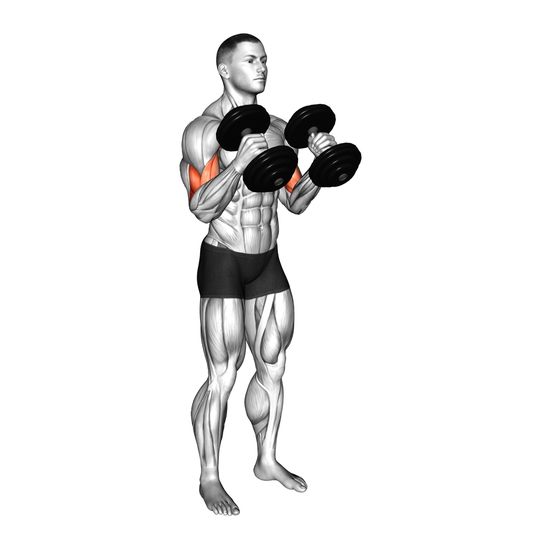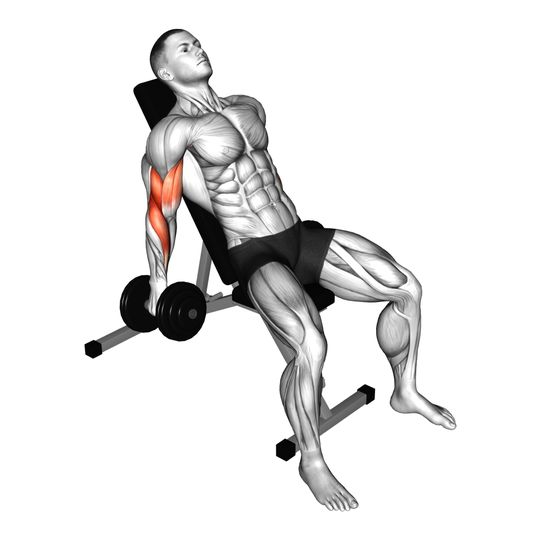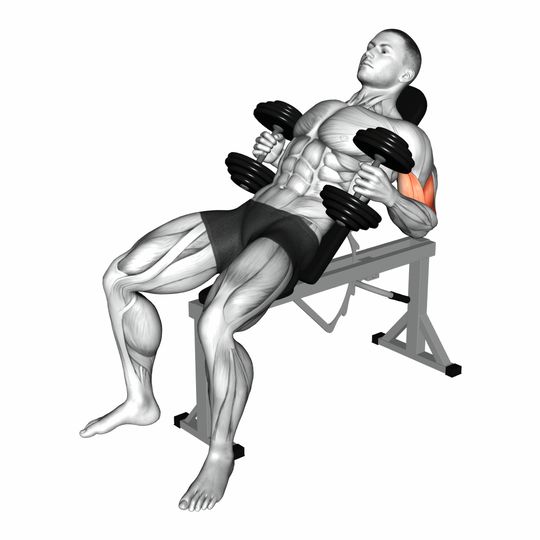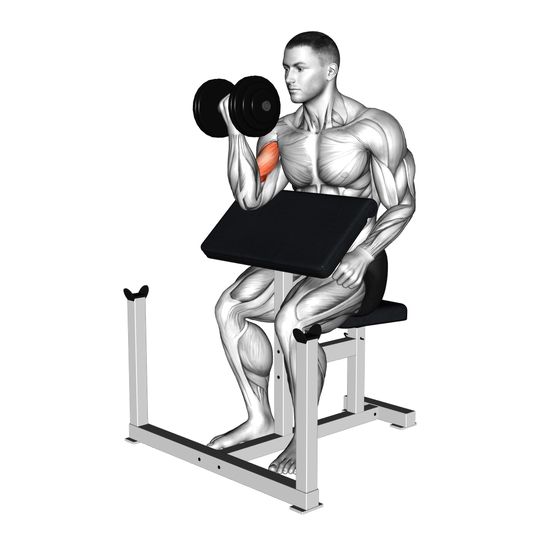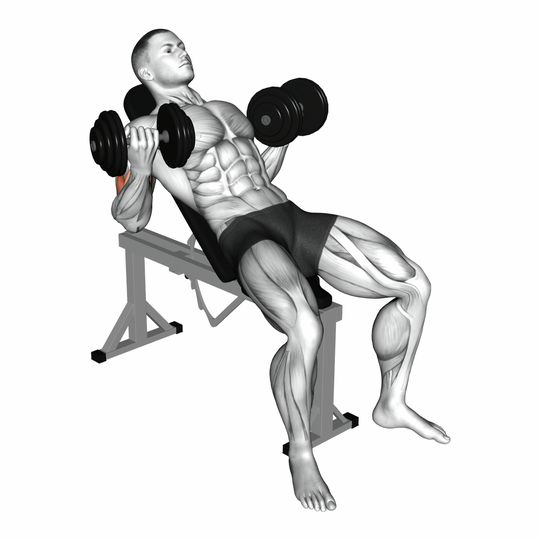


A dumbbell curl variation where you lift with a palms-up grip and rotate to a palms-down position for the descent, working the biceps on the concentric phase and the forearms on the eccentric.
How to do the Zottman Curl#
- Stand tall with a dumbbell in each hand, palms facing up and elbows tucked beside your ribs.
- Keep your upper arms still and curl the dumbbells toward your shoulders until your forearms are vertical.
- Rotate your wrists at the top so your palms face down, then lower the weights slowly with control.
- At the bottom, turn your wrists back to the palms-up start position and repeat.
Muscles worked#
The Zottman curl works the biceps on the way up and the forearms on the way down. With the palms up, the biceps brachii is in its strongest position and does the lifting, helped by the brachialis underneath it. Rotating to palms down at the top shifts the lowering phase onto the brachioradialis, the thick muscle on the thumb side of the forearm, and the wrist extensors, which control a weight they could never curl on their own.
The brachialis works through both halves regardless of grip, which is why Zottman curls thicken the upper arm rather than just peaking the biceps. The wrist flexors and grip hold on through the whole rep. Expect the forearms to burn more than the biceps, especially on the pronated lowering, and expect the elbows to feel it if you go too heavy too soon.
Common mistakes#
- Using torso swing or hip drive to help lift the weights.
- Letting the elbows travel forward away from the sides.
- Rotating the wrists during the upward phase instead of at the top.
- Dropping the weights quickly on the pronated descent.
Why it works#
The Zottman curl is the most efficient way to train biceps and forearms in one movement. The biceps are strongest curling palms up and the forearm extensors are strongest lowering palms down, so each half of the rep lands on the muscle that can handle it. That means heavier weights than a reverse curl and more forearm work than a standard curl, without a second exercise.
The slow pronated lowering also builds elbow and wrist resilience. Lifters with elbow pain from heavy pulling often tolerate Zottman curls better than straight bar curls because the wrists move freely and the descent is controlled. It suits anyone who trains grip-heavy sports or wants forearms that match their upper arms.
Sets, reps and setup#
Three sets of 8-12 reps with 60-90 seconds of rest, once or twice a week at the end of an arm or pull session. Use a three to four second lowering phase; the eccentric is the point. Choose the weight by what you can lower under control palms down, not what you can curl palms up.
- Setup
- Stand or sit with the dumbbells at your sides, elbows pinned to the ribs. Curl palms up and turn the wrists over only once the forearms are vertical at the top. Lower slowly with the knuckles facing the ceiling, rotate back to palms up at the bottom, and start the next rep without swinging.
- Progression
- Add reps to twelve before adding weight, in the smallest increment available. If you cannot control the pronated lowering for three seconds, the weight is too heavy for the forearms even if the biceps can lift it. Alternating arms or sitting on an incline bench both make the movement stricter.
Variations#
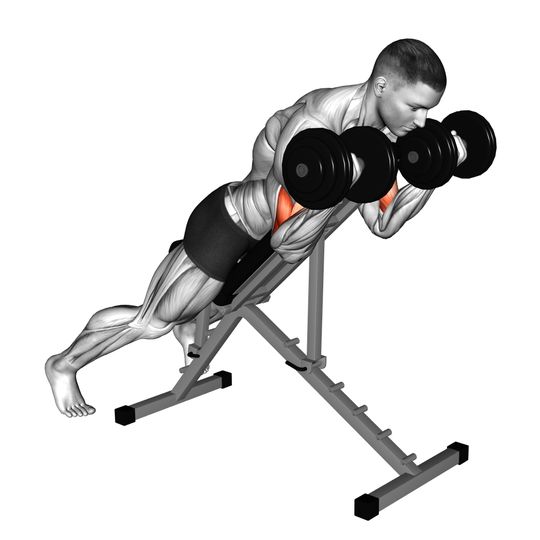
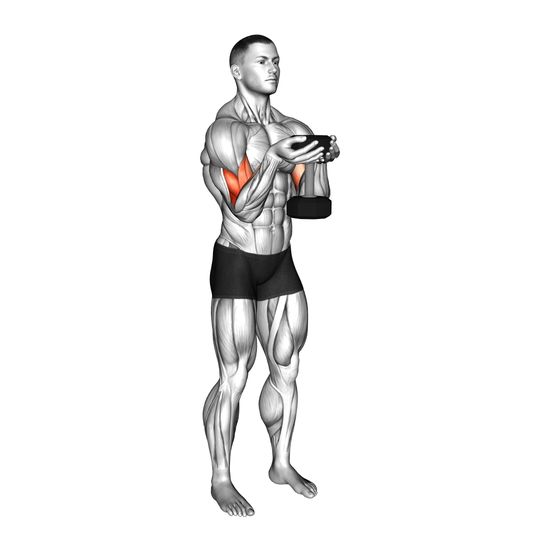
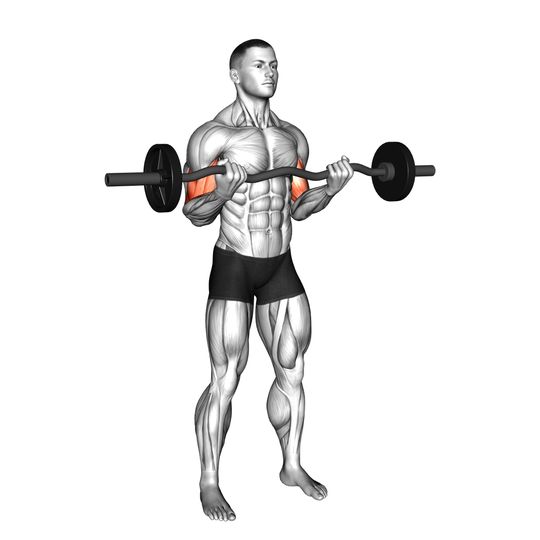
- Dumbbell Hammer Curl Neutral grip throughout, loading the brachialis and brachioradialis without the pronated eccentric.
- Dumbbell Reverse Curl Palms down for the whole rep, so lighter loads and forearm work on the way up too.
- Dumbbell Curl The standard supinated curl, more weight on the biceps with no forearm emphasis.
- Cross Body Hammer Curl Curls across the chest, hitting the brachialis and long head of the biceps harder.
Zottman curl vs hammer curl#
The hammer curl keeps the hands neutral from start to finish. It is easy to load, kind to the elbows, and hits the brachialis and brachioradialis well, but the forearm extensors never get a hard lowering phase and the biceps are never fully supinated. It is the simpler exercise and the better one if you just want heavy arm volume.
The Zottman curl asks for less weight and more attention, and in exchange trains the biceps in their strongest position and the forearms in theirs. If your forearms lag or your grip fails on pulls, the Zottman curl is the better use of three sets. If your arms are the limit and you want the most total load, hammer curls win.
Common questions#
What muscles does the Zottman curl work?
The biceps and brachialis lift the weight palms up, and the brachioradialis and wrist extensors of the forearm control the lowering palms down. The grip muscles work throughout.
Is the Zottman curl good for forearms?
It is one of the best curls for forearms because the pronated lowering loads the brachioradialis and extensors with a weight you could not reverse curl. Keep the eccentric slow and the forearms will grow.
How heavy should Zottman curls be?
Lighter than a normal curl, usually 60-75 percent of your dumbbell curl weight. If you cannot lower for three seconds palms down, it is too heavy to do its job.
Can Zottman curls help with elbow pain?
Often, yes. The controlled pronated eccentric strengthens the forearm extensors commonly involved in outer elbow pain, and the free wrist rotation is easier on the joint than a straight bar. Start light and stop if pain increases during the set.