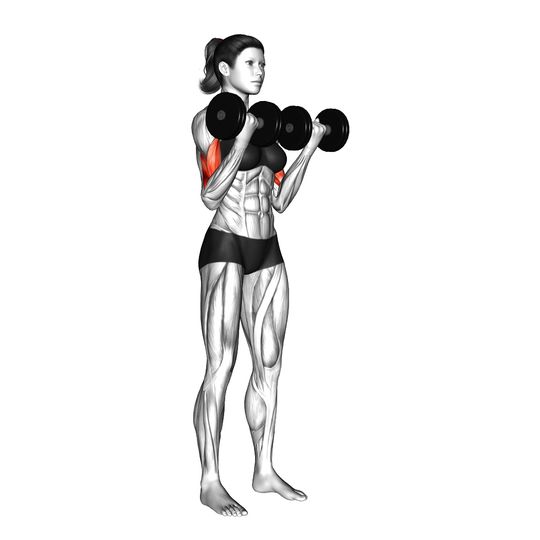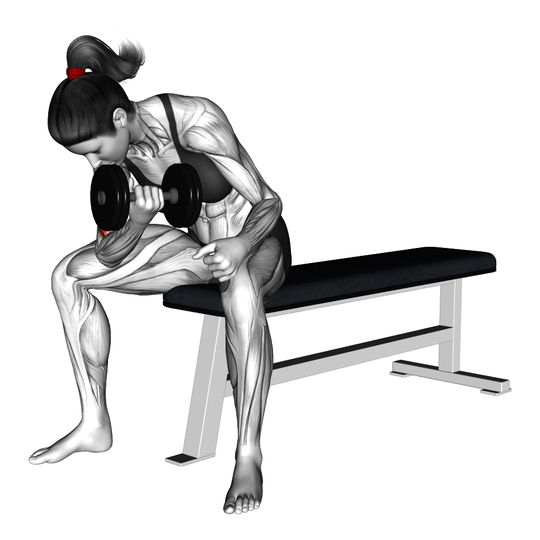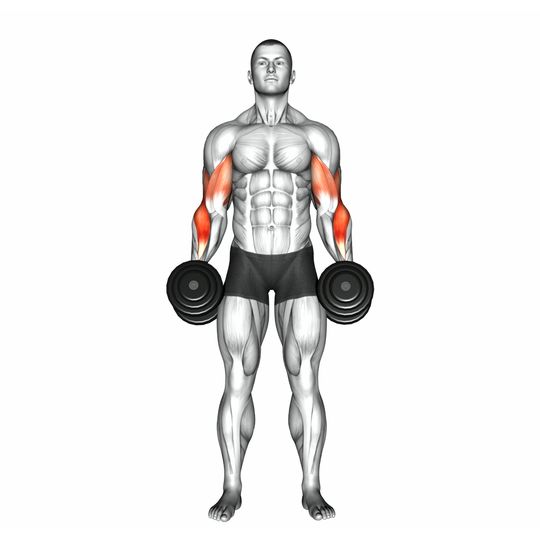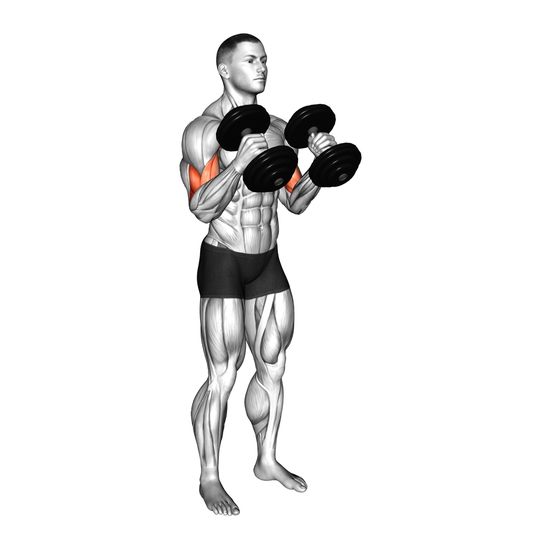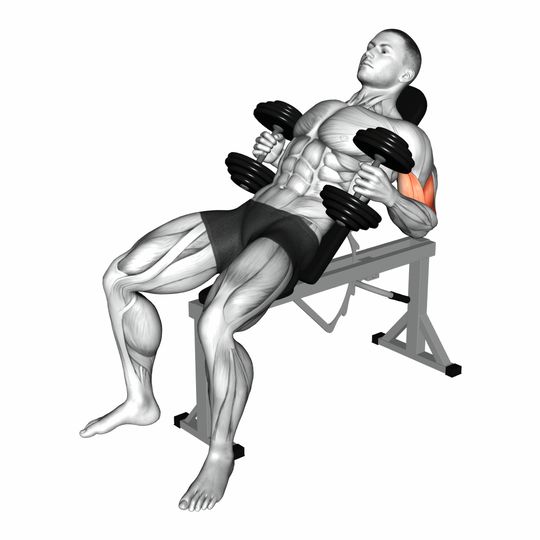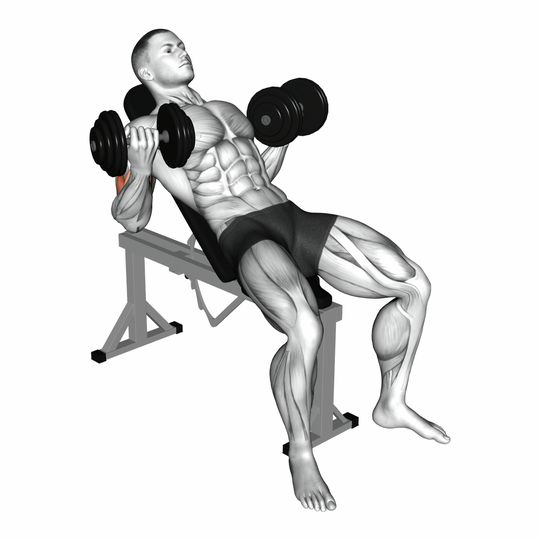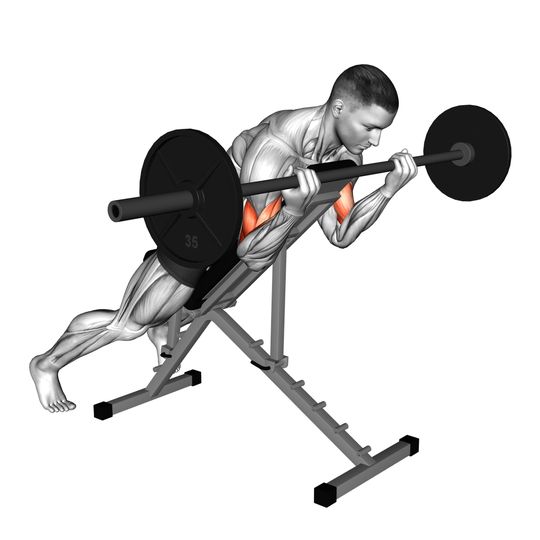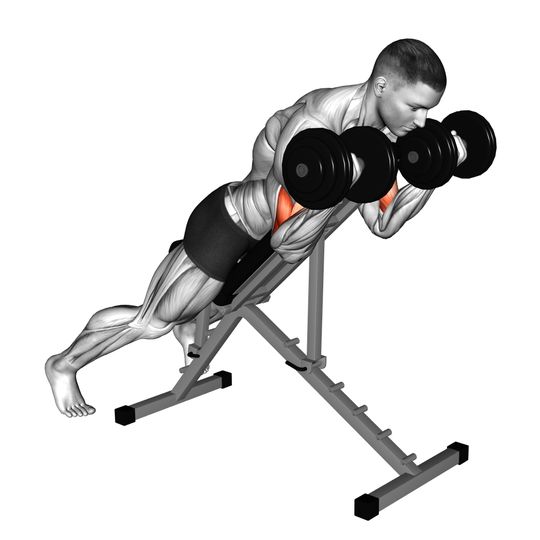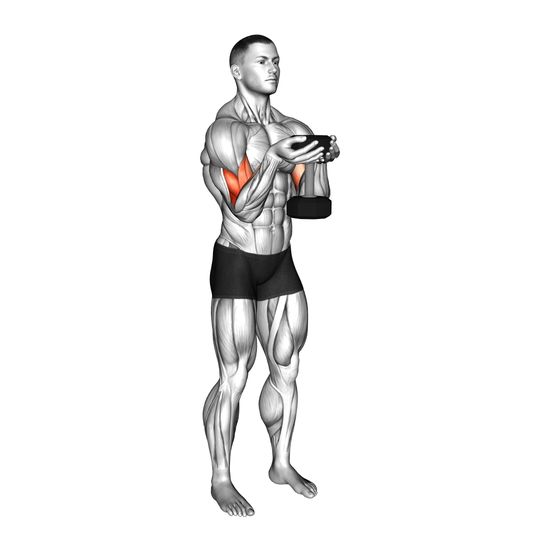


Lie back on an incline bench and perform elbow flexion with dumbbells to work the biceps in the upper arms. The movement emphasizes controlled curling and a focused peak contraction.
How to do the Incline Dumbbell Curl#
- Set the bench to about a 45° incline and lie back with a dumbbell in each hand.
- Let your arms hang down with elbows kept close to your torso and palms facing forward.
- Keep the upper arm still and curl one dumbbell at a time or both together toward the shoulder by bending only at the elbow.
- Pause and squeeze the biceps at the top, then lower the weight slowly until your arm is extended and repeat for reps.
Muscles worked#
The incline dumbbell curl is a biceps exercise that targets the long head more than any other curl. Lying back on the bench puts the upper arm behind the torso, which stretches the long head of the biceps (biceps brachii) at the bottom of every rep and forces it to work from a lengthened position. That stretched start is why the movement feels so much harder than a standing curl with the same weight, and why it is so effective for building the peak of the biceps.
The brachialis under the biceps and the brachioradialis in the forearm assist with elbow flexion, and the forearm flexors hold the wrist neutral against the dumbbell. Because your back is supported, almost nothing else is involved, which is the point: there is no hip drive, no lean, and no way to cheat the weight up once the biceps are tired.
Common mistakes#
- Using torso momentum to lift the weights.
- Letting the elbows drift away from the torso.
- Bending or flicking the wrists during the curl.
- Lowering the weights too quickly instead of controlling the descent.
Why it works#
Most curls train the biceps in the shortened half of their range. The incline curl is one of the few that loads them fully stretched, and training a muscle at long lengths is one of the more reliable ways to grow it. Lifters who have plateaued on standing curls often see new biceps growth from simply adding incline curls at the end of arm day.
It is also honest. The bench removes the body english that makes heavy barbell curls look impressive but do little for the biceps, and it forces a full range because you cannot shorten the bottom by leaning forward. The trade-off is lighter weights, which is exactly what you want from an isolation exercise done for volume.
Sets, reps and setup#
Three sets of 8-12 reps with 60-90 seconds of rest, once or twice a week. Lower each rep over about three seconds and let the arm straighten fully at the bottom. Expect to use about 60-70 percent of what you would curl standing.
- Setup
- Set the bench between 45 and 60 degrees, sit back with the head and shoulders on the pad, and let the arms hang straight down with the palms forward. Curl both dumbbells together without letting the elbows drift forward, squeeze at the top, and lower slowly until the arms are straight and you feel the stretch.
- Progression
- Add reps toward twelve, then move up 1-2 kg per dumbbell. If the elbows keep creeping forward as you fatigue, the weight is too heavy. Lowering the bench angle toward 45 degrees increases the stretch and makes the exercise harder without adding weight.
Variations#
- Dumbbell Curl Standing with the arms at your sides, the standard version that allows heavier loads but less stretch.
- Incline Dumbbell Hammer Curl The same stretched position with a neutral grip, shifting work toward the brachialis and forearms.
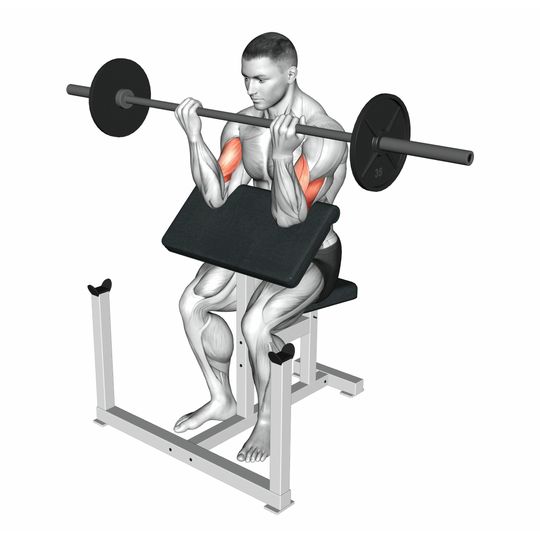
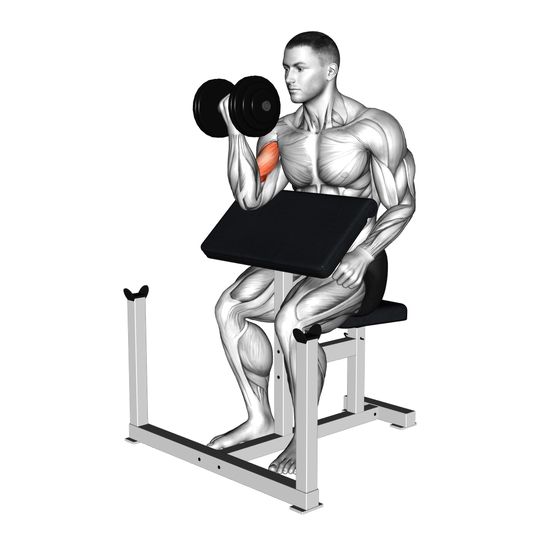
- Dumbbell Preacher Curl The upper arm in front of the body on a pad, which loads the biceps hardest in the shortened position.
- Bayesian Curl A cable curl with the arm behind the body, giving a similar long-head stretch with constant tension.
- Dumbbell Concentration Curl Seated with the elbow braced against the thigh, a strict single-arm curl that isolates the peak contraction.
Incline dumbbell curl vs preacher curl#
The two are mirror images. The incline curl puts the upper arm behind the body, so the biceps are hardest to contract at the bottom, in the stretched position, and easiest at the top. The preacher curl puts the upper arm in front, which makes the top of the rep the hardest part and the stretched bottom relatively easy.
For overall biceps growth, the incline curl has the edge because loading the stretched position tends to produce more growth per set. The preacher curl is the better choice for a strict peak contraction and for lifters with shoulder issues who find the arms-back position uncomfortable. Running one of each in the same week covers the full range.
Common questions#
What muscles does the incline dumbbell curl work?
The biceps, with particular emphasis on the long head that forms the outer peak of the upper arm. The brachialis and brachioradialis assist, and the forearm flexors hold the wrist steady.
What angle should the bench be for incline curls?
Between 45 and 60 degrees. Lower angles stretch the biceps more and make the exercise harder; anything flatter than 45 degrees puts a lot of strain on the front of the shoulder for little extra benefit.
Why are incline curls so much harder than regular curls?
Because the biceps start each rep in a stretched position where they are mechanically weaker, and the bench stops you from leaning or swinging to help. Using 30-40 percent less weight than your standing curl is normal.
Should I curl both arms at once or alternate?
Both together keeps the set short and the tension even. Alternating lets you focus on one arm and is fine if you keep the resting arm fully straight rather than holding it half-curled.
Are incline curls good for the biceps peak?
They are one of the best options because the long head, which contributes most to the visible peak, is the part of the biceps that gets stretched and loaded hardest in this position. Genetics decide the shape, but incline curls grow the muscle that makes it.