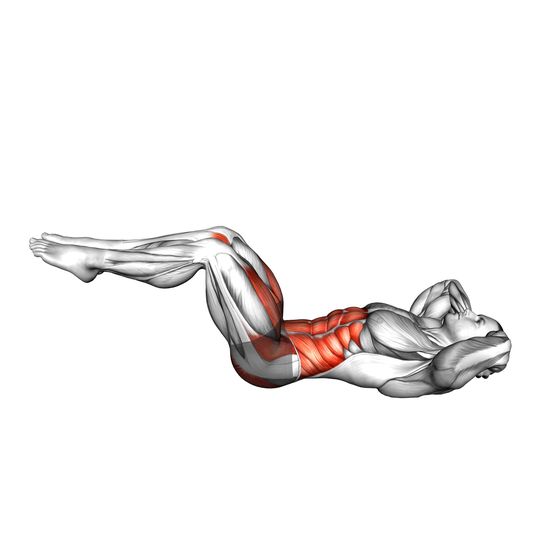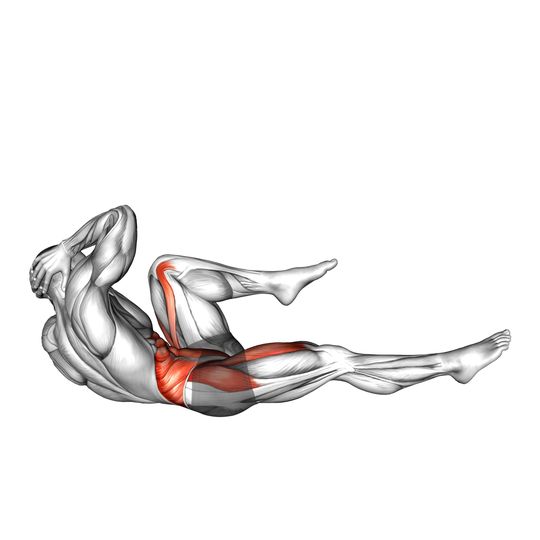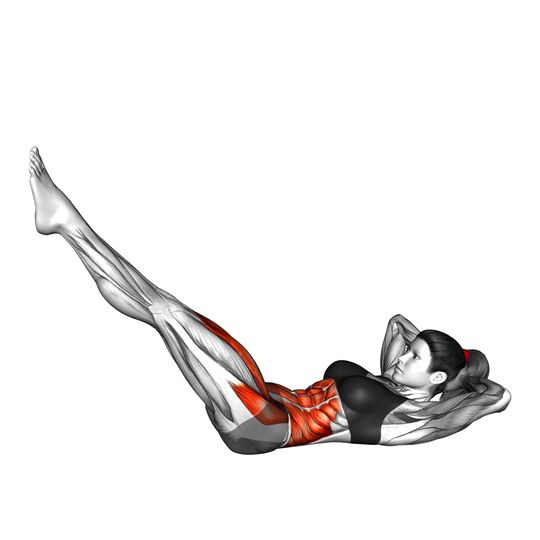


The Dead Bug alternately lowers the opposite arm and leg while you keep the abdominal wall engaged; it primarily works the abdominals.
How to do the Dead Bug#
- Lie on your back with knees bent, feet lifted off the floor, and arms extended toward the ceiling.
- Draw your belly button toward your spine and press your lower back gently into the floor.
- Slowly lower your right arm behind your head while extending your left leg toward the floor in a controlled motion.
- Bring both limbs back to the starting position and repeat the motion on the opposite side.
- Maintain steady, controlled repetitions and keep the core engaged throughout each rep.
Muscles worked#
The dead bug trains the abs to resist movement rather than create it. As one arm reaches overhead and the opposite leg extends toward the floor, the limbs try to pull the lower back into an arch, and the rectus abdominis and the deeper transverse abdominis have to hold the ribs down and the lower back flat against the floor. The muscles work isometrically the entire time, which is a very different feeling from a crunch.
The obliques on both sides stop the pelvis rotating as one leg moves independently of the other, and the hip flexors hold the non-moving leg at 90 degrees, which is why the front of the hips often fatigues before the abs do. The shoulders and head stay relaxed on the floor. Done properly the effort is quiet, deep in the midsection, and much harder than it looks.
- Primary: Abs (Rectus Abdominis)
- Secondary: Obliques (External & Internal Obliques), Hip flexors (Iliopsoas (Hip Flexors))
Common mistakes#
- Allowing the lower back to lift off the floor.
- Dropping the arm or leg too quickly instead of controlling the descent.
- Letting limbs touch the floor before restarting the next rep.
- Holding your breath during the movement.
Why it works#
The dead bug teaches the skill every heavy lift depends on: keeping the ribcage and pelvis stacked while the arms and legs do things. Lifters who lose their brace in a squat or let the lower back arch in an overhead press usually cannot do a slow dead bug without the back lifting either, and fixing it on the floor is far easier than fixing it under a bar.
It is also the safest core exercise there is. Lying on the back with the spine supported removes the compression of sit-ups and the shoulder demand of planks, so it works for beginners, for people returning from back pain, and as a warm-up for anyone. The difficulty scales by slowing down, extending the limbs further, and adding load, so it never has to be outgrown.
Sets, reps and setup#
Two to three sets of 6-10 slow reps per side with 45-60 seconds of rest, two to three times a week, in a warm-up or at the end of a session. Each rep should take four to six seconds, with the limbs lowering on a long exhale. Rushing turns it into a leg-waving exercise; the slower it is, the more the abs work.
- Setup
- Lie on your back with the hips and knees bent to 90 degrees, shins parallel to the floor, arms straight up over the shoulders. Exhale hard to flatten the lower back into the floor and keep it there. Lower one arm overhead and straighten the opposite leg until the heel is a few centimetres from the floor, pause, then return and switch.
- Progression
- First slow down and extend the limbs further. Then hold the bottom position for a breath, or add light dumbbells in the hands or a band around the feet. If the lower back lifts, shorten the range or move one limb at a time until the brace holds.
Variations#
- Bird Dog The same opposite arm and leg pattern from hands and knees, adding the lower back and glutes and a balance demand.
- Hollow Hold Both arms and legs held extended off the floor at once, a static and much harder version of the same brace.
- Cable Pallof Press Standing anti-rotation drill with a cable, loading the obliques against a moving arm the way a dead bug does lying down.
- Leg Raise Both legs lowered together with the back flat, a heavier lower-ab progression once dead bugs are easy.
Dead bug vs bird dog#
Both move the opposite arm and leg while the trunk stays still, and both are used to teach a stable spine. The dead bug is done on the back, which makes the lower back position easy to feel and check against the floor, and the load falls mainly on the abs and obliques as they resist the back arching. It is the better starting point and the better choice for people with back pain.
The bird dog is done on hands and knees, so the glutes and spinal erectors work to hold the hips level and the balance demand is far higher. It trains the same control from the other side of the body and adds the hip extension a deadlift needs. Use the dead bug to learn the brace and the bird dog to apply it against gravity.
Common questions#
What muscles does the dead bug work?
The abs, particularly the deep transverse abdominis and the rectus abdominis, working isometrically to keep the lower back flat. The obliques resist rotation and the hip flexors hold the legs up.
Are dead bugs good for lower back pain?
They are one of the most commonly prescribed exercises for it, because they strengthen the trunk with the spine supported and neutral. Keep the range small enough that the back never lifts, and stop if it hurts during the movement.
How many dead bugs should I do?
Two to three sets of 6-10 slow reps per side is enough for most people. Quality matters far more than quantity; twenty fast reps with the back arching do less than six slow ones with the back pinned to the floor.
Why do I feel dead bugs in my hip flexors?
Because the hip flexors hold the bent leg at 90 degrees while the other one moves, and some of that is normal. If they dominate, exhale harder to flatten the back, shorten the leg range, and keep the bent knee directly over the hip.