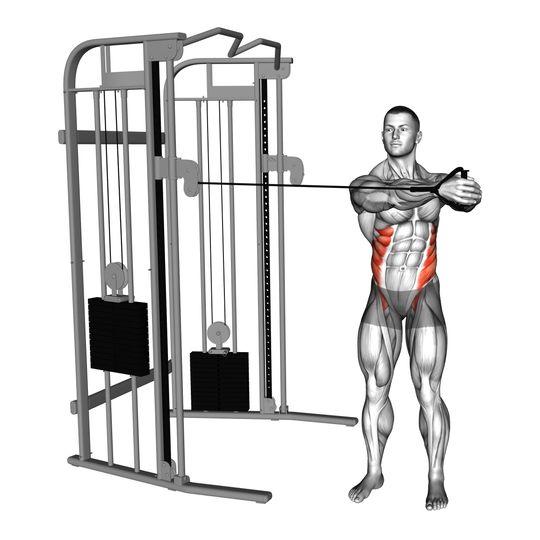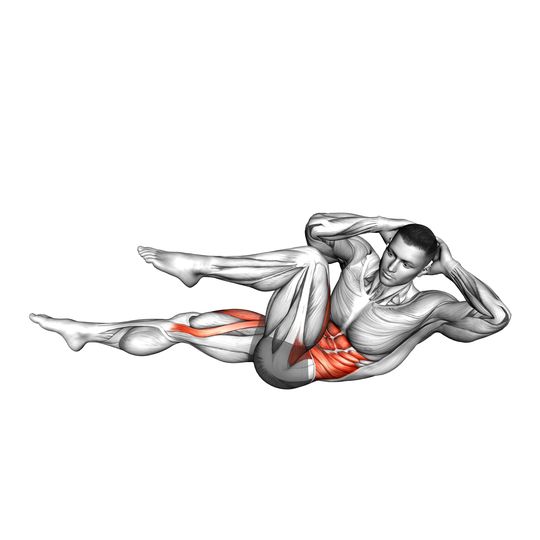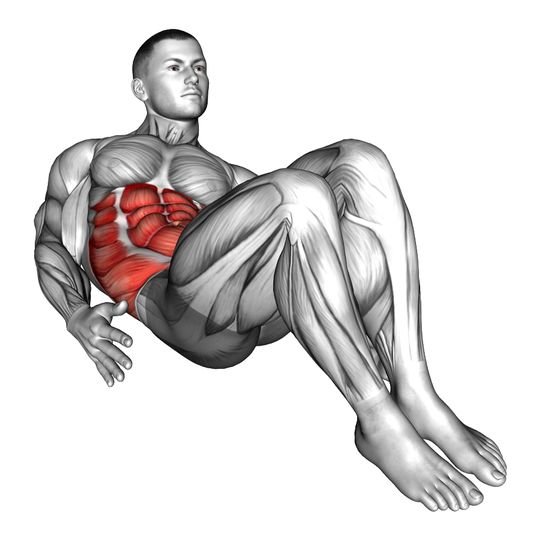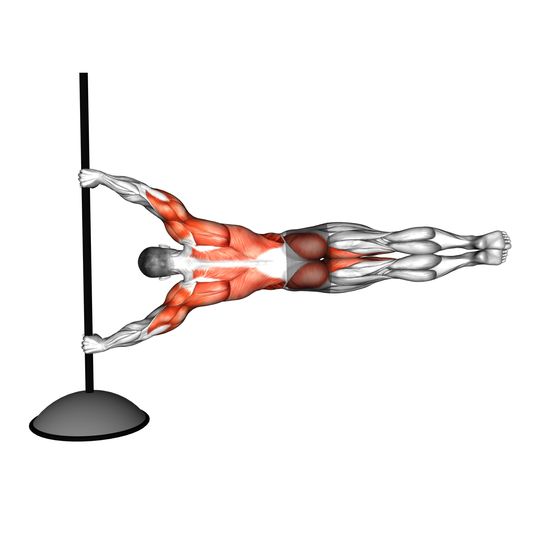


Stand sideways to a cable and press the handle straight out from your chest to resist rotation, loading the abdominals as the primary mover. Hold the extended position briefly before returning under control.
How to do the Pallof Press#
- Attach a single handle at chest height and stand perpendicular to the pulley with feet hip-width apart.
- Grip the handle with both hands at your sternum and step away to create steady tension in the cable.
- Press the handle straight forward until your arms are extended, keeping your torso square and hips stable.
- Pause briefly with the cable pulling you toward the pulley, using your core to prevent any rotation.
- Slowly bring the handle back to your chest under control and repeat for the desired reps.
Muscles worked#
The Pallof press is an anti-rotation exercise, which means the core works by refusing to move. Standing sideways to a cable and pressing the handle straight out in front of you creates a long lever that the cable is trying to twist toward the machine, and the obliques on both sides — external on one, internal on the other — contract to hold the torso square. The rectus abdominis and transversus abdominis brace alongside them.
The glutes and hips lock the pelvis in place so the resistance cannot turn you from below, and the erector spinae keep the spine neutral against the pull. The front delts and serratus anterior extend the arms and hold them there, which is why the shoulders tire on long holds. It feels like a deep tightening through the sides of the waist and the hips, strongest when the arms are fully extended.
- Primary: Obliques (External & Internal Obliques), Abs (Rectus Abdominis)
- Secondary: Lower back (Erector Spinae), Glutes (Gluteus Maximus)
Common mistakes#
- Allowing the torso to rotate toward the pulley.
- Pushing primarily with the arms instead of bracing the core.
- Leaning forward or backward to generate momentum.
- Holding your breath and tensing the neck or shoulders.
Why it works#
It trains the core the way it works under a barbell. Squats, deadlifts and single-arm work all load the trunk with forces that try to rotate or bend it, and the job of the core is to stop that from happening. The Pallof press isolates that job with a load you can measure and progress, and the standing position means the strength carries directly into lifting, carrying and sport.
It is also one of the safest ways to train the obliques hard. There is no spinal flexion, no twisting under load and nothing to jerk, so it suits lifters with back histories, beginners who have never learned to brace, and anyone who needs oblique work without the hip flexor fatigue of seated twists. The setup takes ten seconds and a single handle.
Sets, reps and setup#
Three sets of 8-12 reps per side with a two to three second hold at full extension, and 45-60 seconds of rest, two or three times a week. It works well as a warm-up before heavy lifting or as the last core exercise of a session. Moderate loads and long holds beat heavy sets that pull the hips out of line.
- Setup
- Set a single handle at chest height and stand side-on to the machine, feet shoulder-width, knees soft, far enough away that the cable is taut. Hold the handle in both hands at the sternum. Brace, squeeze the glutes, and press the handle straight forward until the arms are extended, keeping the shoulders and hips square. Hold, then bring it back to the chest under control.
- Progression
- Add one increment on the stack when every rep holds full extension for three seconds with no rotation. Then lengthen the holds, narrow the stance, do it half-kneeling or tall-kneeling to remove the legs, or add a slow overhead sweep at full extension. Moving the pulley higher or lower changes the angle of the pull and trains the same muscles differently.
Variations#
- Cable Twist Rotating against the cable rather than resisting it, which trains the obliques through movement.
- Cable Woodchopper A diagonal high-to-low rotation that adds hips and shoulders to the oblique work.
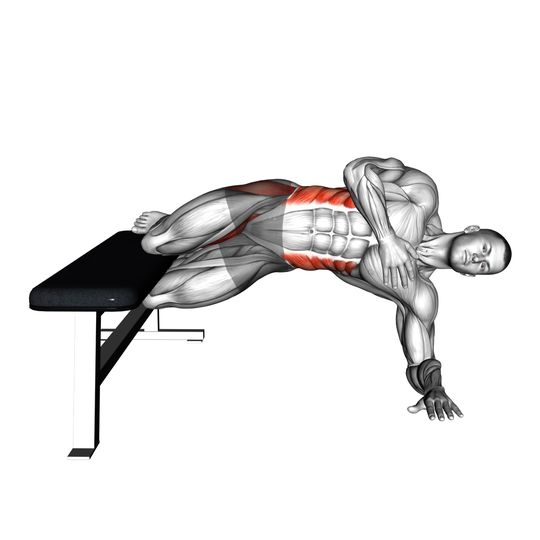
- Side Plank A bodyweight isometric for the obliques that resists side bending instead of rotation.
- Bird Dog Quadruped anti-rotation with the limbs moving, a good no-equipment partner to the Pallof press.
- Dead Bug Lying anti-extension and anti-rotation work that teaches the same bracing on the floor.
Pallof press vs Russian twist#
The Pallof press asks the obliques to stop rotation. You stand tall, the spine stays neutral and the load never twists the back, so it builds the stability that protects the lower back under heavy lifts and it can be loaded progressively without risk. For most lifters, and for anyone with a back history, it is the more useful oblique exercise.
The Russian twist asks the obliques to produce rotation, seated with the hips flexed and the torso turning under load. That builds strength in the act of twisting, which matters for throwing, striking and rotational sport, but it also loads a flexed lower back and tires the hip flexors. Use the Pallof press for stability and the Russian twist, or a standing cable twist, when you specifically want rotational power.
Common questions#
What muscles does the Pallof press work?
The obliques are the main target, working together to stop the torso rotating toward the cable. The rectus abdominis and transversus abdominis brace, the glutes and hips hold the pelvis square, and the front delts and serratus anterior extend and hold the arms.
Is the Pallof press good for lower back pain?
Usually, yes. It strengthens the trunk with the spine neutral and no flexion or twisting, which is why it is common in rehabilitation programs. Start light, keep the holds controlled, and stop if you feel it in the back rather than the sides of the waist.
How many Pallof presses should I do?
Three sets of 8-12 reps per side with a two to three second hold at full extension, two or three times a week. It is not a heavy exercise; if the hips start to rotate or the arms wobble, the weight is too high.
What height should the cable be for a Pallof press?
Chest height is the standard and trains pure anti-rotation. A high pulley adds an anti-extension component as the cable pulls you back and up; a low pulley adds anti-flexion. Rotating through all three over time covers the core more completely.
Can I do the Pallof press with a band?
Yes. Anchor a resistance band at chest height and follow the same setup. The resistance increases as you press out, which is slightly different from a cable, but the exercise trains the same muscles and is a good option at home.