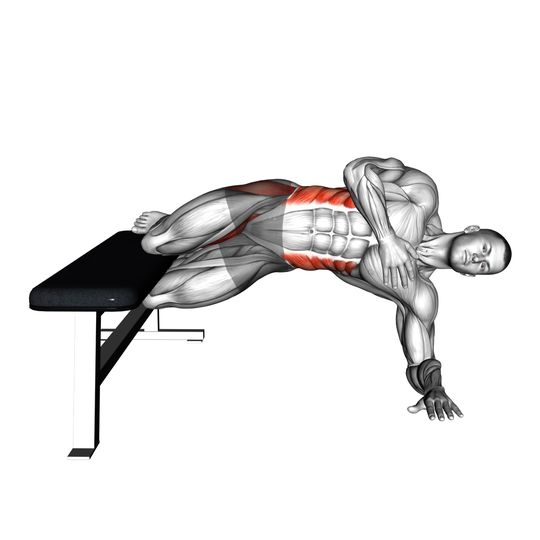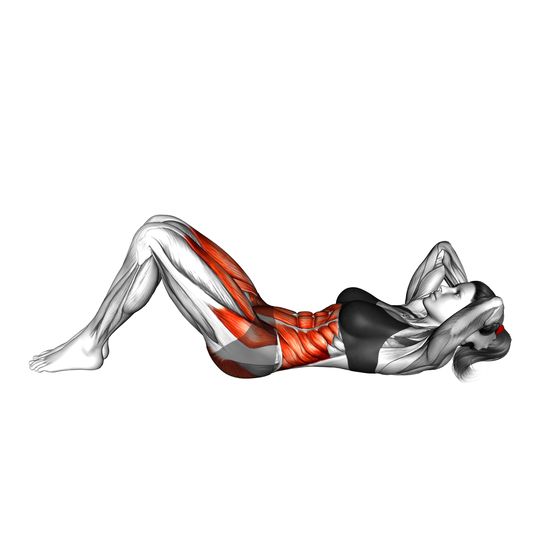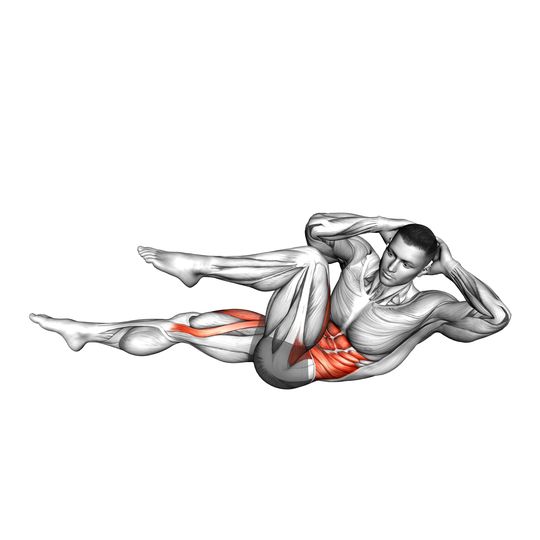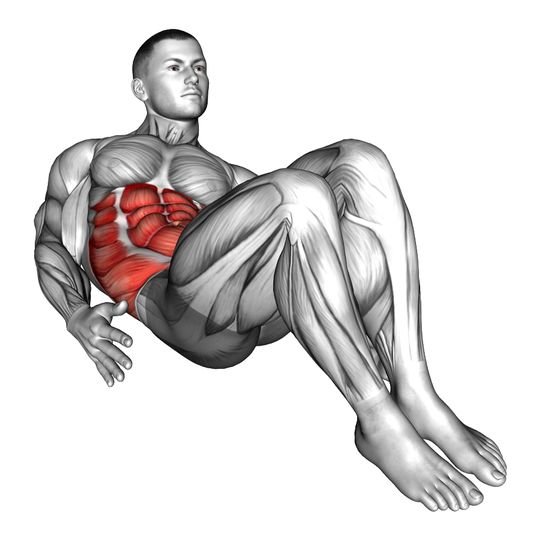


Hold a lateral plank on one forearm, keeping your body in a straight line to engage the abdominals.
How to do the Side Plank#
- Lie on your side and place your forearm on the ground with the elbow roughly under the shoulder.
- Stack your feet (or place one slightly in front of the other) and lift your hips until your body forms a straight line from head to heels.
- Tighten your core and keep your hips elevated to maintain a neutral spine.
- Breathe steadily and hold the position for the planned duration.
- Lower your hips with control to finish the set.
Muscles worked#
The side plank is the oblique exercise most people should be doing. Lying on one side and holding the hips off the floor means gravity is trying to fold you sideways, and the obliques on the bottom side — external and internal together — contract isometrically to stop it. The quadratus lumborum, a deep muscle between the ribs and pelvis, works alongside them, and the rectus abdominis and top-side obliques brace to keep the trunk from rolling.
The bottom hip is held up by its abductors, above all the gluteus medius, which is why the outer hip burns on long holds. The glutes keep the hips extended, and the side delt and rotator cuff of the supporting arm hold the shoulder in place. It should feel like a long band of tension down the side of the waist and into the outer hip; a burning shoulder means the position, not the core, is doing the work.
- Primary: Obliques (External & Internal Obliques), Abs (Rectus Abdominis)
- Secondary: Abductors (Gluteus Medius & Minimus (Hip Abductors)), Glutes (Gluteus Maximus), Side delts (Lateral Deltoid)
Common mistakes#
- Letting the hips sag toward the floor.
- Rotating the torso instead of keeping the body aligned.
- Shrugging the support shoulder toward the ear.
- Holding your breath during the hold.
Why it works#
It trains the sides of the trunk without twisting or bending the spine. Most oblique work involves rotation or lateral flexion, which is fine for healthy backs but not what everyone can tolerate. The side plank loads the same muscles isometrically in a neutral spine, which is why it is the standard lateral core exercise in back rehabilitation and a staple for anyone whose lower back complains about twists.
It also strengthens the gluteus medius, the muscle that keeps the pelvis level when you stand on one leg. Weakness there shows up as knees caving in squats, hips dropping when you run and a wobbly single-leg stance, and the side plank trains it under load without any equipment. Comparing your hold time left versus right is also a quick way to find an imbalance that is worth fixing.
Sets, reps and setup#
Three holds of 20-40 seconds per side with 30-45 seconds of rest between sides, three times a week. Hold with maximal tension rather than for as long as possible. Once 40 seconds is easy on both sides, make the variation harder rather than extending the time.
- Setup
- Lie on one side with the forearm on the floor and the elbow directly under the shoulder. Stack the feet, or place the top foot in front for more stability. Lift the hips until the body forms a straight line from head to heels, push the floor away with the forearm so the shoulder does not sink, and squeeze the glutes. Keep the hips stacked and the eyes forward.
- Progression
- Lift the top leg for a star side plank, which doubles the demand on the bottom hip and obliques. Rest the supporting hand on the floor for a straight-arm side plank, add a slow hip dip and lift, or place a weight on the top hip. If one side is much weaker, add an extra set on that side until the times match.
Variations#
- Star Side Plank Top leg and arm lifted, which increases the load on the bottom obliques and gluteus medius.
- Copenhagen Plank Top leg resting on a bench, shifting the work to the adductors of the inner thigh.
- Plank The front-facing version that loads the abs against extension instead of side bending.
- Side Bend Dynamic lateral flexion that moves the obliques through a range rather than holding them still.
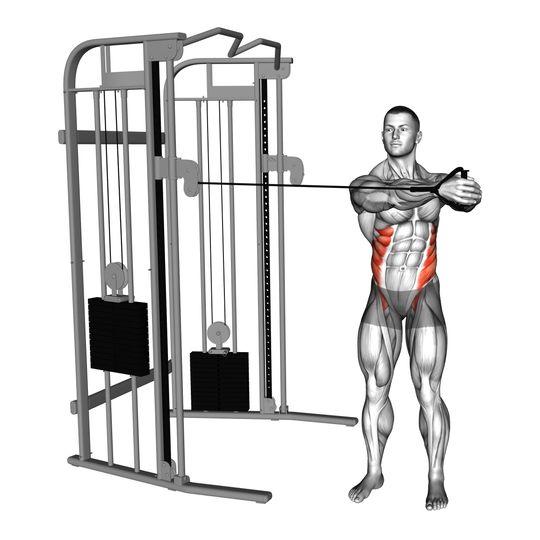
- Pallof Press A standing anti-rotation hold that trains the obliques with a cable and an upright spine.
Side plank vs plank#
The standard plank resists extension: gravity pulls the hips down and the abs and glutes hold them up. It trains the front of the trunk and is the right choice for learning to brace and for building the stiffness that transfers to squats and presses.
The side plank resists lateral flexion, which shifts the work to the obliques, the quadratus lumborum and the outer hip. Those muscles get little from front planks and are usually the weak link in single-leg movements and in lower backs that ache on one side. Neither replaces the other; a basic core routine holds both, and most people find the side plank the harder of the two.
Common questions#
What muscles does the side plank work?
The obliques and quadratus lumborum on the bottom side hold the trunk from folding, the gluteus medius of the bottom hip keeps the hips up, and the rectus abdominis and glutes brace the rest of the trunk. The side delt and rotator cuff of the supporting arm stabilise the shoulder.
How long should you hold a side plank?
Twenty to forty seconds per side with hard tension, for three sets. Once you can hold 40 seconds comfortably on both sides, lift the top leg or add load rather than holding for longer.
Are side planks good for love handles?
They build the oblique muscles underneath, but they do not burn the fat on top. Love handles are body fat, and body fat comes off through a calorie deficit. Side planks make the waist stronger and more defined once the fat is gone.
Why is one side harder than the other?
Almost everyone has a stronger side, usually from years of favouring one leg and one hand. A difference of a few seconds is normal. If one side gives out much earlier, add an extra set on that side each session until the times are close.
Should my feet be stacked or staggered?
Stacked is the standard and slightly harder because the base is narrower. Staggering the top foot in front of the bottom one gives more balance and is a good place to start. Both load the obliques the same way.