

Hold a straight, face-down plank on your forearms and toes while keeping the torso aligned; the isometric hold develops the abdominals.
How to do the Plank#
- Place your forearms on the floor with elbows directly under your shoulders.
- Step your feet back and extend your legs so only your forearms and toes touch the ground.
- Raise your body until it forms a straight line from head to heels, keeping your spine neutral.
- Engage your core and breathe steadily while maintaining the position for the desired time.
- Lower your knees to the floor to exit the hold and rest.
Muscles worked#
The plank trains the abs to do what they do most in real life: hold the spine still against a load. Gravity is trying to pull your hips to the floor and arch your lower back, and the rectus abdominis and the deep transversus abdominis brace to stop it. Because the hips and spine never move, this is an isometric contraction — the muscles produce force without changing length, which is why the burn builds slowly and then all at once.
The obliques stop the hips rotating and assist the brace, the glutes lock the hips into extension, and the quads hold the knees straight. The front delts and serratus anterior support the shoulders, which is why they fatigue on long holds. Done properly it feels like the whole front of the body tightening from ribs to knees; if you only feel it in the shoulders or lower back, the position is wrong.
- Primary: Abs (Rectus Abdominis)
- Secondary: Obliques (External & Internal Obliques), Glutes (Gluteus Maximus), Front delts (Anterior Deltoid), Quads (Quadriceps Femoris)
Common mistakes#
- Letting the hips sag toward the floor.
- Lifting the hips too high so the body angles upward.
- Holding your breath during the hold.
- Placing the elbows too far forward of the shoulders.
Why it works#
It builds the core stiffness that every other lift depends on. A squat, a deadlift, an overhead press and a heavy carry all require the trunk to stay rigid while the limbs move, and the plank trains exactly that skill with no spinal flexion and almost no injury risk. It also teaches the position — ribs down, glutes tight, neutral spine — that people are told to hold under a barbell but have never actually practised.
It is safe for nearly everyone and needs nothing. It is the standard core exercise in back rehabilitation because the spine stays neutral, it scales from knees to a single arm without equipment, and it can be done daily. The limitation is that once you can hold two minutes it stops building strength and starts building endurance, at which point the progression is harder variations, not longer holds.
Sets, reps and setup#
Three to four holds of 20-45 seconds with 45-60 seconds of rest, three or four times a week. Hold hard rather than long: a maximal 30-second brace with the glutes squeezed and the ribs pulled down does more than three relaxed minutes. Once 45 seconds is easy, progress the variation instead of the time.
- Setup
- Forearms on the floor with the elbows directly under the shoulders, hands either flat or lightly clasped. Step the feet back, squeeze the glutes, tuck the ribs toward the hips and push the floor away so the upper back rounds slightly. The body should form a straight line from head to heels with the eyes on the floor. Breathe steadily and keep the tension.
- Progression
- Add difficulty, not seconds. Squeeze the glutes and pull the elbows toward the toes to increase tension in the same position, then lift one foot, then one arm, then move to the side plank or a plank with shoulder taps. If you want to keep it simple, add a weight plate across the upper back and keep the holds at 20-30 seconds.
Variations#
- High Plank On the hands instead of the forearms, which asks more of the shoulders and serratus.
- Side Plank Turned on one side to load the obliques and the outer hip instead of the front of the trunk.
- Single Leg Plank One foot lifted, which makes the abs and glutes fight rotation as well as sag.
- Plank to Push Up Alternating between forearms and hands, adding movement and shoulder work to the hold.
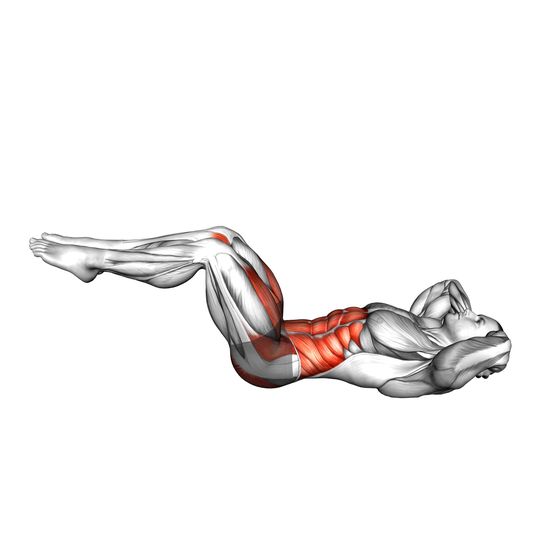
- Hollow Hold The same anti-extension brace lying on your back, with the lever controlled by arm and leg position.
Plank vs crunch#
The plank trains the abs to resist movement and the crunch trains them to create it. Planks build the bracing strength that transfers to lifting and protects the lower back, and they do it with the spine in neutral, which is why they suit beginners and anyone with a back history. They do not, however, load the abs through a range of motion, and the muscles adapt quickly, so long planks stop building size.
Crunches shorten the rectus abdominis against resistance, which is what makes a muscle grow, and they are easy to load and progress. They involve repeated spinal flexion, which is fine for healthy backs in moderate doses. A complete routine uses both: planks for stiffness and control, crunches or their loaded variants for muscle.
Common questions#
What muscles does the plank work?
The rectus abdominis and transversus abdominis brace the spine against sagging, the obliques stop the hips rotating, and the glutes and quads hold the hips and knees extended. The front delts and serratus anterior support the shoulders.
How long should you hold a plank?
Twenty to forty-five seconds with maximal tension, repeated for three or four sets. Once you can hold a hard 45-second plank, longer holds mostly build endurance, so move to a harder variation instead of chasing minutes.
Do planks give you abs?
They build core strength and stiffness, but they are not the best exercise for growing the abdominal muscles because the muscle never shortens against a load. Visible abs depend mainly on body fat; the plank helps the muscles function, while loaded crunches and leg raises do more for their size.
Are planks good for lower back pain?
Usually, yes. They strengthen the trunk with the spine held neutral and no flexion, which is why they are a staple in back rehabilitation. If a plank itself hurts your back, your hips are probably sagging; shorten the hold, squeeze the glutes and tuck the ribs, or start on the knees.
Should I do planks every day?
You can, because the load is light and recovery is fast, but three or four sessions a week of hard, short holds are enough. Daily two-minute planks build endurance rather than strength and are not a good use of the time once the basic hold is easy.
Why do my shoulders hurt during planks?
The elbows are probably too far forward, or you are hanging in the shoulder joints instead of pushing the floor away. Set the elbows directly under the shoulders, spread the shoulder blades and let the upper back round slightly. If they still tire fast, the abs are letting the shoulders do the holding.