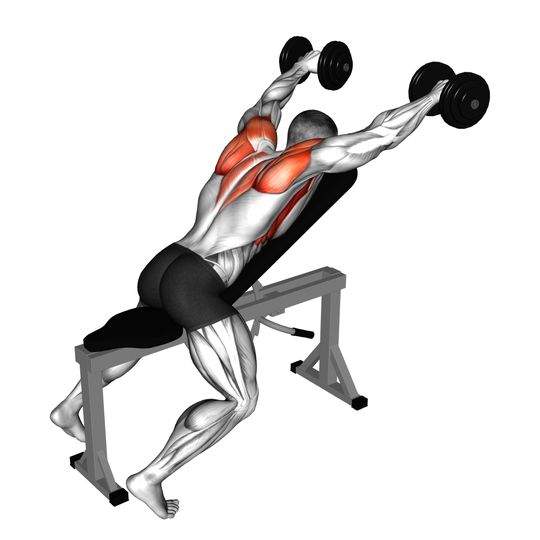


A chest-supported shrug named after powerlifting coach Paul Kelso, who built a whole system of scapular training around it. Lying face down on an incline bench, you let the weight hang and then retract your shoulder blades with the elbows locked straight, which isolates the mid-traps and rhomboids from the lats and biceps that normally take over in a row. Because the bench removes the hip hinge, the lower back contributes nothing, making it a low-fatigue way to add upper-back volume late in a pulling session or on days when heavy rows are already done.
How to do the Kelso Shrug#
- Set an incline bench to roughly 30 to 45 degrees and load a barbell on the floor in front of it.
- Lie face down with your chest against the pad and your feet braced on the floor.
- Take the bar with an overhand grip slightly wider than shoulder width and let your arms hang straight down.
- Keeping your elbows completely straight, pull your shoulder blades back and together so the bar rises a few inches.
- Hold the squeeze for a beat with the mid-back fully contracted.
- Let the shoulder blades spread apart again under control until the weight hangs freely.
- Repeat without bending the elbows or pushing off the bench with your feet.
Muscles worked#
- Primary: Traps (Trapezius), Upper back (Rhomboids & Middle Trapezius)
- Secondary: Rear delts (Posterior Deltoid), Lats (Latissimus Dorsi), Forearms (Forearm Flexors & Extensors (incl. Brachioradialis))
Common mistakes#
- Bending the elbows and turning the movement into a chest-supported row.
- Loading the bar so heavily that the range of motion collapses into a small bounce.
- Shrugging the shoulders toward the ears instead of retracting them back and together.
- Lifting the chest off the pad to steal extra range.