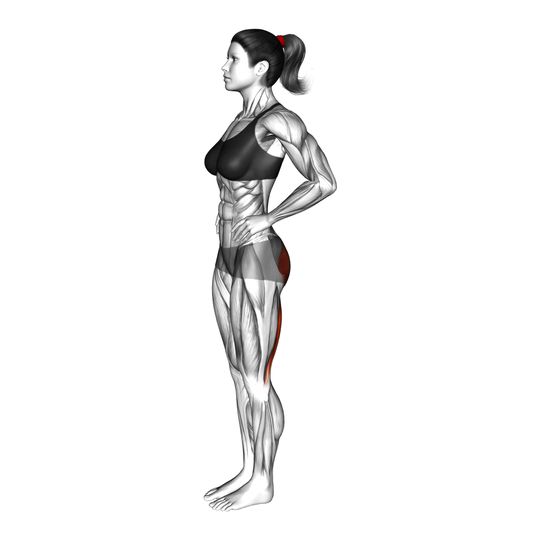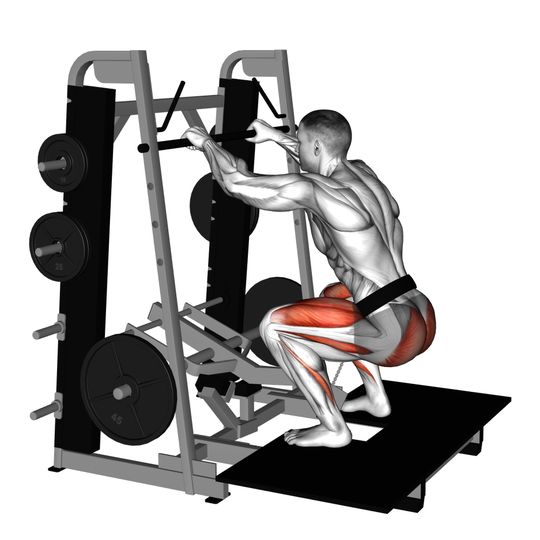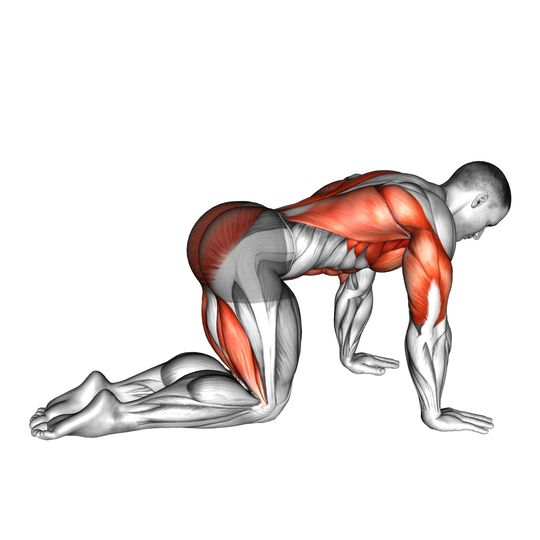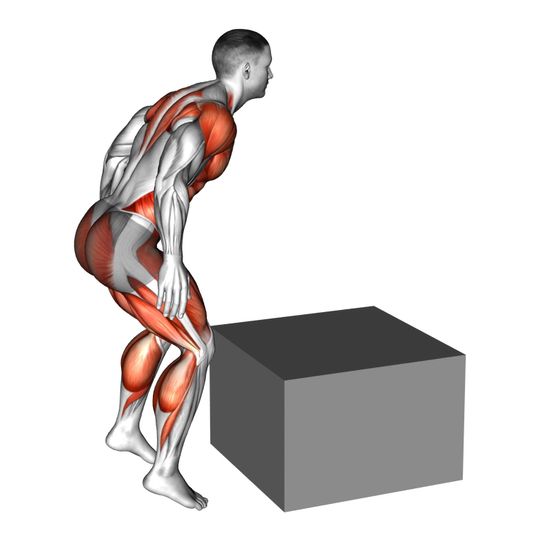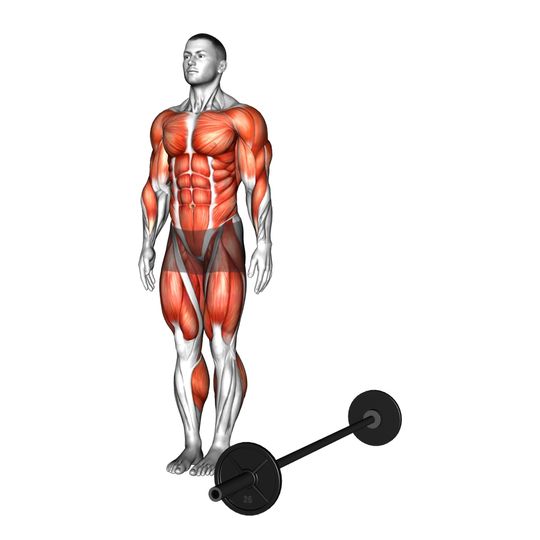


A cable hip-hinge that loads and strengthens the glutes by driving the hips forward against a low-pulley rope.
How to do the Cable Pull Through#
- Set the pulley to a low position and attach a rope handle.
- Stand with your back toward the machine, let the cable run between your legs, and grasp the rope with both hands behind you.
- Hinge at the hips, pushing your butt back and lowering your torso while keeping a long spine and straight arms.
- Explode the hips forward, contracting the glutes to return upright while keeping the arms passive.
- Slowly control the hinge back to the lowered position and repeat for the desired reps.
Muscles worked#
The cable pull through is a hip hinge, so the glutes and hamstrings do the work. As you push the hips back, the hamstrings lengthen and the glutes stretch under the pull of the cable; as you drive the hips forward and stand, the glutes contract hard to extend the hip, with the hamstrings helping at the top. Because the cable pulls backward rather than straight down, the resistance is highest when the hips are fully extended, which is where the glutes work the most.
The spinal erectors of the lower back hold the spine straight through the hinge and the abs brace against the cable trying to pull you backward at the top. The arms and upper back do almost nothing; they are hooks for the rope. That is why the movement feels like a glute squeeze rather than a lift, and why the lower back stays relatively fresh compared with a deadlift or a good morning.
- Primary: Glutes (Gluteus Maximus), Hamstrings (Biceps Femoris, Semitendinosus & Semimembranosus)
- Secondary: Lower back (Erector Spinae), Abs (Rectus Abdominis)
Common mistakes#
- Pulling the rope with the arms instead of generating movement from the hips.
- Rounding the lower back during the hip hinge.
- Shrugging or lifting the shoulders to move the weight.
- Using too much load so the hips cannot fully extend.
Why it works#
The cable pull through teaches the hip hinge better than any barbell movement, because the line of pull comes from behind and drags the hips back for you. Beginners who round their back in a Romanian deadlift usually hinge cleanly here within a set or two, and the pattern transfers straight to the deadlift, kettlebell swing, and hip thrust.
It also loads the glutes in the position where most hinges give up on them. A deadlift has almost no tension at lockout because the bar is just hanging; the pull through peaks at lockout, so you get a hard glute contraction at full hip extension on every rep with very little spinal load. That makes it a strong glute builder, a useful warm-up before heavy hinges, and a finisher you can take to failure safely.
Sets, reps and setup#
Three to four sets of 12-15 reps with 60-90 seconds of rest, once or twice a week, either as a warm-up before deadlifts or as a glute finisher. It is a moderate-load movement; when the stack is heavy enough to pull you backward at the top, you lose the squeeze and start heaving with the arms, so keep the load where you can pause at lockout.
- Setup
- Set the pulley at its lowest position with a rope handle, face away from the machine, and straddle the cable with the rope held between the legs and the arms straight. Step forward until the stack is off its rest, then push the hips back with a soft knee bend until the torso is nearly parallel to the floor and the hamstrings are tight. Drive the hips forward to stand tall, squeeze the glutes for a full second, and do not lean back past vertical.
- Progression
- Add reps to fifteen, then move up one plate and drop back to twelve. When adding weight starts to pull you around, slow the lowering to three seconds and hold the top for two seconds instead. Once the cable stack stops being enough, move the same pattern to a barbell Romanian deadlift or a kettlebell swing.
Variations#
- Barbell Romanian Deadlift The same hinge with a barbell, which allows far heavier loading and shifts more of the tension toward the bottom.
- Kettlebell Swing An explosive version of the hinge that uses momentum and trains the glutes to fire fast.
- Barbell Hip Thrust Loads the glutes at full hip extension from a supported position, the heavy alternative for peak contraction.
- Barbell Good Morning The bar on the back turns the hinge into a demanding lower back and hamstring exercise with much more spinal load.
- Machine Glute Kickback Single-leg hip extension on a machine, which isolates one glute at a time with no hinge to control.
Cable pull through vs Romanian deadlift#
The Romanian deadlift loads the hinge with a barbell, so the tension is highest at the bottom where the hamstrings are stretched and lightest at the top where the bar simply hangs. It is the better choice for heavy loading and for building the hamstrings and lower back.
The pull through does the opposite: the cable pulls from behind, so the load is highest at full hip extension and the glutes have to squeeze hard against it. It uses less weight, spares the lower back, and is the better teaching tool for the hinge and the better glute finisher. Most programs benefit from the RDL as the main hinge and the pull through as the warm-up or accessory.
Common questions#
What muscles does the cable pull through work?
The glutes are the main target, contracting hard against the cable at full hip extension, with the hamstrings lengthening and assisting through the hinge. The lower back and abs keep the spine neutral, and the arms only hold the rope.
Is the cable pull through good for glutes?
Yes, it is one of the better cable exercises for them. The line of pull from behind means the resistance peaks when the hips are fully extended, so every rep finishes with a hard glute contraction that a deadlift or squat never provides.
How heavy should cable pull throughs be?
Heavy enough that twelve to fifteen reps is hard, but light enough that you can stand fully upright and pause at the top without being pulled backward. For most people that is a moderate setting on the stack, not the heaviest plates.
Should you bend your knees in a cable pull through?
Slightly, as in a Romanian deadlift. A soft knee bend lets the hips travel back further and keeps the hamstrings loaded without turning the movement into a squat. Locking the knees straight strains the lower back and shortens the range.
Why do I feel cable pull throughs in my lower back?
Either the spine is rounding at the bottom or you are leaning back at the top. Push the hips back rather than folding the torso down, stop the descent when the hamstrings are tight, and finish by standing tall and squeezing the glutes instead of arching backward.