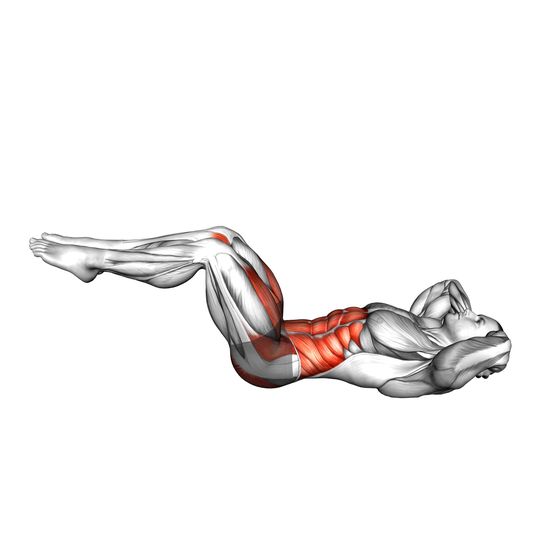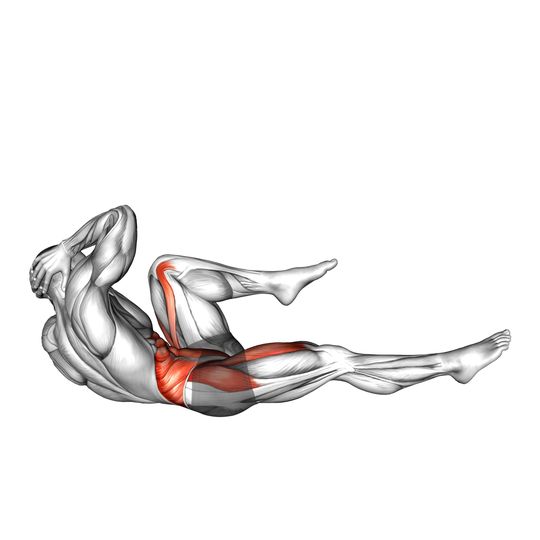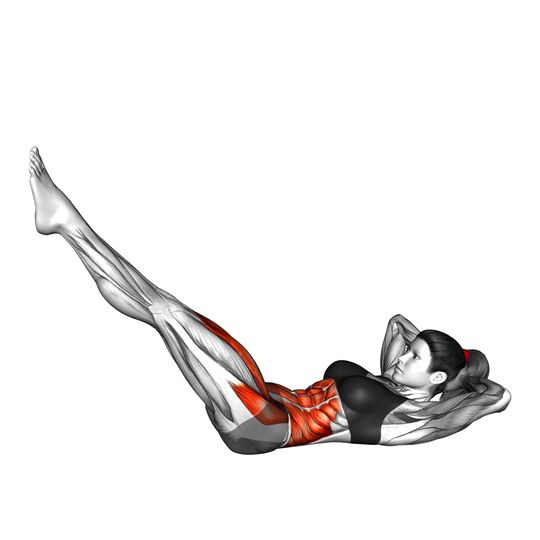


Curl the hips upward by flexing the lower spine to lift the heels toward the ceiling; the movement primarily works the abdominals.
How to do the Reverse Crunch#
- Lie on your back and raise your legs so your thighs are vertical (perpendicular to the floor).
- Exhale and contract your abdominal muscles to lift your hips and lower spine off the floor, moving your heels upward.
- Hold briefly with the hips elevated while keeping the motion driven by your core.
- Inhale and lower your hips and legs back down with control to the starting position.
Muscles worked#
The reverse crunch works the rectus abdominis from the other end. A regular crunch fixes the pelvis and moves the ribs; the reverse crunch fixes the ribs and curls the pelvis toward them, lifting the hips off the floor. The muscle contracts as a whole either way, but this direction lets you feel the lower portion of the abs far more clearly, which is why it is the standard answer to lower-ab training.
The hip flexors hold the legs in position and will take over if you swing the legs instead of rolling the pelvis, and the obliques assist and stop the hips rotating. The arms press into the floor for stability. It should feel like the lower abs gripping and the tailbone peeling off the floor, not like the thighs pulling the knees to the chest.
- Primary: Abs (Rectus Abdominis)
- Secondary: Hip flexors (Iliopsoas (Hip Flexors)), Obliques (External & Internal Obliques)
Common mistakes#
- Using momentum from the legs instead of abdominal contraction.
- Lifting the upper torso off the floor instead of initiating movement from the hips.
- Dropping the hips quickly on the descent rather than lowering under control.
Why it works#
It trains the part of the abs most people cannot feel. The lower rectus abdominis does work in ordinary crunches, but pelvic tilt is the action that makes it obvious, and learning to tilt the pelvis with the abs rather than swing the legs with the hip flexors carries over to hanging leg raises, hollow holds and even bracing under a barbell.
It is also easier on the neck and lower back than most ab exercises. The head and shoulders stay down, there is no pull on the cervical spine, and the range of lumbar movement is small. It needs no equipment, progresses cleanly from bent knees to straight legs to a decline bench, and can be added to the end of any session without affecting recovery.
Sets, reps and setup#
Three sets of 12-20 controlled reps with 45-60 seconds of rest, two or three times a week. Tempo matters more than count: lift the hips over one second, hold for one, and lower over two or three so the abs control the descent rather than the legs dropping.
- Setup
- Lie on your back with arms by your sides and palms pressing into the floor. Bring the knees up so the thighs are vertical and the knees bent about 90 degrees. Exhale and curl the pelvis toward the ribs, lifting the hips and lower back a few centimetres off the floor while the knees drift toward the chest. Lower slowly until the tailbone touches down, without letting the feet swing.
- Progression
- Slow the lowering phase first, then hold the top for two seconds. Straighten the legs slightly to lengthen the lever once bent-knee sets of 20 are easy, then move to a decline bench so gravity works against you through more of the range, or hold a light dumbbell between the feet. Hanging knee raises are the natural next step.
Variations#
- Crunch The standard version that moves the ribs instead of the pelvis, emphasising the upper abs.
- Lying Leg Raise Straight legs lifted from the floor, which lengthens the lever and adds hip flexor work.
- Hanging Knee Raise The same pelvic curl performed hanging from a bar, with far more load on the lower abs.
- Bicycle Crunch Alternating knee-to-elbow reps that combine hip and rib movement with a twist for the obliques.
- Decline Crunch The bench used for weighted upper-ab work, which pairs naturally with reverse crunches.
Reverse crunch vs leg raise#
The reverse crunch keeps the knees bent and focuses on rolling the pelvis, which means the abs do the lifting and the hip flexors stay relatively quiet. The short lever makes it accessible to beginners and easy to feel in the lower abs from the first session.
The leg raise uses straight legs, so the lever is longer and the hip flexors have to hold the legs up throughout. It is harder and trains the hip flexors as much as the abs, and many people arch the lower back doing it. If you cannot yet keep your lower back on the floor during leg raises, reverse crunches are the better exercise until you can.
Common questions#
What muscles does the reverse crunch work?
The rectus abdominis, with the emphasis on its lower portion because the movement is a pelvic tilt rather than a rib curl. The hip flexors hold the legs in position, and the obliques stabilise the pelvis against rotation.
Do reverse crunches work the lower abs?
Yes. The abs are one muscle, but curling the pelvis toward the ribs loads the lower fibres more directly than a regular crunch does, and it is the most reliable way to feel the area below the navel working.
How many reverse crunches should I do?
Three sets of 12-20 slow reps, two or three times a week. If you can do 20 with no burn, slow the lowering phase to three seconds or straighten the legs slightly rather than adding more reps.
Why do I feel reverse crunches in my hip flexors?
Because you are pulling the knees to the chest with your legs instead of curling the pelvis with your abs. Keep the knee angle fixed, think about lifting the tailbone off the floor, exhale hard at the top, and slow down; the movement is small and the hips barely need to travel.
Are reverse crunches better than regular crunches?
They are different rather than better. Regular crunches emphasise the upper abs and reverse crunches the lower, and a complete routine includes both. If you only have time for one and your lower abs lag, choose the reverse crunch.