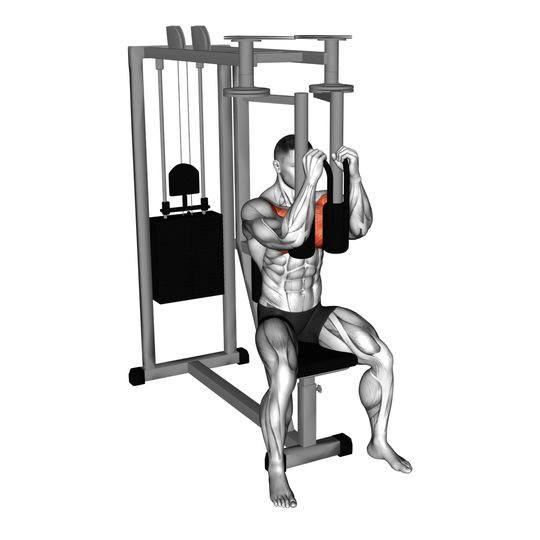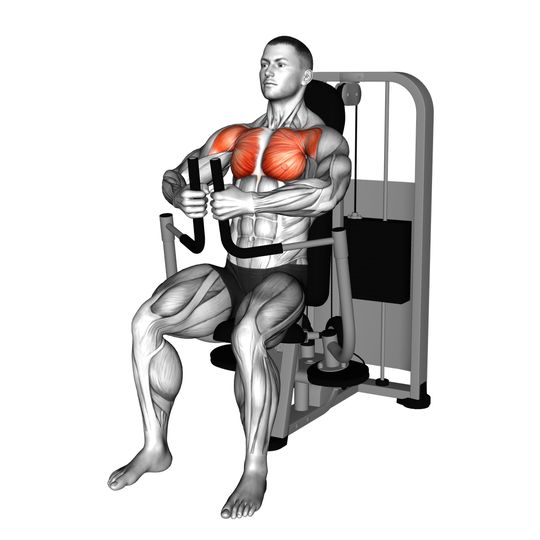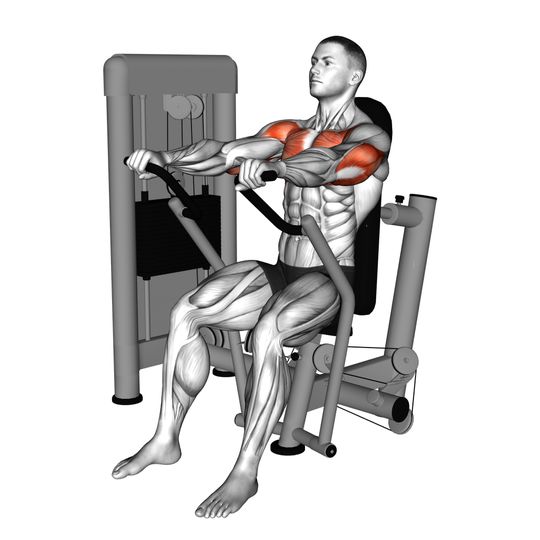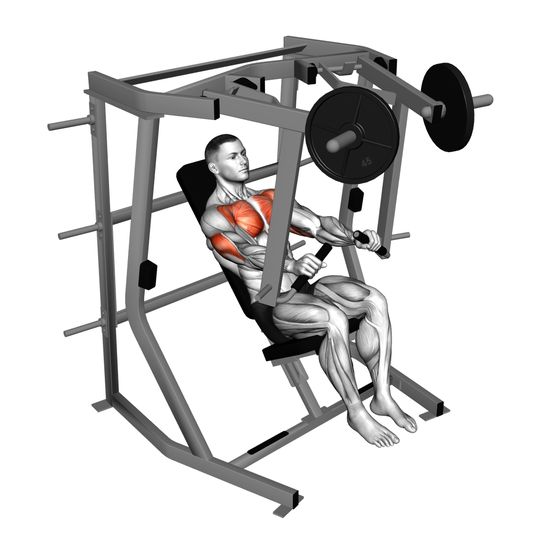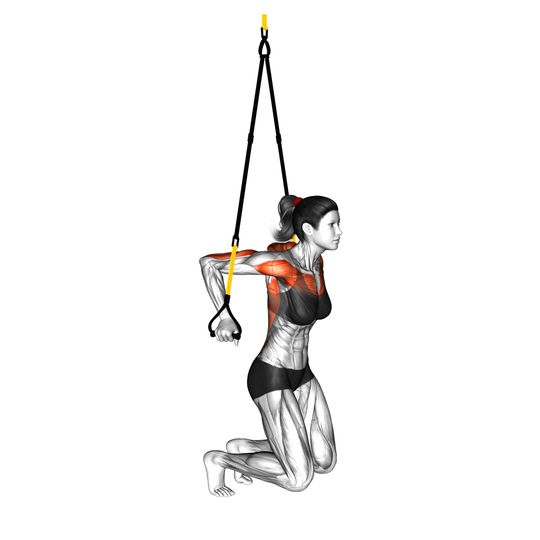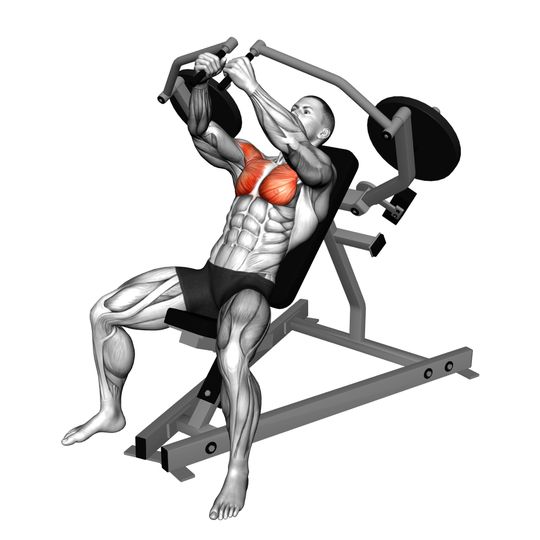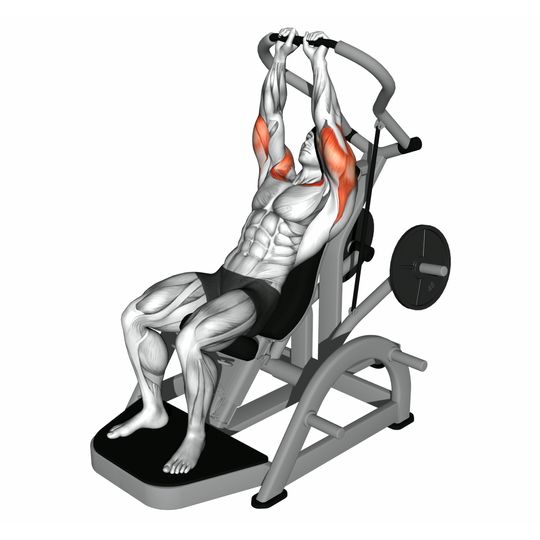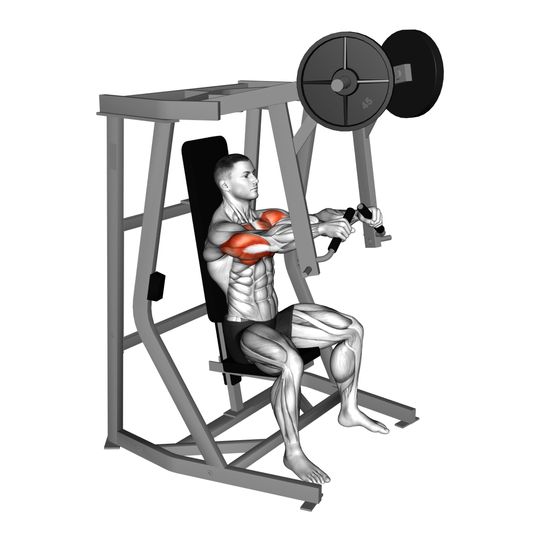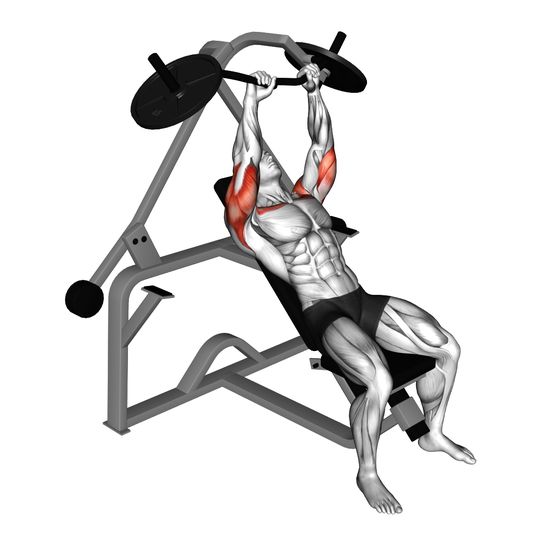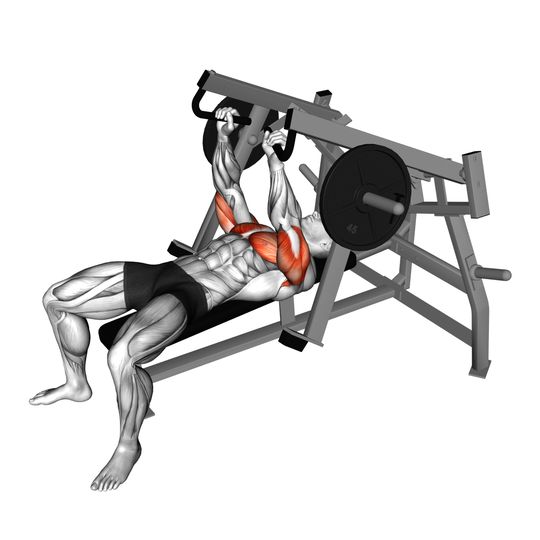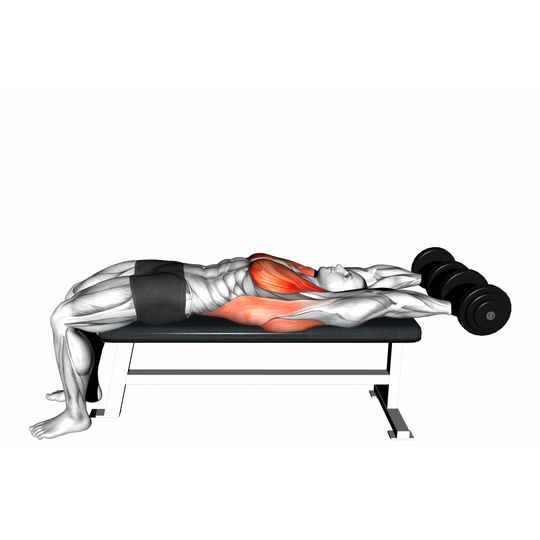


Seated leverage-machine press that brings the forearms together in front of the torso, primarily working the pectoralis major (chest).
How to do the Pec Deck#
- Sit with your back pressed firmly to the pad and set the seat so the forearm pads line up with the middle of your chest; bend your elbows to about 90°.
- Rest your forearms against the pads and keep your shoulders pulled down and back.
- Exhale and move your elbows inward in a controlled arc until the pads meet or you feel a firm chest contraction.
- Pause briefly at the top of the movement while maintaining tension in the chest.
- Inhale and slowly guide the pads back to the starting position without letting the weight snap back.
Muscles worked#
The pec deck is a chest isolation exercise. The pectoralis major pulls the upper arm across the body, which is exactly the movement the machine resists, and because the elbows stay bent and braced against the pads, the triceps cannot help the way they do in a press. The sternal fibres of the chest, the bulk of the muscle running from the breastbone to the upper arm, do most of the work, with a peak squeeze as the pads meet in front of you.
The front delts assist as the arms swing forward, and the short head of the biceps stabilises the shoulder at the stretched position. Nothing else contributes much, which is the point: unlike a bench press, a set on the pec deck fails because the chest is done, not because the shoulders or triceps gave out first. Expect a pump across the whole chest rather than the soreness of a heavy press.
- Primary: Chest (Pectoralis Major)
- Secondary: Front delts (Anterior Deltoid)
Common mistakes#
- Using momentum or jerking the weight instead of controlling the motion.
- Lifting or arching the lower back away from the pad.
- Allowing the shoulders to shrug up toward the ears during the press.
Cannot do this one today?#
Machine taken, gym closed, or the movement just not agreeing with you? Here is what to run instead, and what each substitute changes.
8 best pec deck alternatives →
Why it works#
The pec deck lets you take the chest to failure safely. No spotter, no bar over your face, and a fixed path that keeps the shoulders from drifting forward, so you can push sets hard and add drop sets or partials that would be reckless on a barbell. For lifters whose triceps or shoulders always quit before their chest on presses, this is the fix.
It also loads the chest evenly through the range, including the fully contracted position where dumbbell flyes provide almost no resistance because the weights end up stacked over the shoulders. That constant tension at the squeeze, plus the deep stretch at the back, is a strong hypertrophy stimulus with very little joint cost, which is why it is a staple at the end of chest sessions.
Sets, reps and setup#
Three to four sets of 10-15 reps with 60-90 seconds of rest, once or twice a week after your pressing. Take the last set to failure or close to it. Heavier than eight reps turns into a shrugging, back-arching heave that spares the chest, so keep the load moderate and the tempo slow.
- Setup
- Set the seat so the handles or pads sit at the middle of the chest with the upper arms roughly parallel to the floor. Set the arm start position so the stretch at the back is deep but pain-free, usually with the elbows just behind the torso. Sit tall with the shoulder blades pulled down and back, then bring the arms together in an arc and hold the squeeze for a second before lowering over two to three seconds.
- Progression
- Add reps up to fifteen, then increase the weight by one plate and drop back to ten. Once the working weight stalls, add a one-second pause at the squeeze or a set of partial reps from the stretched position at the end of the last set.
Variations#
- Machine Chest Fly Uses handles held in the hands with straighter arms, which lengthens the lever and shifts the load slightly toward the stretched position.
- Cable Crossover The same arc with free-moving cables, so you can change the angle and cross the hands over for extra range at the squeeze.
- Dumbbell Chest Fly Loads the stretch heavily but loses most of its tension at the top, making it the complementary free-weight version.
- Machine Chest Press The pressing version on the same style of machine, which brings the triceps and front delts in and allows more load.
Pec deck vs dumbbell fly#
The dumbbell fly loads the chest hardest at the bottom of the arc, where the arms are wide and the shoulders are in their most vulnerable position. As the dumbbells come together the lever shortens and the tension almost disappears, so the squeeze at the top is essentially unloaded.
The pec deck reverses that profile: the cam keeps tension on through the whole arc and peaks as the pads meet, and the back pad stops your shoulders from rolling forward. It is the safer, more consistent choice for taking the chest to failure. The dumbbell fly earns its place if you specifically want to load the stretch.
Common questions#
What muscles does the pec deck work?
It isolates the chest, mainly the sternal portion of the pectoralis major that pulls the arms across the body. The front delts assist at the start of the arc, and the biceps help stabilise the shoulder in the stretched position.
Is the pec deck better than the chest press?
Neither is better; they do different jobs. The chest press allows heavier loads and builds the triceps and front delts alongside the chest. The pec deck removes those muscles so the chest is the limiting factor, which makes it the better finisher after pressing.
How do I set up the pec deck machine?
Adjust the seat until the pads or handles line up with the middle of your chest and your upper arms are level with the floor. Set the starting position so you feel a firm stretch across the chest with the elbows just behind the torso, and keep your back flat against the pad.
Why do I feel the pec deck in my shoulders?
Usually the seat is too low or the start position is too far back, putting the shoulders in a stretched, unstable spot. Raise the seat until your upper arms are level, shorten the range slightly, and keep the shoulder blades pinned back and down throughout the set.
Should the pec deck be done with heavy weight?
No. It is an isolation movement, and heavy loads lead to arching, shrugging, and swinging that move the work away from the chest. Ten to fifteen slow reps with a hard squeeze at the top does far more than a heavy set of six.