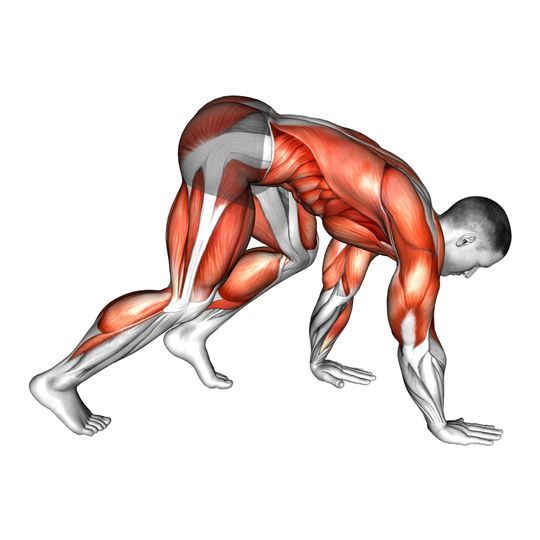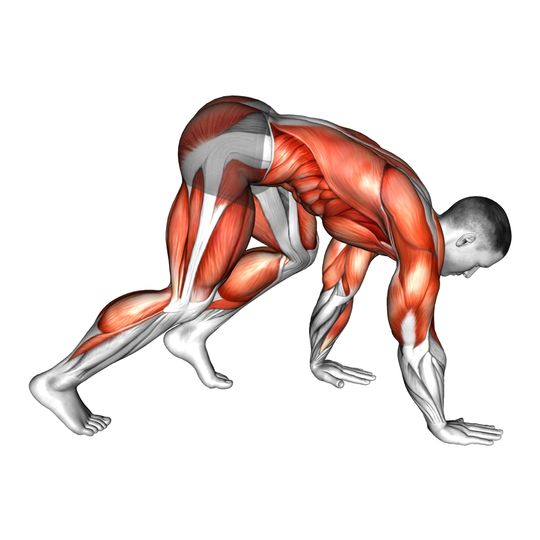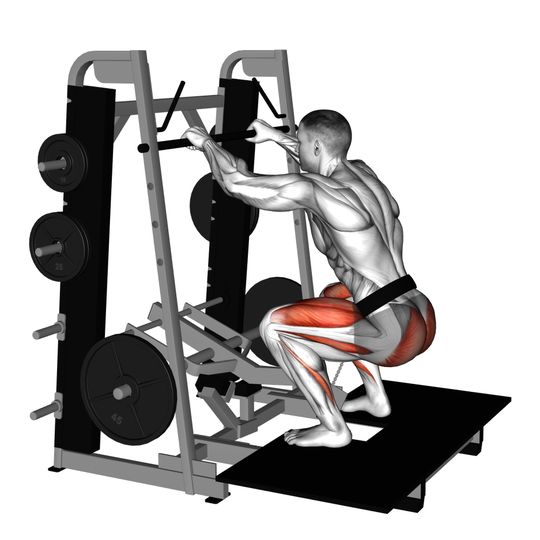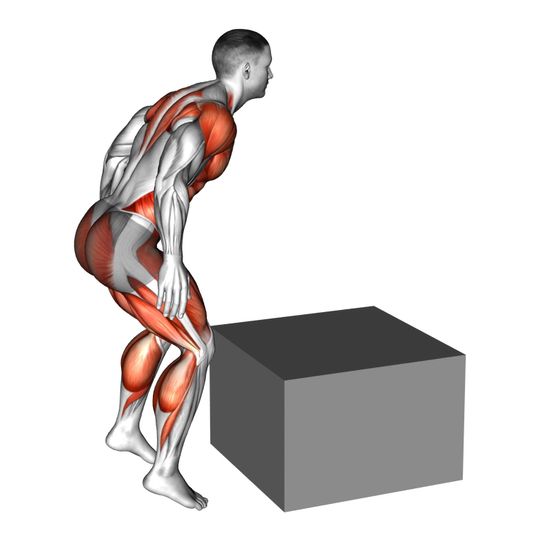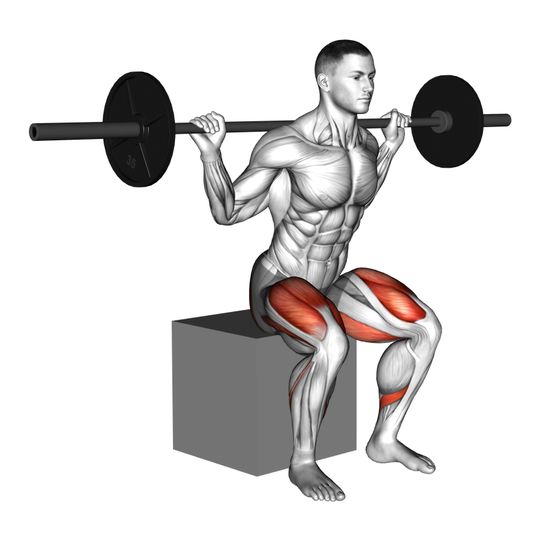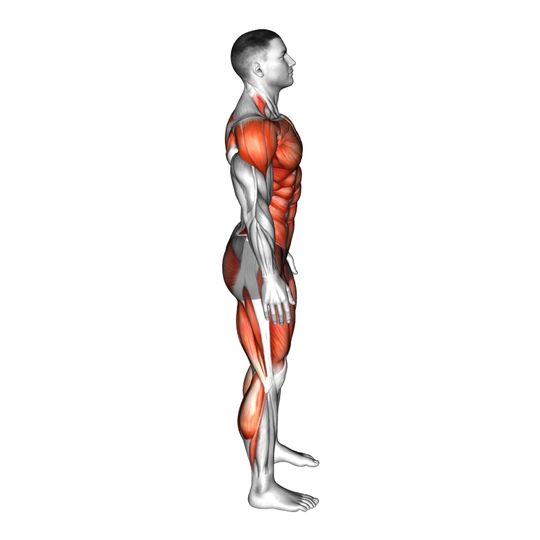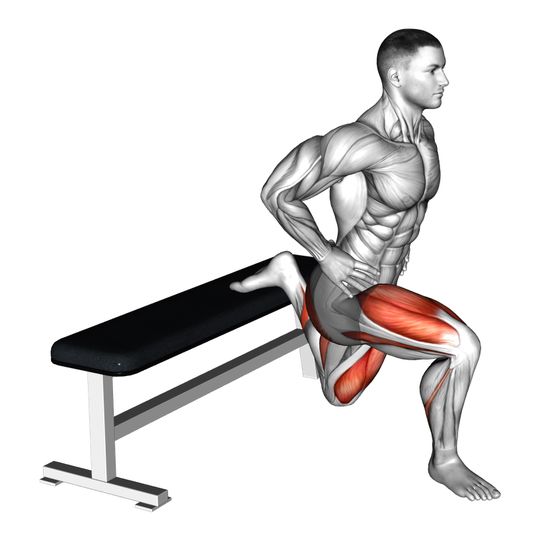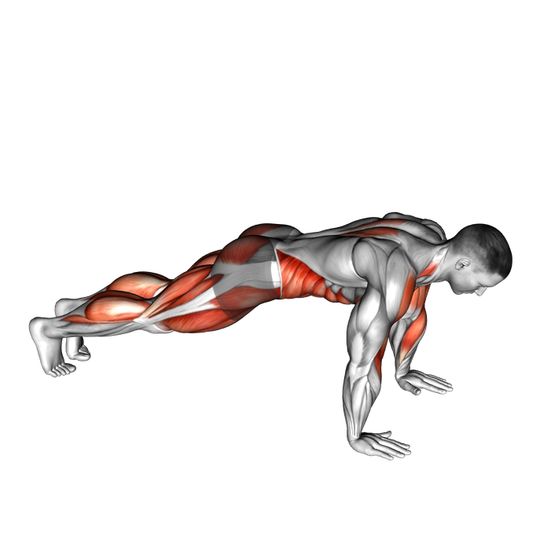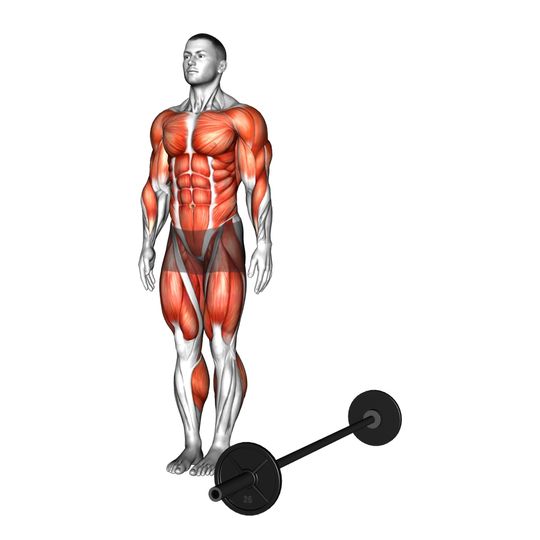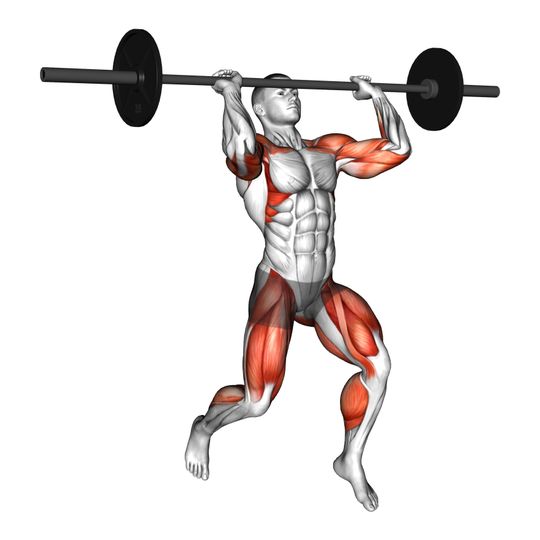


A single-leg squat where you lower and rise on one leg, focusing load on the quadriceps and gluteus maximus. It uses hip and knee flexion to descend and extend to return to standing.
How to do the Pistol Squat#
- Stand on one foot with the other leg extended forward and your arms reached out for balance.
- Brace your core and keep a neutral spine with your chest upright.
- Begin the movement by bending the hip and knee of the standing leg, sitting back and down as far as your mobility allows.
- Keep your weight through the heel of the working foot and control the descent without bouncing.
- Drive through the heel to extend the hip and knee and return to standing, then switch sides after completing the set.
Muscles worked#
The pistol squat loads the quads and glutes of the working leg with your entire bodyweight through a full range of motion. The quads (quadriceps) take the biggest share because the knee travels far forward and the torso stays relatively upright, so the deep bottom position is essentially a maximal knee-flexion squat on one leg. The glutes drive you out of the hole and stop the pelvis from dropping toward the free leg side.
The supporting cast is what makes the move hard. The hamstrings and calves stabilise the knee and ankle, the adductors keep the thigh from drifting outward, and the abs and hip flexors hold the free leg off the floor, which is often the first thing to fail. Ankle mobility decides whether you can reach the bottom at all, so the movement also trains the calf and shin through a long range.
Common mistakes#
- Lifting the heel of the working foot off the ground.
- Allowing the knee to collapse inward.
- Rounding the lower back or dropping the chest forward.
- Bouncing at the bottom instead of a controlled descent and ascent.
Why it works#
Few bodyweight exercises give the legs a stimulus comparable to a loaded squat, and the pistol is one of them. Standing on one leg roughly doubles the load on that limb compared with a two-legged squat, and the full range means the quads work through a longer stretch than most people ever reach on a barbell. It builds single-leg strength, balance, and ankle mobility at the same time.
It also exposes asymmetries. If your left side needs an assist and your right does not, you have found something a barbell squat was hiding. For travellers, home trainers, and anyone who wants strong legs without a rack, a well-trained pistol squat with a light dumbbell or kettlebell is a complete quad exercise.
Sets, reps and setup#
Three to four sets of 3-8 reps per leg with 90 seconds to two minutes between sets, two or three times a week. Treat it as a strength exercise, not a conditioning drill.
- Setup
- Stand on one foot with the other leg straight out in front, arms reached forward as a counterweight. Sit back and down slowly, letting the knee travel forward over the toes while the heel stays glued to the floor. At the bottom the hamstring should touch the calf. Drive the whole foot into the ground and stand up in one motion.
- Progression
- Start with box pistols to a bench, lower the surface a few centimetres a week, then move to holding a light kettlebell in front of you, which shifts your balance back and makes the movement easier. Once you own bodyweight reps, add load with a weighted vest or a dumbbell held at the chest rather than adding endless reps.
Variations#
- Assisted Pistol Squat Holding a post, band, or rings takes the balance problem away so you can train the range and strength first.
- Shrimp Squat The free leg is bent behind you rather than out in front, which needs less ankle mobility and hip flexor strength.
- Skater Squat A single-leg squat with the back knee reaching toward the floor, easier to balance and more hip-dominant.
- Dumbbell Bulgarian Split Squat The rear foot on a bench gives you a stable single-leg squat that is easy to load heavy.
- Cossack Squat A deep lateral squat that builds the ankle and hip mobility a pistol demands.
Pistol squat vs Bulgarian split squat#
The Bulgarian split squat is the better muscle builder for most people. The rear foot provides enough balance that you can hold heavy dumbbells and take sets close to failure, and the range is easy to control. It is also far less dependent on ankle mobility, so it works for almost everyone from the first session.
The pistol squat is a skill as much as an exercise. It trains balance, deep knee flexion, and mobility that the split squat does not, and it needs zero equipment. If your goal is leg size, use the split squat as the main lift. If you want a portable strength test and better single-leg control, learn the pistol and keep it in rotation.
Common questions#
What muscles does the pistol squat work?
The quads and glutes of the working leg do the bulk of the work, with the hamstrings, calves, and adductors stabilising the knee and hip. The abs and hip flexors hold the free leg up, which is why the core often tires before the legs.
Why can't I do a pistol squat?
It is almost always one of three things: not enough ankle mobility to keep the heel down at the bottom, not enough strength to stand up from the deepest position, or losing balance backward because you are sitting back instead of down. Test each separately with assisted reps and fix the weakest one.
Are pistol squats bad for your knees?
No. The knee travelling far past the toes is normal in a deep squat and healthy knees tolerate it well. Build up gradually with assisted and box versions, keep the knee tracking over the middle of the foot, and do not bounce at the bottom.
How long does it take to learn a pistol squat?
Someone who can already do a deep bodyweight squat and has decent ankle mobility can usually get a clean rep in four to eight weeks of training it two or three times a week. If mobility is the limit it can take several months, most of it spent on the ankles.
Does holding a weight make pistol squats easier?
Yes, up to a point. A light kettlebell held out in front acts as a counterbalance that lets you sit deeper without falling backward, so a 4-8 kg weight often makes the first reps possible.