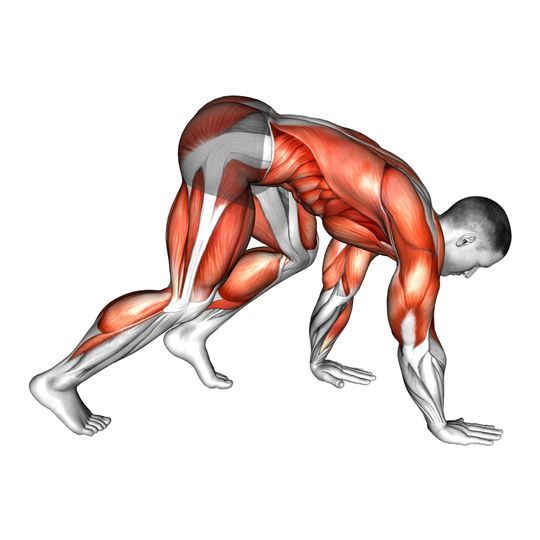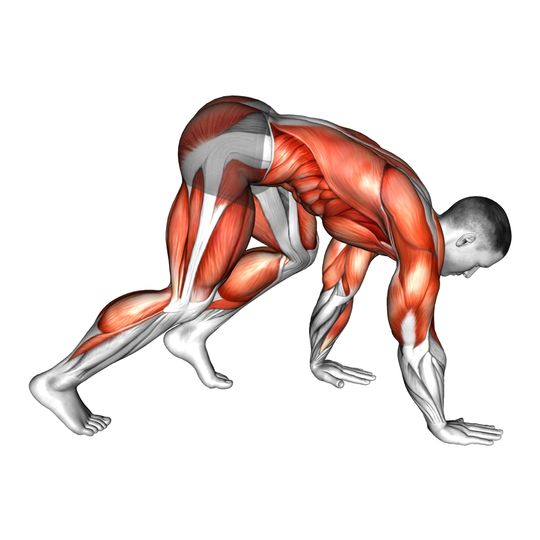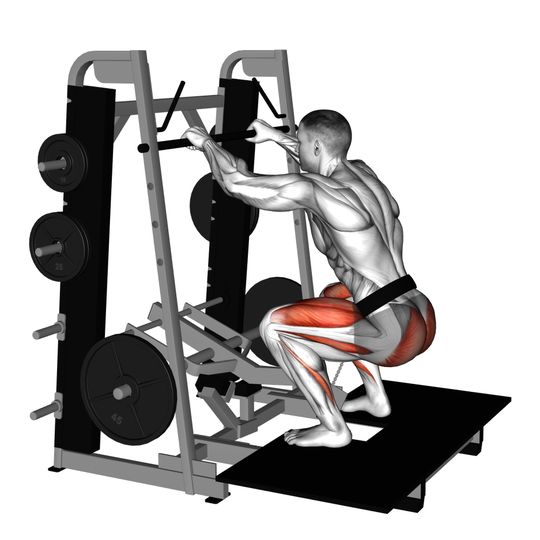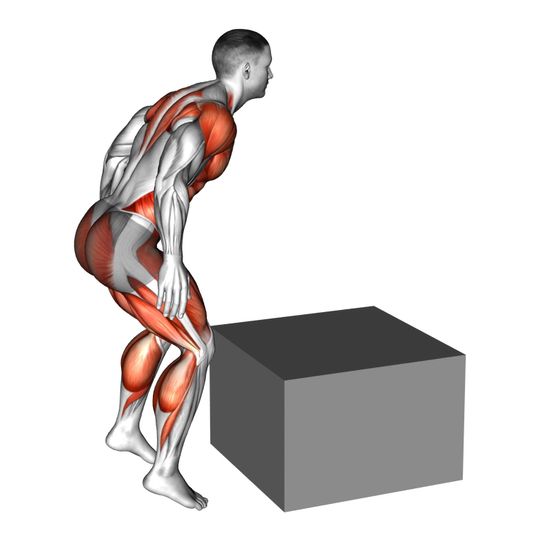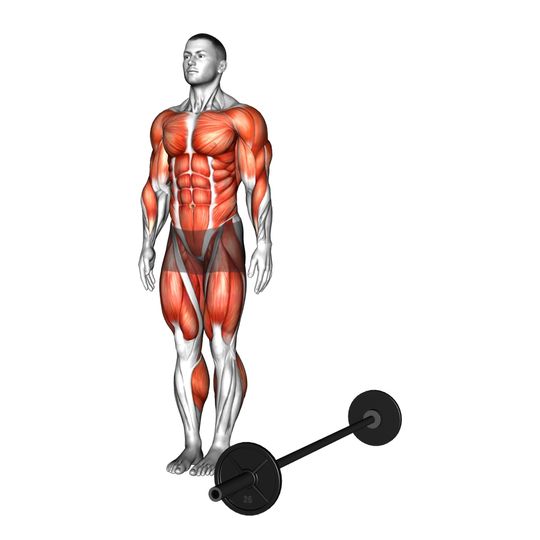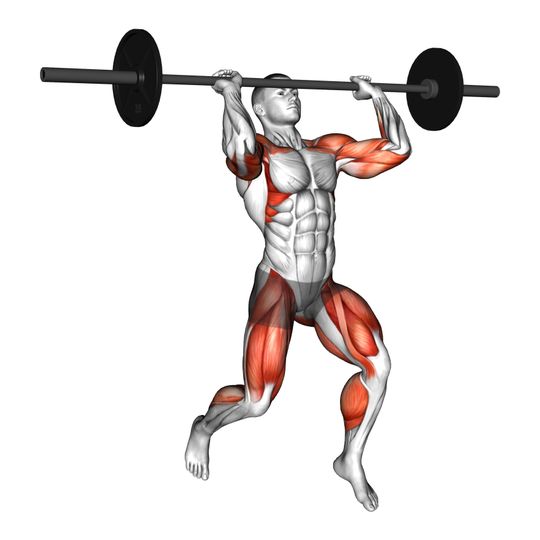


Stand in a staggered stance and lower your hips straight down in a single-leg squat pattern, primarily working the quadriceps and glutes.
How to do the Split Squat#
- Step into a staggered stance with one foot forward and the other behind, feet pointing forward.
- Brace your core and keep your torso upright and stable.
- Bend the front knee and hip to lower until the front thigh is about parallel to the floor.
- Press through the front heel to extend the knee and return to standing.
- Finish the set, then switch legs and repeat the same steps on the other side.
Muscles worked#
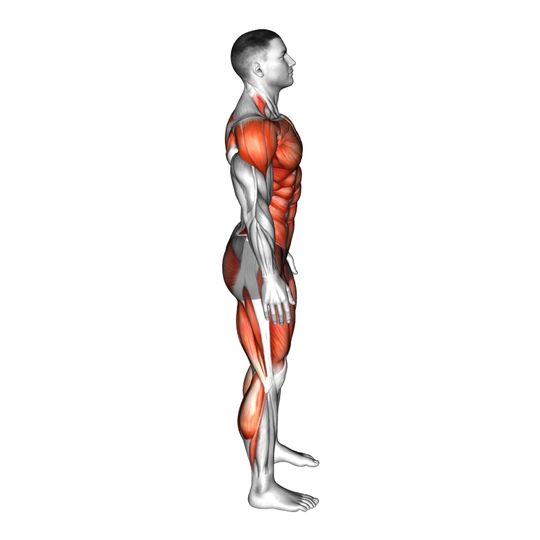
The split squat is a single-leg squat with the back foot on the floor for balance. The front leg does the work: the quads control the knee as you lower and drive you back up, and the glutes of the front leg extend the hip. Because the stance is staggered, the front hip and knee move through a long range under load while the back leg simply steadies you, so almost all the tension lands on one quad and one glute.
The adductors of both legs work to keep the pelvis level, the hamstrings assist the glute at the hip, and the calf of the back leg is stretched and loaded in a way few exercises manage. The abs and obliques brace against the split stance. Most people feel the front quad first and the front glute a day later, with a noticeable stretch through the back leg's hip flexor.
Common mistakes#
- Allowing the front knee to collapse inward.
- Leaning the torso forward instead of keeping it upright.
- Pushing through the toes instead of driving through the front heel.
- Relying on the back leg to push you up rather than loading the front leg.
Why it works#
It gives you the strength benefits of single-leg training without the balance problem. Lunges move and Bulgarian split squats put the back foot on a bench, both of which turn the exercise into a stability test for many people. The split squat keeps both feet planted, so you can concentrate on loading the front leg and actually pushing hard, which is what makes muscle.
It also fixes things bilateral squats hide. Almost everyone has a stronger leg, and squats let that leg take over. Training one at a time forces each side to carry its own load, evens out strength and size, and builds hip stability that shows up in running, jumping and heavy squatting. The loads required are modest, so it is easy on the spine and works well in any home setup.
Sets, reps and setup#
Three sets of 8-12 reps per leg with 60-90 seconds of rest, once or twice a week. Do all the reps on one leg before switching. Bodyweight sets of 12-15 are a good starting point; once you add dumbbells, 8-10 per side is the sweet spot.
- Setup
- Take a stride long enough that the front shin stays roughly vertical at the bottom and the back knee ends up under or slightly behind the hip. Torso upright, weight through the whole front foot. Lower until the back knee nearly touches the floor, pause, then push straight up through the front leg without letting the back leg help.
- Progression
- Add a dumbbell in each hand, or one held goblet-style at the chest, once bodyweight sets of 15 per leg are easy. Increase weight when all sets hit the top of the range with a level pelvis. From there, raise the back foot onto a bench for the Bulgarian version, which lengthens the range and pushes more load onto the front leg.
Variations#
- Dumbbell Split Squat The same stance with a dumbbell in each hand, the simplest way to keep adding load.
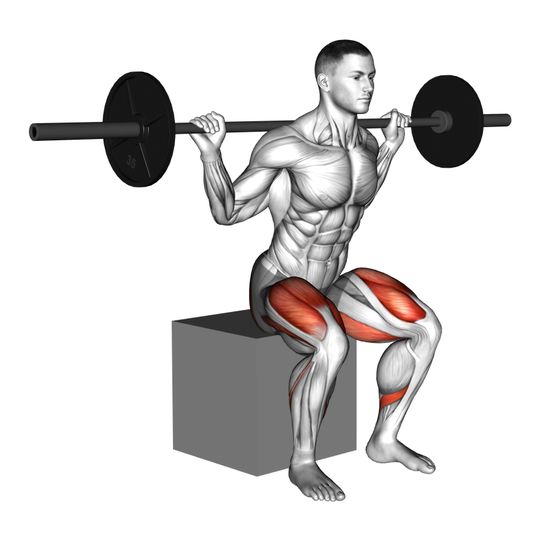
- Barbell Split Squat Bar on the back for the heaviest loading, with a stronger core and balance demand.
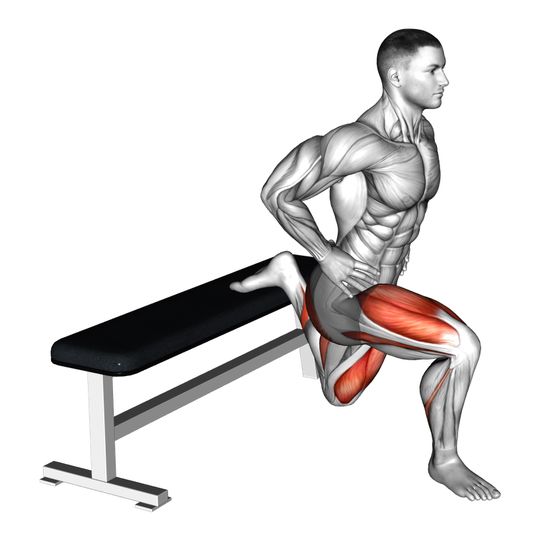
- Dumbbell Bulgarian Split Squat Back foot elevated, so the front leg carries more of the load through a longer range.
- Reverse Lunge Stepping back into the same position on every rep, adding a balance component and hip mobility work.
- Smith Machine Split Squat A fixed bar path that removes balance entirely so you can load the front leg heavier.
Split squat vs Bulgarian split squat#
The split squat keeps both feet on the floor, so it is more stable, easier to learn and easier to load heavy without the set turning into a wobble. The back leg shares a small amount of the work, which makes it the better choice for beginners, for heavy dumbbell or barbell loading, and for anyone whose hip flexor mobility does not tolerate a raised back foot.
The Bulgarian split squat puts the back foot on a bench, which lengthens the range on the front leg, stretches the back hip harder and forces the front quad and glute to do nearly all of the work. It is the more demanding and more effective single-leg builder once you can control it, but it takes more balance and more setup. Start with the split squat and graduate.
Common questions#
What muscles does the split squat work?
The front leg's quads and glutes are the main movers, with the hamstrings and adductors assisting at the hip. The back leg's hip flexor and calf are stretched and loaded, and the core braces to keep the pelvis level in the staggered stance.
What is the difference between a split squat and a lunge?
A split squat is stationary: you set up in the staggered stance and lower and rise without moving your feet. A lunge involves stepping into or out of that position on every rep. The split squat is more stable and easier to load; the lunge adds balance and coordination.
How many split squats should I do?
Three sets of 8-12 reps per leg, once or twice a week. Complete all reps on one side before switching so the working leg gets a proper set rather than a rest between every rep.
Should my back knee touch the floor?
Lower until it is a couple of centimetres off the floor. Touching down lightly is fine, but resting the knee unloads the front leg and breaks the tension you are trying to build. If you cannot get close to the floor, shorten the stride slightly.
Why do I feel split squats in my back leg?
Usually because you are pushing off the back foot to stand up, or because the stride is so long that the back hip flexor is doing a lot of stretching under load. Shift your weight over the front foot, think of the back leg as a kickstand, and take a slightly shorter stance.