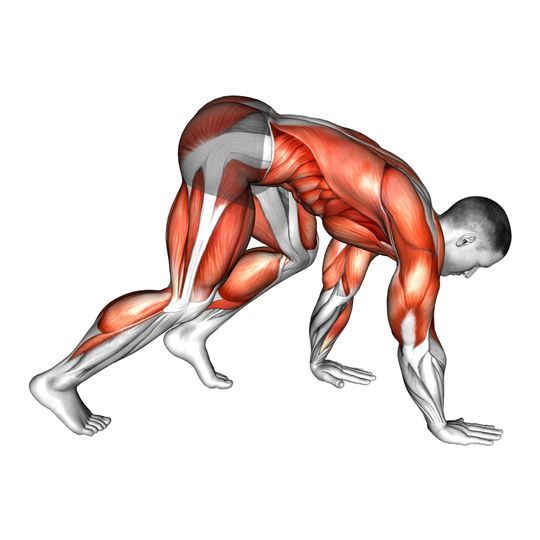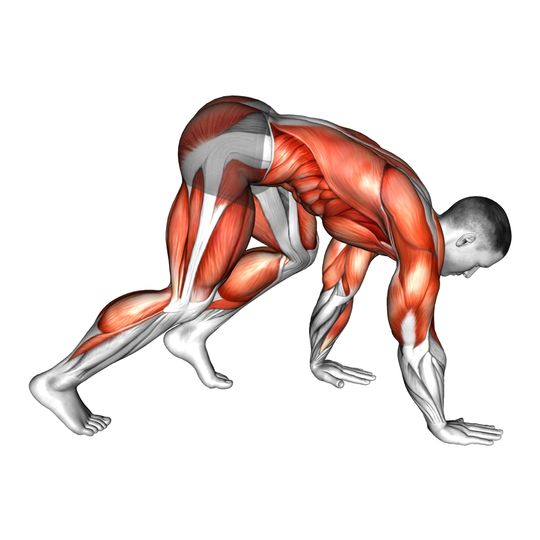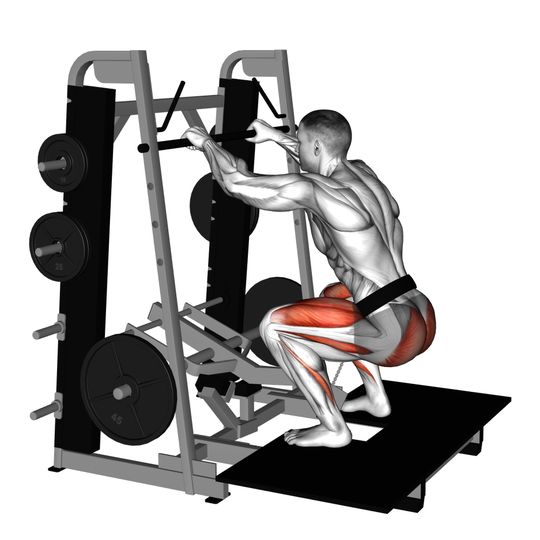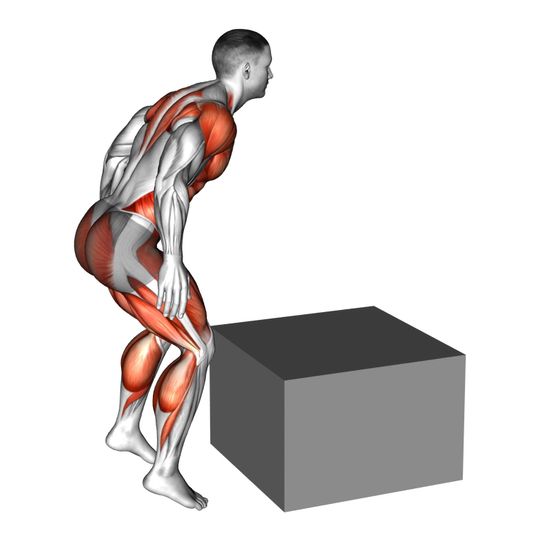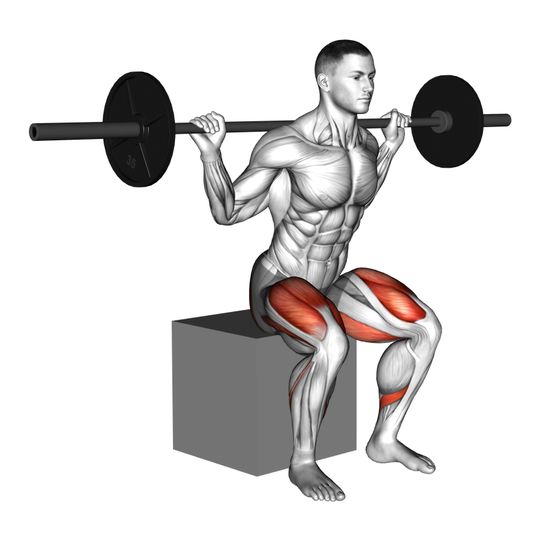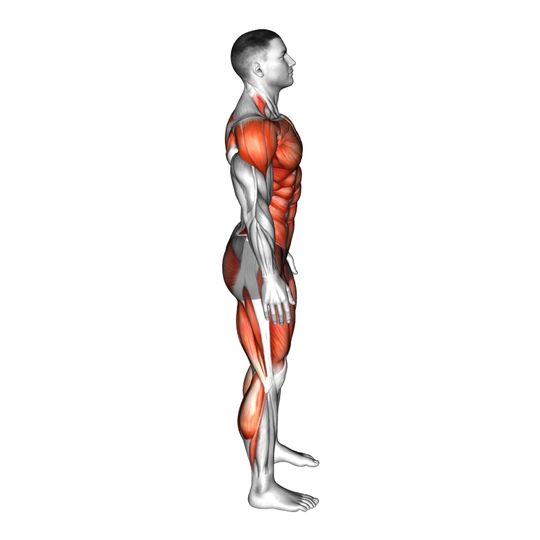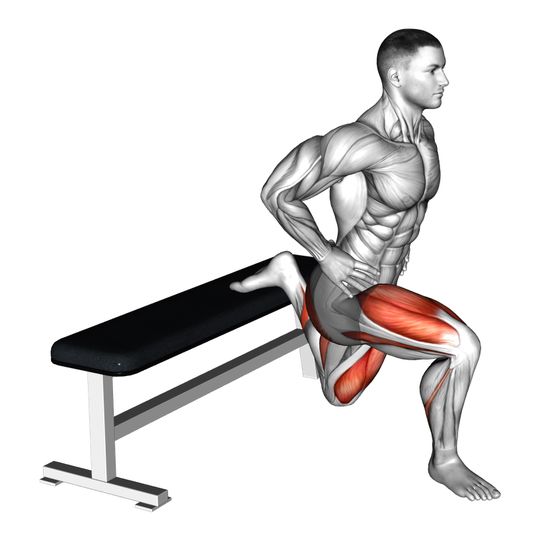


Hold a static, seated position with your back against a wall to isometrically load the quadriceps and the front of the thighs.
How to do the Wall Sit#
- Stand with your back against a wall and place your feet about hip-width apart a short step forward.
- Slide down the wall until your thighs are roughly parallel to the floor and your knees form about a 90° angle.
- Keep your weight through your heels, press your lower back into the wall, and lift your chest.
- Breathe evenly and maintain the position for the programmed duration.
- Finish by pressing through your feet and slowly sliding up the wall to return to standing.
Muscles worked#
The wall sit is an isometric quad exercise. With the knees and hips held at 90 degrees, the quadriceps have to produce force continuously to stop you sliding down the wall, and because nothing moves, there is no rest at the top or bottom of a rep. The vastus medialis on the inside of the knee and the rectus femoris down the front of the thigh work hardest, and the burn builds steadily until the legs shake and give out.
The glutes contribute by holding the hips at 90 degrees and pressing the lower back into the wall, the hamstrings co-contract to stabilise the knee, and the calves keep the feet planted. The abs stay lightly braced to keep the back flat. Compared with a squat, almost nothing is asked of the lower back, which is why the wall sit is often the first quad exercise given after a knee injury and why it is safe to hold to the point of failure.
- Primary: Quads (Quadriceps Femoris)
- Secondary: Glutes (Gluteus Maximus), Hamstrings (Biceps Femoris, Semitendinosus & Semimembranosus), Calves (Gastrocnemius & Soleus)
Common mistakes#
- Letting the knees collapse inward.
- Positioning the feet too far forward so the knees travel past the toes.
- Lifting the hips away from the wall.
- Rounding the upper back or slumping the chest.
Why it works#
The wall sit builds quad endurance and tendon tolerance with zero equipment and almost no joint stress. Isometric holds at a fixed knee angle are one of the most reliable ways to calm patellar tendon pain and rebuild strength around a knee that cannot yet handle squatting, which is why physiotherapists lean on it so heavily. It also trains the mental side of holding an uncomfortable position that skiing, hiking, and long sets of squats all demand.
It is easy to fit anywhere: no warm-up, no setup, a wall and a timer. That makes it useful as a finisher after leg day, as a filler in a home workout, or as a daily habit for anyone who sits a lot and wants stronger legs without a gym. Progress is easy to measure in seconds, and the progressions to single leg or weighted holds keep it useful long after the basic hold gets easy.
Sets, reps and setup#
Three to four holds of 30-60 seconds with 60 seconds of rest, two or three times a week. Once you can hold 90 seconds comfortably, stop adding time and make the hold harder instead; endurance holds beyond two minutes stop building strength and just build tolerance for the burn.
- Setup
- Stand with the back flat against a wall and step the feet out about 50 to 60 centimetres, hip width apart. Slide down until the thighs are parallel to the floor, the knees are at 90 degrees, and the shins are vertical with the knees directly over the ankles. Press the whole back into the wall, keep the weight through the heels, and breathe steadily rather than holding your breath.
- Progression
- Add ten seconds per hold each week up to 90 seconds. Then hold a dumbbell or plate on the thighs, lift one foot off the floor for a single-leg hold of 15-30 seconds per side, or sink slightly below parallel. Squeezing a ball between the knees adds the adductors and keeps the knees from collapsing in.
Variations#
- Squat Hold The same isometric position without the wall, which adds balance and lower back demand.
- Bodyweight Squat Moves through the range instead of holding it, the natural next step once the wall sit is easy.
- Leg Extension Isolates the quads with adjustable load and a moving range, for progression beyond bodyweight holds.
- Split Squat A single-leg squat pattern that builds on the quad strength the wall sit develops.
- Goblet Squat A loaded squat with a dumbbell at the chest, the simplest way to add weight to the same quad-dominant position.
Wall sit vs squat#
The squat moves the hips and knees through a full range and can be loaded heavily, so it builds strength and size in the quads and glutes far more effectively than any hold. It also demands balance, mobility, and a braced trunk, which is exactly what makes it hard for beginners and for anyone with a sore knee or back.
The wall sit holds one position, so it builds endurance and tendon tolerance at that specific knee angle with almost no skill or joint stress. It is the right choice for rehab, for building the base to squat, or as a finisher after squats. On its own it will not grow legs the way loaded squats do; treat it as a complement rather than a replacement.
Common questions#
What muscles does the wall sit work?
Mainly the quads, which hold the knees at 90 degrees for the entire duration. The glutes and hamstrings stabilise the hips and knees, the calves keep the feet planted, and the abs keep the back flat against the wall.
How long should you hold a wall sit?
Thirty seconds is a fair starting point, 60 seconds is solid, and 90 seconds with perfect position means it is time to make the hold harder rather than longer. Holds past two minutes build tolerance for discomfort more than strength.
Are wall sits good for knee pain?
Often, yes. Isometric quad holds at a pain-free angle are widely used to reduce patellar tendon pain and rebuild strength around the knee. Start with a shallower angle if 90 degrees hurts, and keep the knees over the ankles rather than out past the toes.
Do wall sits build muscle?
A little, especially for beginners, but not much. Isometric holds are effective for strength at the trained angle and for endurance, while muscle growth needs loading through a range with progressive weight. Use wall sits alongside squats or leg extensions, not instead of them.
Is it okay to do wall sits every day?
Yes, as long as the holds are not taken to complete failure every time. The movement is low impact and easy to recover from, and daily holds of 30 to 60 seconds are a common rehab prescription. Two or three focused sessions a week is enough for most people.
Where should my feet be for a wall sit?
About 50 to 60 centimetres from the wall, hip width apart, so that when you slide down the knees sit directly above the ankles and the shins are vertical. If the knees end up past the toes the feet are too close; if you cannot reach 90 degrees they are too far out.