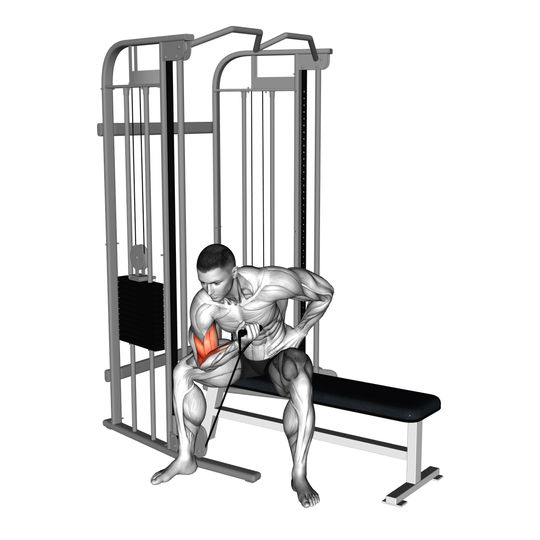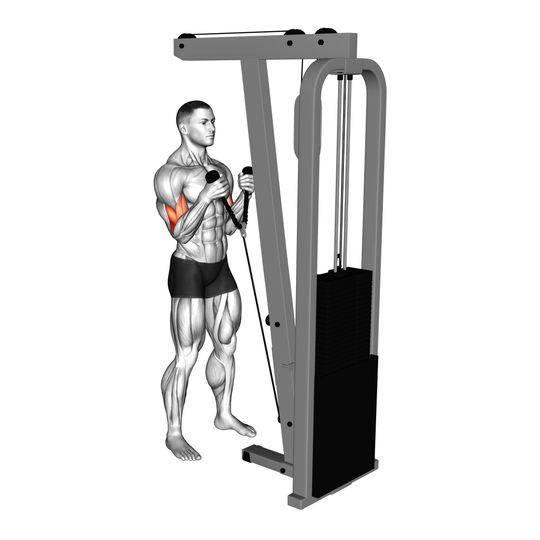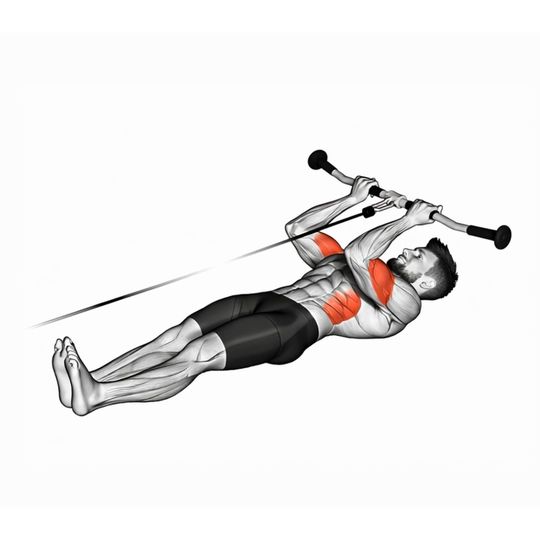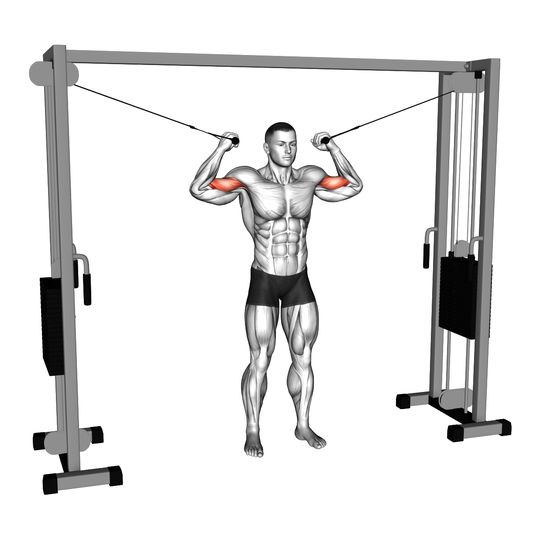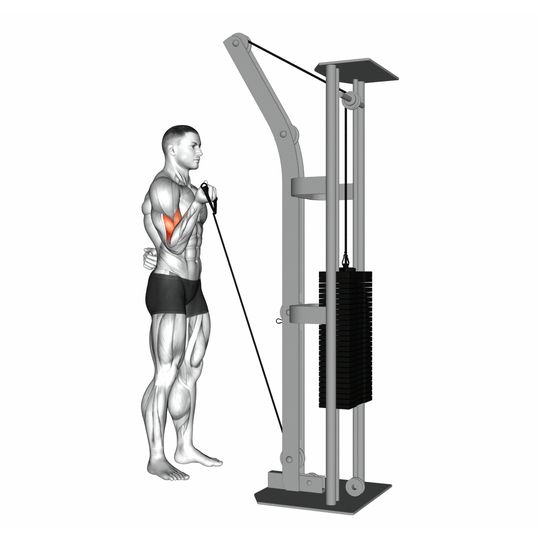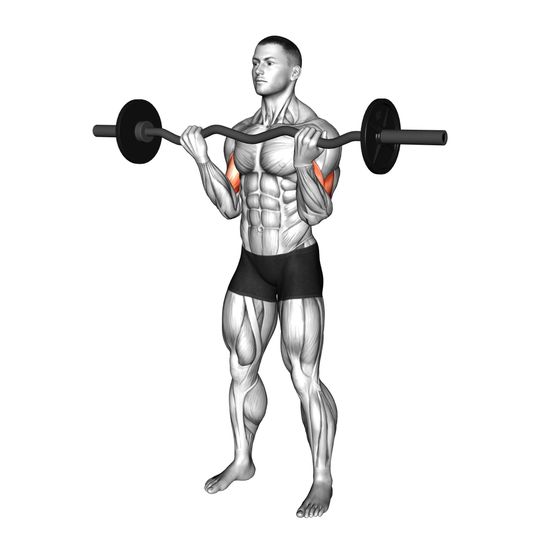


Stand and pull a cable bar upward by flexing at the elbow, using the biceps as the primary mover.
How to do the Cable Curl#
- Stand holding the cable bar with an underhand (palms-up) grip about shoulder-width apart and elbows touching your sides.
- Keep your upper arms stationary and elbows pinned to your torso throughout the movement.
- Curl the bar upward by bending at the elbows until your hands approach shoulder level.
- Pause briefly and contract the biceps at the top of the curl.
- Lower the bar back to the start in a controlled manner and repeat for the desired reps; you can perform single-arm variations by switching to a single-hand cable grip.
Muscles worked#
Common mistakes#
- Using torso swing or momentum to lift the weight.
- Letting the elbows move forward away from the sides.
- Allowing the wrists to bend instead of staying neutral.
- Dropping the weight quickly on the way down instead of controlling the descent.
Why it works#
A barbell or dumbbell curl gives you nothing at the bottom. With the arm straight the weight hangs directly under the elbow, so there is no torque to resist, and the hardest point sits around ninety degrees before falling away again near the top. A cable pulling from a low pulley in front of you keeps the load on the elbow flexors at full extension, which is the position most of the recent hypertrophy work suggests is worth loading.
The stack also removes the two things that ruin curl sets: fixed jumps and body English. You can add two and a half kilos instead of five, you can run a drop set by moving one pin, and because the resistance is smooth there is far less temptation to swing the weight up with your hips.
Sets, reps and setup#
Three to four sets of 10-15 reps with 60-90 seconds of rest, twice a week. Biceps are small, recover quickly and tolerate frequency well, so two moderate sessions beat one long one.
- Setup
- Straight or EZ attachment on the lowest pulley. Stand one to two steps back so the cable is angled and there is still tension when your arms are straight, keep your elbows pinned at your sides, and let the arm extend fully on every rep rather than stopping short.
- Progression
- Work each set from 10 up to 15 reps, then add one plate and start again. When adding load stops working, add a drop set to the last set instead — biceps respond well to that extra work at a lighter weight.
Variations#
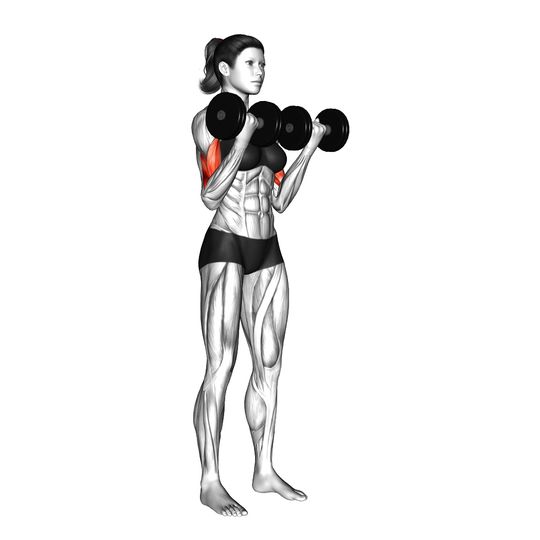
- Bicep Curl (Dumbbell) Lets each arm rotate freely into supination, which the biceps also does. The bottom of the rep is unloaded.
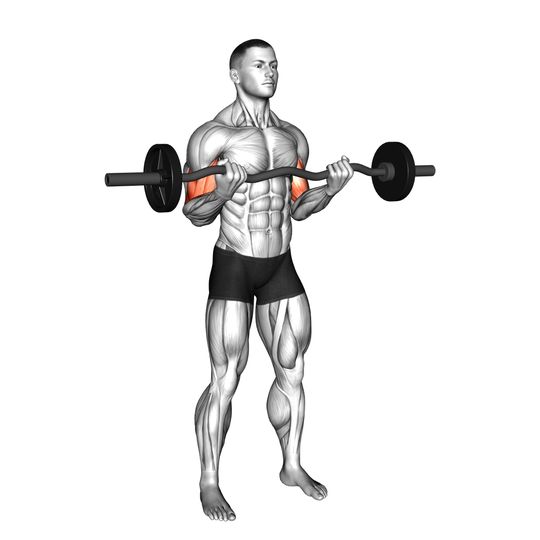
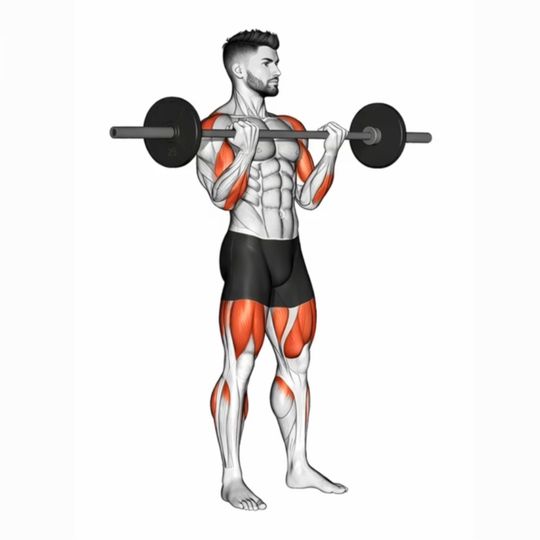
- Bicep Curl (Barbell) The heaviest way to curl and the easiest to progress in small steps, at the cost of a fixed wrist position.
- Bayesian Curl A single-arm cable curl with the arm held behind the torso, which loads the biceps in a stretched position.
- Single Arm Curl (Cable) One side at a time, so a stronger arm cannot quietly take over the set.
- Hammer Curl (Cable) A neutral grip that brings in the brachialis and the forearm, and is usually kinder to sore elbows.
Cable curl vs dumbbell curl#
The cable wins on tension. It loads the stretched position where a dumbbell gives you nothing, it holds tension at the top instead of letting the forearm stack over the elbow, and it progresses in smaller increments. For pure elbow flexor stimulus per set, it is the better tool.
The dumbbell wins on the wrist. Your hand is free to rotate from neutral into full supination, which is part of what the biceps does, and you can work one arm at a time anywhere in the gym. The usual answer is to run both — a cable movement for tension and a dumbbell movement for supination.
Common questions#
What muscles does the cable curl work?
The biceps brachii is the target, with the brachialis underneath it and the brachioradialis in the forearm assisting. The forearm flexors also work to hold the bar or handle.
How many sets and reps should I do for biceps?
Three to four sets of 10-15 reps, taken to within a couple of reps of failure, twice a week. Biceps are a small muscle — more sets is not the answer, but more frequency often is.
How far from the pulley should I stand?
One to two steps back. Far enough that the cable is angled forward and there is still tension when your arms hang straight; close enough that the weight stack does not pull you forward at the top.
Is the cable curl better than the barbell curl?
It is better at loading the stretched position and easier to progress in small jumps. The barbell moves more total weight, so it is the better strength lift. Most lifters get the most out of running one of each.