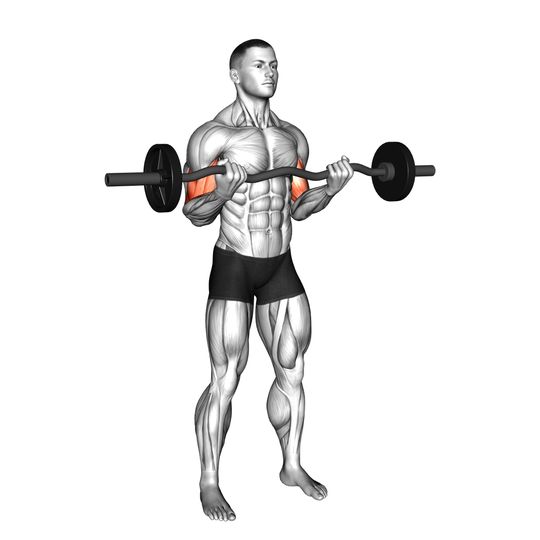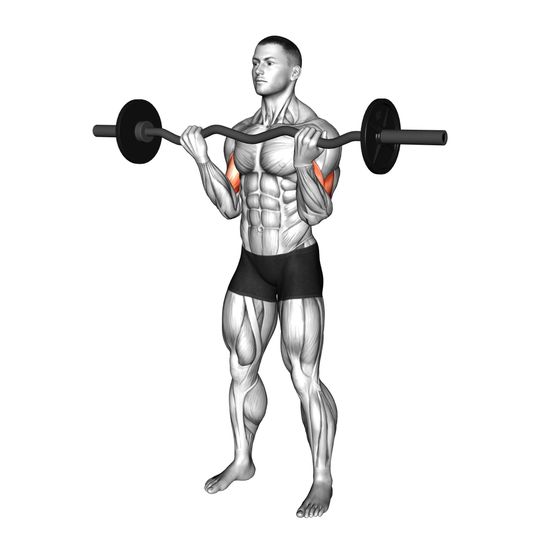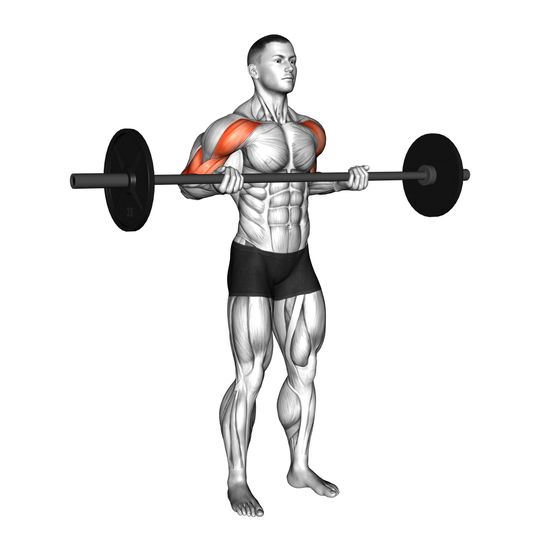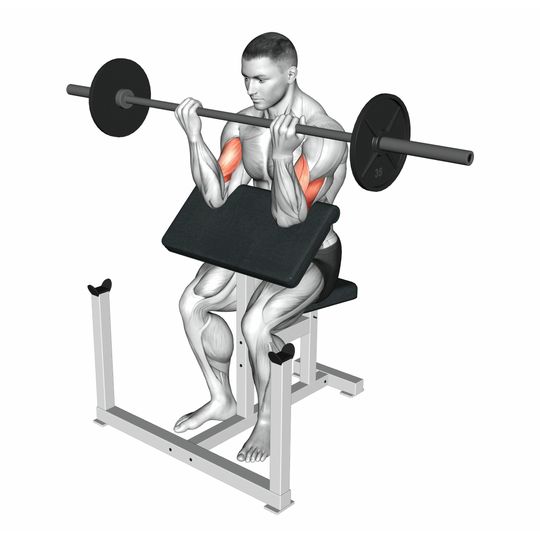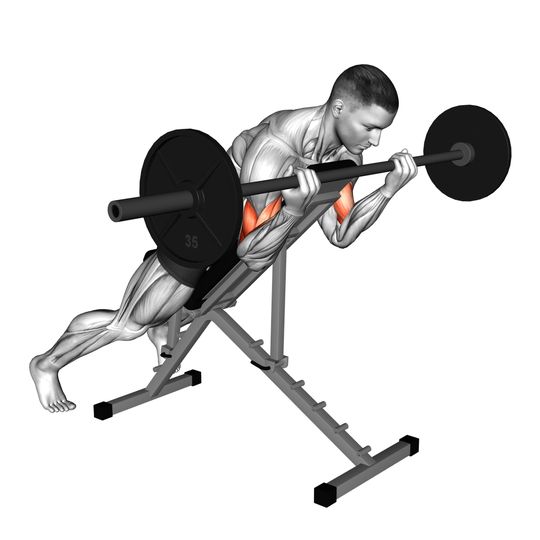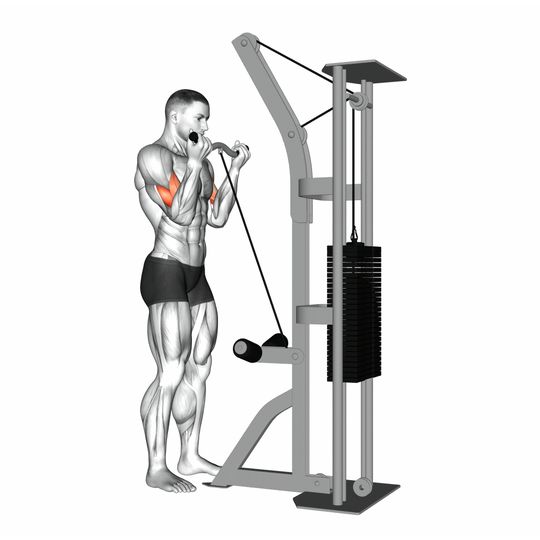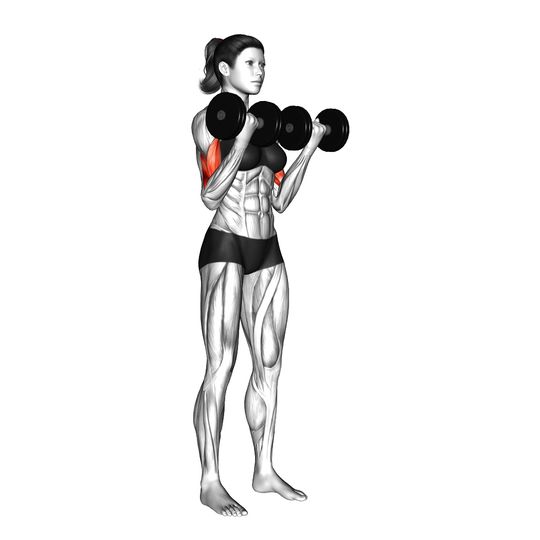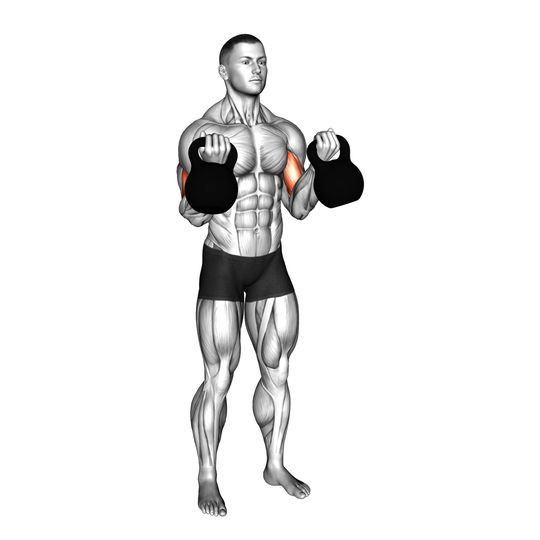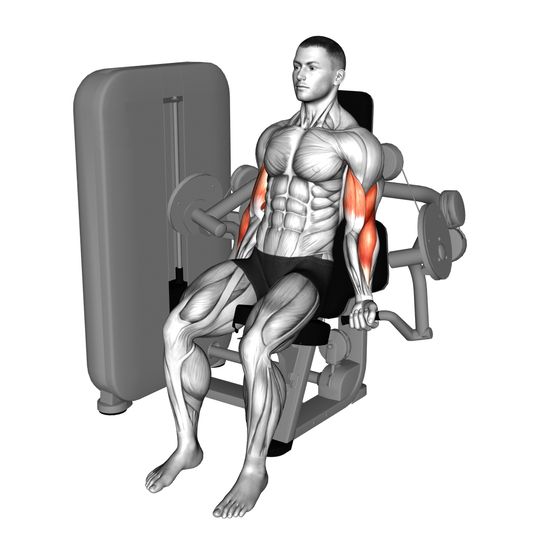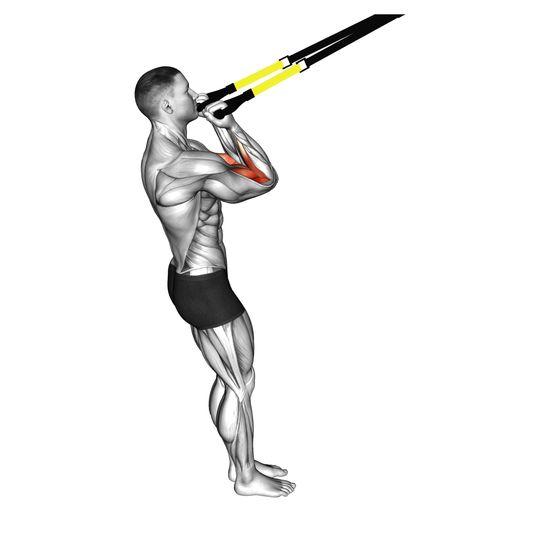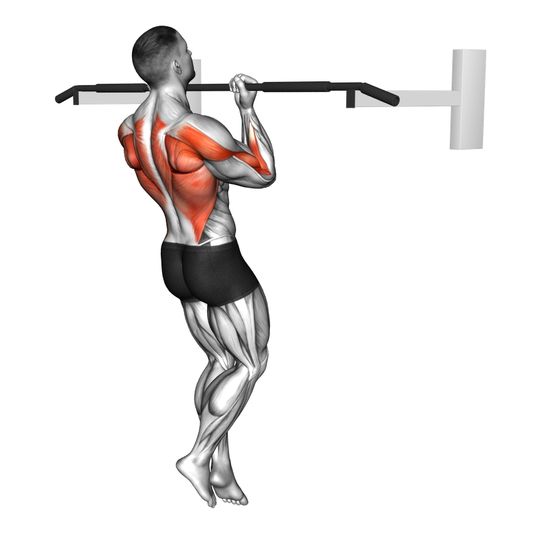


Standing underhand barbell curls bend the elbows to lift the bar toward the shoulders, primarily working the biceps.
How to do the Barbell Curl#
- Stand with feet hip-width apart and grasp the barbell with an underhand grip about shoulder-width.
- Keep your upper arms still and your elbows tucked against your sides.
- Contract the biceps to curl the bar upward until it reaches shoulder level.
- Hold the top briefly while keeping the movement controlled.
- Lower the bar slowly back to full arm extension before the next rep.
Muscles worked#
The barbell curl is the heaviest way to isolate the biceps. Both heads of the biceps (biceps brachii) bend the elbow against the bar, and because the hands are supinated and fixed on a straight bar, the biceps stay in their strongest position for the whole rep. Both arms sharing one bar means the stronger arm can help the weaker one, which is why most people curl more total weight with a barbell than with two dumbbells.
The brachialis under the biceps and the brachioradialis on the top of the forearm assist with elbow flexion and grow along with the biceps. The forearm flexors hold the wrist straight against the load, the front delts stabilise the upper arm, and the abs and lower back keep the torso still, which is where cheat curls start to cost you. The elbows should not move; the upper arm is a hinge, not a lever.
Common mistakes#
- Using torso momentum or swinging the back to help lift the weight.
- Letting the elbows move away from the sides instead of staying fixed.
- Bending the wrists and lifting with the hands rather than the biceps.
- Dropping the weight quickly on the descent without control.
- Not fully extending the arms between repetitions.
Why it works#
Progressive overload is what grows muscle, and the barbell curl is the easiest biceps exercise to overload in small steps. A pair of dumbbells jumps in 2 kg increments per hand; a barbell lets you add 1.25 kg total, week after week. Over months that steady loading builds arms that scattered high-rep pump work does not.
The straight bar also demands full supination, which trains the biceps through their complete function of both bending the elbow and turning the palm up. It is the standard against which arm strength is measured for a reason, and a lifter who can curl a strict 40 kg barbell for ten reps has biceps to show for it.
Sets, reps and setup#
Three or four sets of 8-12 reps with 60-90 seconds of rest, once or twice a week. Lower every rep over about two seconds to a fully straight arm. Heavy sets of 6 have a place, but below that the movement stops being a curl and becomes a swing.
- Setup
- Stand with the feet hip width and hold the bar with an underhand grip at shoulder width. Pin the elbows to the sides of the ribs, keep the chest up and the wrists straight, and curl the bar to the top of the chest. Squeeze for a second, then lower under control until the arms are straight and the biceps are stretched.
- Progression
- Add 1.25 kg per side when you can do 12 clean reps on all sets. If your torso starts leaning back or the elbows drift forward on the top reps, the weight is ahead of you. Stand with your back against a wall for a cycle to remove the cheat and reset your honest working weight.
Variations#
- EZ Bar Curl The angled grip is kinder to the wrists and elbows, with slightly more brachialis involvement.
- Dumbbell Curl Each arm works alone, which evens out strength differences and allows rotation of the wrist through the rep.
- Barbell Preacher Curl The upper arms braced on a pad, which removes all body english and loads the biceps hardest near the top.
- Drag Curl The bar is dragged up the torso with the elbows travelling back, isolating the biceps without shoulder involvement.
- Barbell Reverse Curl An overhand grip that shifts the work to the brachialis and forearm extensors.
Barbell curl vs dumbbell curl#
The barbell lets you lift more total weight and progress in smaller increments, which makes it the better main biceps exercise for building strength and size over time. The fixed supinated grip keeps the biceps fully engaged throughout, and the movement is simple to perform consistently.
Dumbbells let each arm work independently, so a stronger side cannot cover for a weaker one, and the wrists can rotate through the rep, which some people find more comfortable. They also allow incline, hammer, and concentration variations that the bar cannot. Use the barbell for your heavy curl and dumbbells for the second exercise or to fix an imbalance.
Common questions#
What muscles does the barbell curl work?
The biceps are the main target, with the brachialis and brachioradialis assisting the elbow flexion. The forearm flexors hold the wrist, and the front delts and core stabilise the arm and torso.
How much should I be able to barbell curl?
A strict 10-rep set with 30 kg is a solid intermediate standard for a man, and 40-50 kg for ten reps is strong. For women, 15-20 kg for ten strict reps is a good target. Numbers done with a swinging torso do not count.
Is the barbell curl bad for your wrists?
Not for most people, but the fully supinated straight bar grip does stress the wrists and the inside of the elbows more than a dumbbell or EZ bar. If it aches, switch to the EZ bar, loosen your grip width by a few centimetres, or keep the wrists slightly bent back rather than curled.
Should I use a wide or narrow grip on barbell curls?
Shoulder width is the default and trains both heads evenly. A narrower grip biases the long head that forms the outer peak, a wider grip biases the short head on the inside. The differences are small; comfort and a straight wrist matter more.
Are cheat curls ever useful?
A little hip drive on the last rep or two of a heavy set is a legitimate way to overload the lowering phase, as long as the eccentric is slow and controlled. Cheating from the first rep just means the weight is too heavy for your biceps.