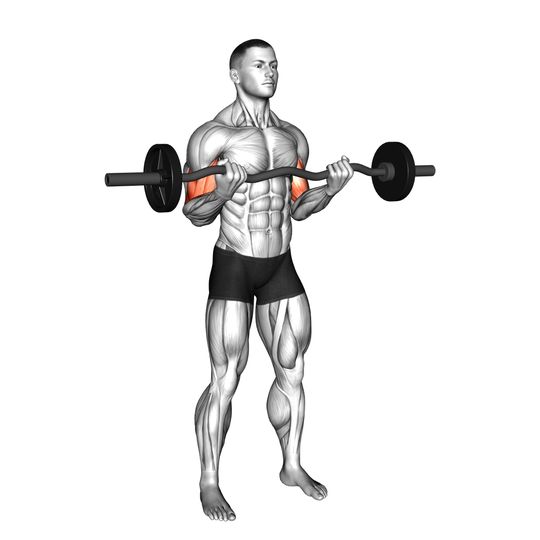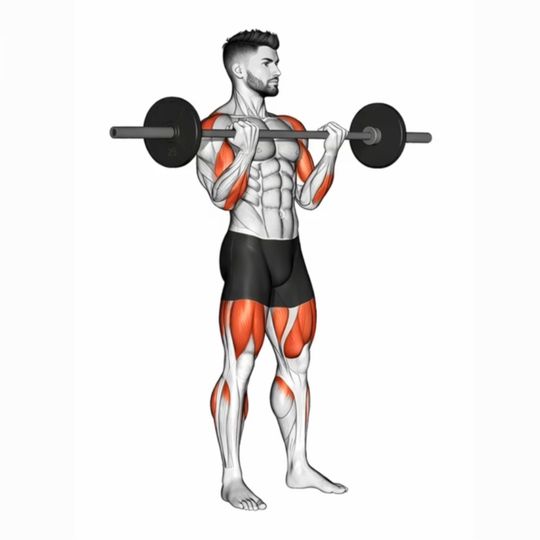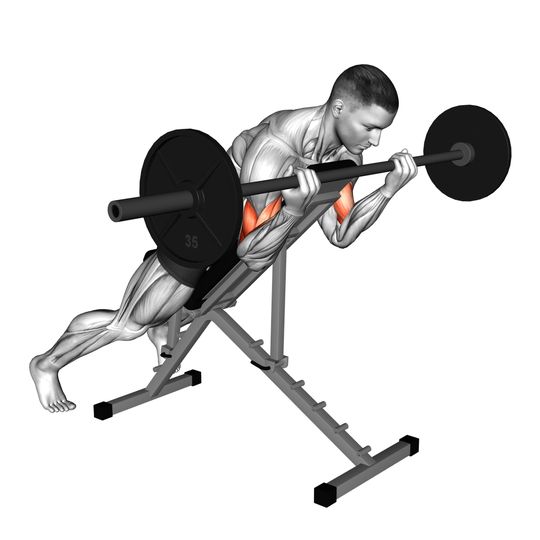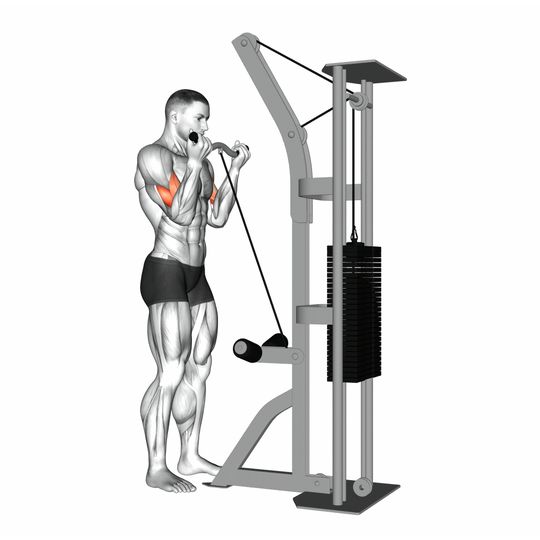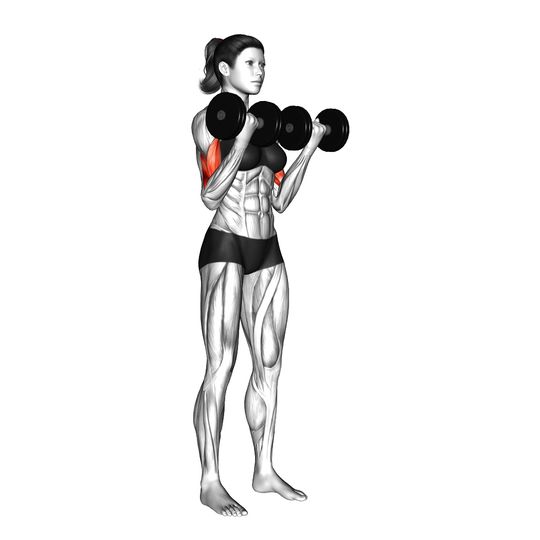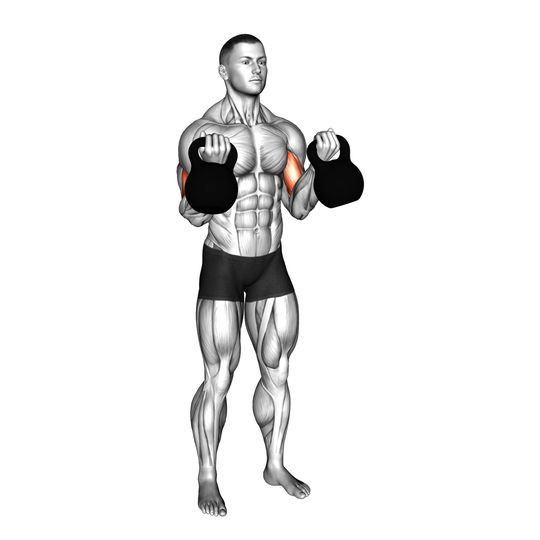


Stand upright holding an EZ bar with a supinated (underhand) grip and curl it toward your shoulders by flexing the elbows to work the biceps.
How to do the EZ Bar Curl#
- Stand with feet hip-width apart and hold the EZ bar with an underhand grip, hands positioned on the angled sections.
- Keep your chest up, shoulders back, and elbows close to your sides with the arms extended at the start.
- Curl the bar up by bending only at the elbows until it nears shoulder level, maintaining a steady path.
- Pause briefly and contract the biceps at the top without swinging the torso.
- Lower the bar under control back to full arm extension before beginning the next rep.
Muscles worked#
The EZ bar curl works the biceps, the biceps brachii, through their main job of bending the elbow. The angled grip puts the hands in a semi-supinated position, somewhere between a straight bar curl and a hammer curl, which turns the forearm slightly and brings the brachialis, the muscle under the biceps that pushes them up and out, and the brachioradialis in the upper forearm into the movement more than a straight bar does. Both heads of the biceps work through the full range.
The forearm flexors hold the wrist steady and grip the bar throughout, and they fatigue less than on a straight bar because the wrists are not forced into full supination. The front delts stabilise the shoulder and are the first thing to take over if the elbows drift forward. Done with a still torso, you should feel the whole upper arm working and very little in the wrists or shoulders.
Common mistakes#
- Using body momentum to lift the bar.
- Allowing the elbows to travel forward away from the sides.
- Curling through the wrists instead of the elbows.
- Dropping the bar quickly on the lowering phase.
Why it works#
The EZ bar exists because straight bar curls hurt a lot of wrists and elbows. The angled grips let the hands sit at a natural slight inward turn, which takes the strain off the wrist flexors and the tendons on the inside of the elbow while still letting you load the biceps heavily with both arms at once. For most lifters it is the most comfortable way to curl heavy and stay pain-free over years of training.
Because the bar links both arms, you can move more total weight than with dumbbells and the strong arm cannot quietly do more than its share of the work in the way it can with a cable machine. It is a simple movement to progress: add small plates, hold the top, or slow the lowering, and the biceps grow. Paired with a hammer or incline curl it covers arm training completely.
Sets, reps and setup#
Three to four sets of 8-12 reps with 60-90 seconds of rest, once or twice a week, after your pulling work. Take the last set close to failure. Heavy sets of five are mostly a lower back and shoulder exercise once the swinging starts, so keep the load where the elbows stay pinned.
- Setup
- Hold the bar on the angled sections with the palms turned slightly in, stand with the feet hip width and a soft knee bend, and pin the elbows to the sides of the ribs. Curl until the forearms are just past vertical, squeeze for a beat, and lower over two to three seconds to a full straight arm at the bottom. Keep the wrists straight; the bar should move only because the elbows bend.
- Progression
- Add reps to twelve, then add 1.25 to 2.5 kilograms per side and drop back to eight. When progress stalls, slow the lowering to four seconds, add a one-second pause at the halfway point, or run a set of 21s at the end of the session to extend time under tension without adding load.
Variations#
- Barbell Curl Straight bar with a fully supinated grip, which puts slightly more emphasis on the biceps but more strain on the wrists.
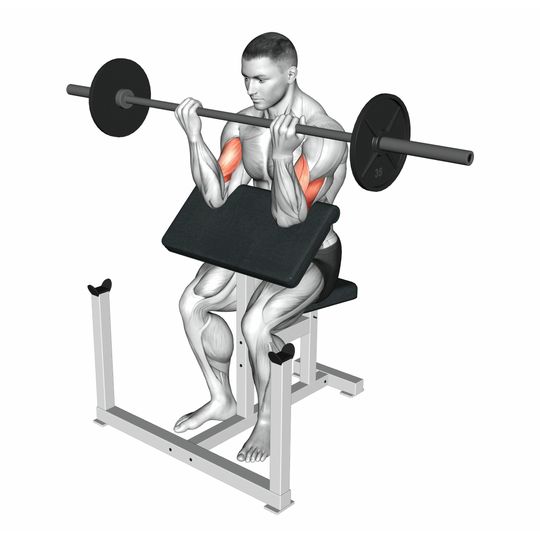
- Barbell Preacher Curl Rests the arms on an angled pad so the shoulders cannot help and the bottom of the range is loaded hardest.
- Dumbbell Curl Independent arms with a free wrist path, so you can rotate through the rep and fix side-to-side imbalances.
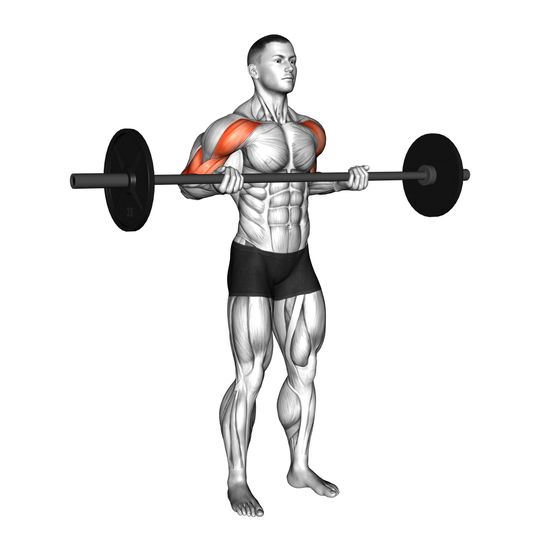
- Barbell Reverse Curl Palms down on the same bar, which shifts the load to the brachialis and forearms.
- Hammer Curl A neutral grip that targets the brachialis and brachioradialis for arm thickness.
EZ bar curl vs barbell curl#
The straight barbell forces the hands into full supination, which is technically the strongest position for the biceps to work in and gives a marginally better peak contraction. It is also the reason many lifters develop wrist pain and inner-elbow tendon irritation from heavy barbell curls.
The EZ bar's angled grip sits the hands at a slight inward turn, which spares the wrists and elbows, brings the brachialis in a little more, and lets most people curl a similar or heavier weight comfortably. The biceps stimulus is nearly identical. Unless a straight bar feels perfectly fine on your joints, the EZ bar is the better everyday choice.
Common questions#
What muscles does the EZ bar curl work?
The biceps do the majority of the work bending the elbow, with the brachialis and the brachioradialis in the upper forearm contributing more than on a straight bar because of the angled grip. The forearm flexors hold the wrist and grip, and the front delts stabilise the shoulder.
Is the EZ bar curl better than the barbell curl?
For most people, yes. The angled grip is far easier on the wrists and elbows, the biceps stimulus is nearly the same, and the brachialis gets slightly more work. The straight bar has a small edge in peak biceps contraction if it does not bother your joints.
Should I use the wide or narrow grip on an EZ bar?
The inner, narrower grip turns the palms up a little more and biases the biceps; the outer, wider grip is closer to neutral and brings in more brachialis and forearm. Both are fine. Use whichever lets you curl without wrist discomfort, or alternate between sessions.
How heavy should I go on EZ bar curls?
Heavy enough that eight to twelve reps is hard with the elbows still and the torso upright. If you have to swing, lean back, or let the elbows drift forward to finish a rep, drop the weight by ten percent. For most men that is a 20 to 35 kilogram total; for most women 10 to 20.
Why do my forearms hurt more than my biceps when curling?
Usually the wrists are curling up during the rep or the grip is too tight. Keep the wrists straight so the bar moves only from the elbow, loosen the grip slightly, and consider the wider grip on the EZ bar, which lets the forearms relax more.