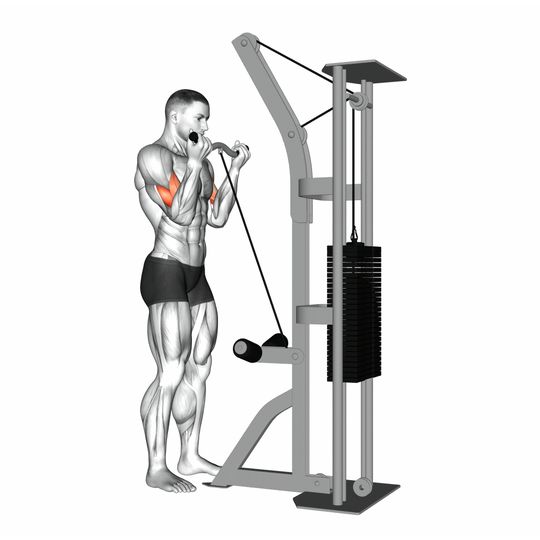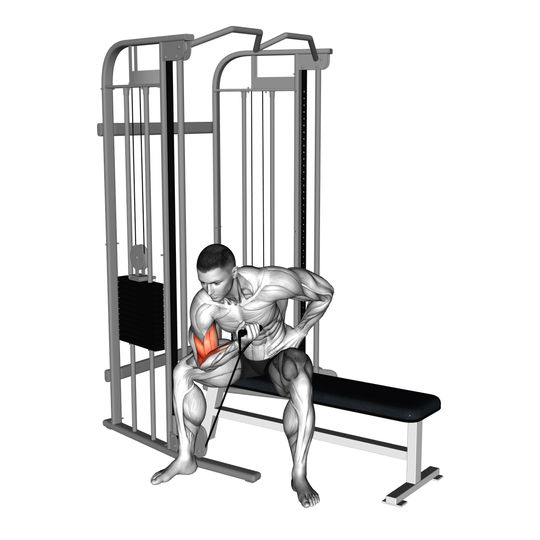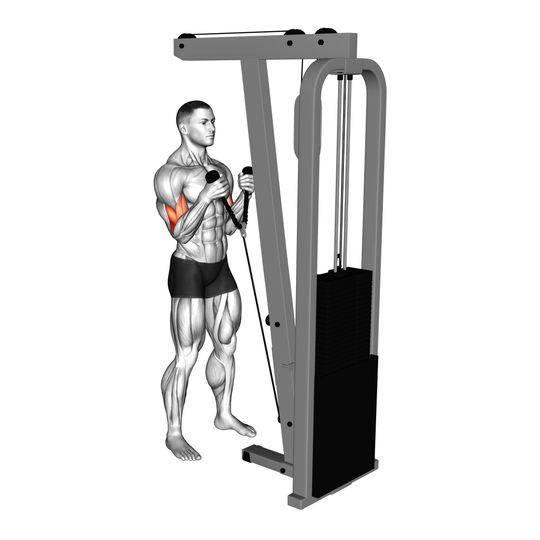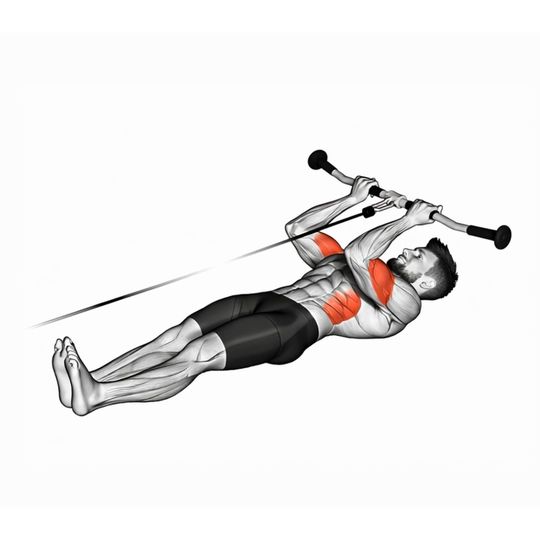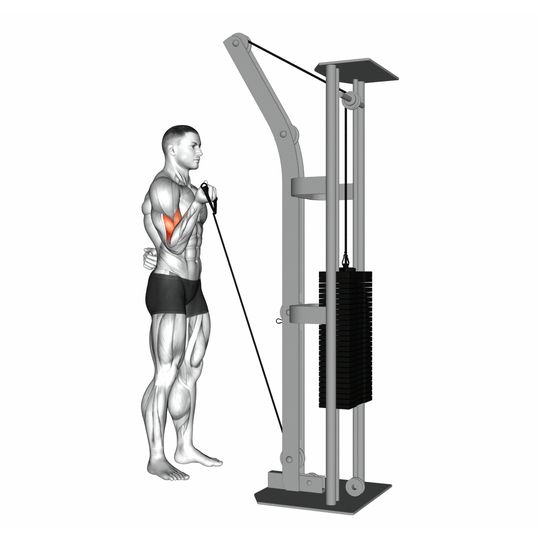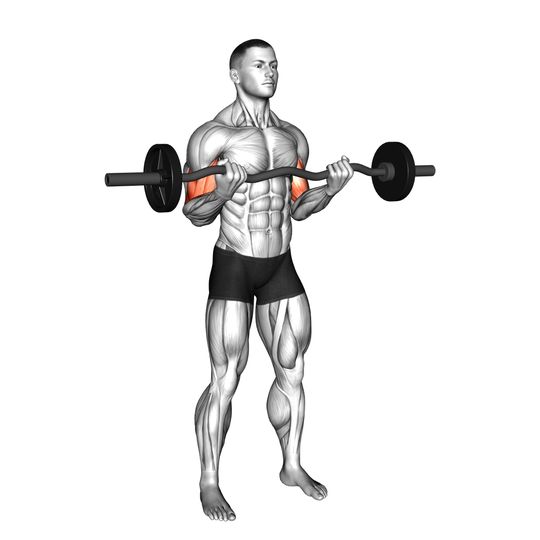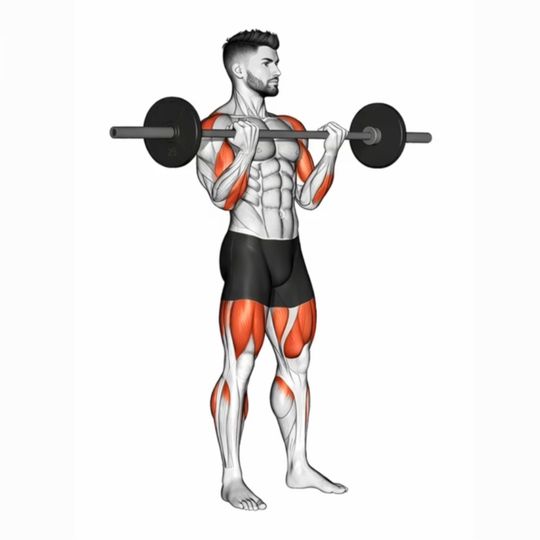


A single-arm cable curl performed a step in front of a low pulley so the working arm stays behind your torso for the whole set. That behind-the-body position keeps the shoulder extended, which lengthens the long head of the biceps and loads it hardest in the stretched position — the part of the range a standing dumbbell curl barely challenges. The cable also holds tension at the bottom instead of letting it fall away, so it works well as a second biceps movement after heavy barbell or EZ-bar curls, or as a finisher where the stretch matters more than the load.
How to do the Bayesian Curl#
- Set a cable pulley to its lowest position and attach a single-handle grip.
- Take the handle in one hand with an underhand grip and step forward one to two feet so the cable pulls your arm behind your torso.
- Stagger your stance with the opposite foot forward, brace your core, and let the working arm hang back with the shoulder slightly extended.
- Keep your upper arm fixed behind your body and curl the handle toward your shoulder by bending only at the elbow.
- Squeeze the biceps at the top without letting the elbow drift forward.
- Lower under control until the arm is fully straight and you feel a strong stretch in the biceps.
- Complete all reps on one side, then switch arms.
Muscles worked#
Common mistakes#
- Standing too close to the pulley, which removes the stretch that makes the exercise work.
- Letting the elbow travel forward so the movement becomes an ordinary cable curl.
- Cutting the bottom of the range short instead of letting the arm straighten fully.
- Leaning back or twisting the torso to move a heavier stack.
Why it works#
What makes a curl "bayesian" is the position, not the curl itself. You stand a step in front of a low pulley with a single handle so the working arm stays behind your torso for the whole set. The biceps crosses the shoulder as well as the elbow, so holding the shoulder in extension puts the long head at a longer length than any standing curl reaches — and that is where the cable loads it hardest.
That matters because training a muscle in its lengthened position appears to be at least as effective for growth as loading the shortened end, and the long head of the biceps is difficult to lengthen any other way. The cable also holds tension at full elbow extension instead of letting it fall away, so the bottom of every rep does real work rather than being a rest stop.
Sets, reps and setup#
Two to three sets of 8-15 reps per arm with 60-90 seconds of rest. Use it as your second or third biceps exercise, after the heavy barbell or EZ-bar work, where a strong stretch is more useful than a big number on the stack.
- Setup
- Lowest pulley, single handle, underhand grip. Step one to two feet forward with the opposite foot leading, let the arm hang behind your torso with the shoulder slightly extended, and curl by bending only the elbow — the upper arm stays behind you from the first rep to the last.
- Progression
- Earn 15 reps on both arms before adding a plate, and take two to three seconds on the lowering phase. If the elbow drifts forward or you start leaning back, the load is too heavy for the position that makes this exercise work.
Variations#
- Bicep Curl (Cable) The standard two-arm cable curl, with the arms beside the body rather than behind it.
- Single Arm Curl (Cable) The same one-handed cable curl without the step forward, so the shoulder stays neutral.
- Incline Curl (Dumbbell) The free-weight way to get the arm behind the torso, using a bench instead of a step forward.
- Spider Curl (Dumbbell) The opposite end of the range: arms hanging in front, hardest at the top of the rep.
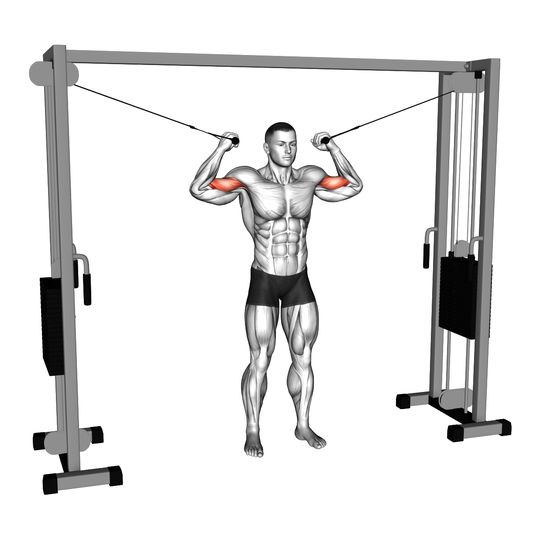
- Overhead Curl (Cable) Arms out to the sides at shoulder height, which loads the biceps in a shortened, fully contracted position.
Bayesian curl vs incline dumbbell curl#
Both put the shoulder behind the torso, so both train the long head of the biceps at length. The incline curl needs nothing but a bench and a dumbbell, and it loads the stretch well — but the resistance drops off as the forearm approaches vertical, so the top of the rep gives you very little.
The bayesian curl keeps tension the whole way because the cable pulls from behind you, and you can adjust the angle simply by stepping further forward or back. The trade-off is that it takes a free cable station, one arm at a time, and a bit of practice to stop the torso from drifting.
Common questions#
Why is it called a Bayesian curl?
The name comes from the Bayesian Bodybuilding coaching brand that popularised the setup — it says nothing about the mechanics of the movement. Descriptively it is a behind-the-body cable curl, and you will also see it listed as a bayesian cable curl.
What muscles does the Bayesian curl work?
The biceps brachii, with an emphasis on the long head because the shoulder is held in extension. The brachialis and the forearm flexors assist, and the shoulder and core work to hold the position.
How far in front of the pulley should I stand?
One to two feet — far enough that the cable pulls your arm behind your torso and you feel a stretch in the biceps at the bottom. Stand too close and the arm hangs beside you, which makes it an ordinary cable curl.
Is the Bayesian curl better than a regular cable curl?
It is better at loading the stretched position, which is why it works well as a second biceps movement. A regular cable or barbell curl still lets you handle more weight, so the sensible approach is one of each rather than replacing one with the other.