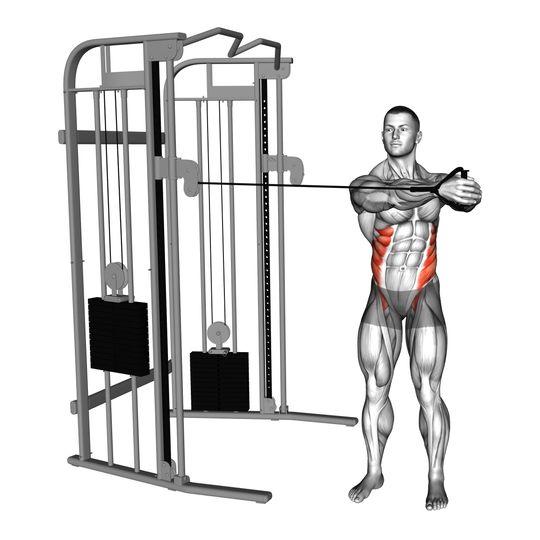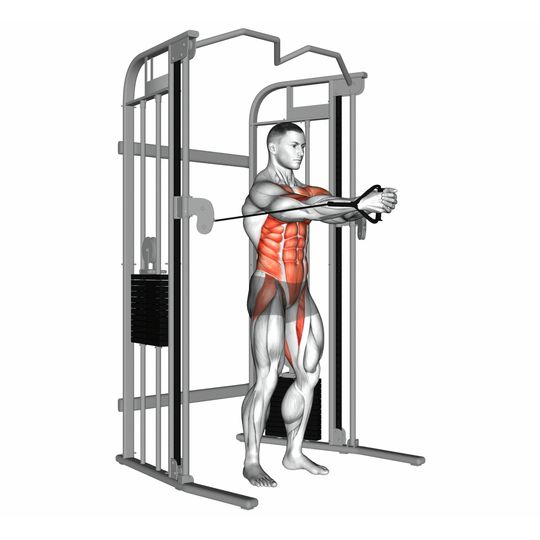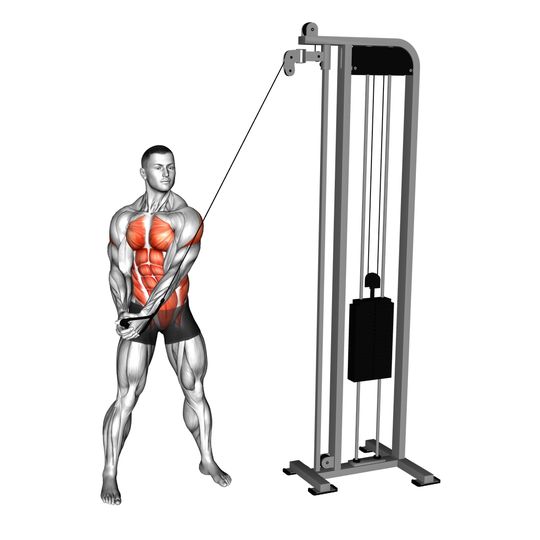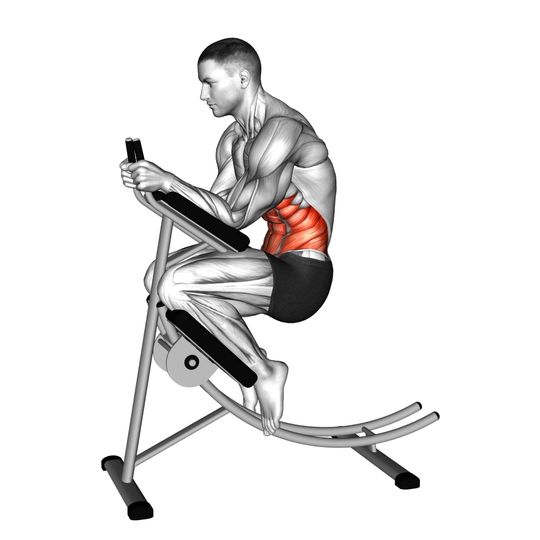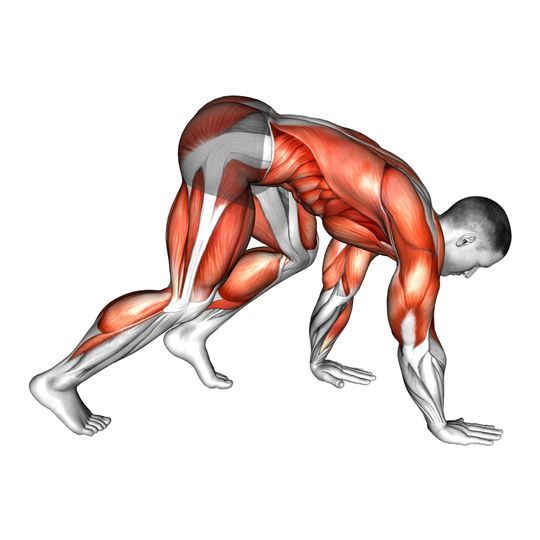


Kneeling cable crunches perform resisted trunk flexion to strengthen the abdominal muscles. You curl the torso down against the cable while keeping the hips fixed.
How to do the Cable Crunch#
- Attach a rope to the machine pulley and kneel facing the stack, holding the rope behind your head.
- Brace your core and keep your hips and lower body still with a neutral spine.
- Exhale as you curl your ribcage toward your pelvis, pulling the rope down until your elbows move toward your thighs.
- Pause briefly at the bottom and then inhale while slowly returning to the starting upright position under control.
- Repeat for the prescribed number of repetitions.
Muscles worked#
The cable crunch is a loaded spinal flexion exercise, which makes it one of the few ab movements you can progressively overload with real weight. The rectus abdominis, the six-pack muscle, shortens to pull the ribcage toward the pelvis against the resistance of the stack. Because the cable pulls upward and the hips stay still, the work is concentrated in the abs rather than in the hip flexors that dominate sit ups and leg raises.
The obliques assist with flexion and stop the torso from twisting, especially if you add a slight rotation to alternate sides. The lats and triceps hold the rope in position behind the head but should not be moving it; if they are, the weight is going down with your arms rather than your spine. The glutes and hamstrings keep the hips fixed so the movement stays a crunch and not a hip hinge.
Common mistakes#
- Pulling the rope with the arms instead of flexing the spine.
- Hinging at the hips rather than curling the torso.
- Using too much weight and losing control of the movement.
- Rushing reps without a controlled eccentric return.
Why it works#
Most ab exercises stop being hard once you can do 20 or 30 reps, and past that point they build endurance rather than muscle. The cable crunch solves this because you can add weight, which puts it in the same category as any other resistance exercise: pick a rep range, add load over time, and the abs grow like any other muscle.
The kneeling position also keeps the lower back out of trouble. There is no repeated hip flexion, no pulling on the neck, and the range can be as short or long as your spine is comfortable with. For lifters who want visible abs and a stronger trunk for squats and deadlifts, it is one of the highest-value core movements available.
Sets, reps and setup#
Three or four sets of 10-15 reps with 60-90 seconds of rest, two or three times a week. Use a weight that makes the last two reps a struggle while the hips stay still. Hold the contracted position for a second on every rep and take two seconds to return.
- Setup
- Attach a rope to a high pulley, kneel a metre or so back from the stack, and hold the rope at the sides of your head or behind your neck. Sit the hips back slightly and keep them there. Round the upper back and pull the elbows toward the knees by shortening the abs, exhaling hard at the bottom, then unroll slowly to a tall kneeling position with the abs stretched.
- Progression
- Add one plate when you can do 15 reps with a full pause at the bottom. If the hips start rocking or the arms pull the rope, the weight is ahead of your abs.
Variations#
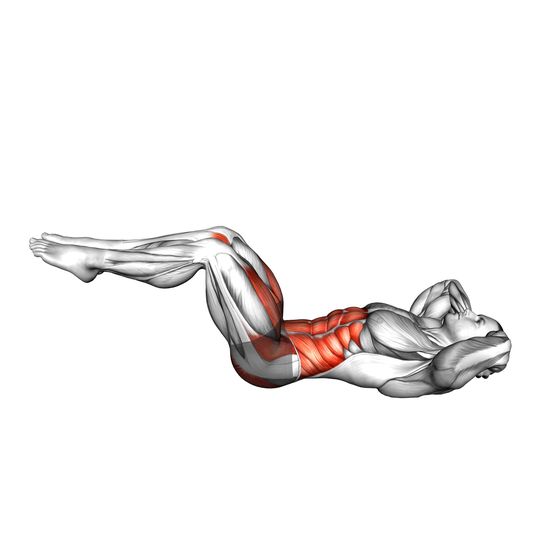
- Crunch The floor version with no external load, useful as a warm up or when you have no cable access.
- Machine Crunch A seated machine with a fixed path that is easier to learn and lets you go heavy without worrying about the hips.
- Decline Crunch Adds range and a stretched start by anchoring the feet on a decline bench.
- Hanging Leg Raise Trains the lower part of the abs and the hip flexors by lifting the pelvis toward the ribs from a hang.
- Cable Woodchopper A rotational cable exercise for the obliques that pairs naturally with the crunch.
Cable crunch vs hanging leg raise#
The cable crunch moves the ribs toward a fixed pelvis, which trains the upper part of the rectus abdominis hardest and is easy to load progressively. It is the more reliable choice for building the abs as a muscle because the weight is adjustable and the movement is stable.
The hanging leg raise moves the pelvis toward fixed ribs and involves the hip flexors heavily, while demanding grip and shoulder stability. It is harder to progress and easier to do badly, but it trains the lower abs and the whole front of the body. Do the cable crunch for loaded flexion and add leg raises when you want the pelvis-tilting pattern as well.
Common questions#
What muscles does the cable crunch work?
The rectus abdominis is the main mover, with the obliques assisting and controlling rotation. The lats and triceps hold the rope in place, and the glutes and hamstrings keep the hips still so the movement stays in the spine.
Are cable crunches effective?
Yes. They are one of the few ab exercises that let you add weight in small steps, which is what makes a muscle grow. Done with a controlled tempo and a full contraction, they build the abs as effectively as any exercise, though they will not reveal them without body fat coming down.
How heavy should cable crunches be?
Heavy enough that 10-15 reps with a one-second squeeze is hard but the hips do not move. Many lifters end up in the 40-70 kg range on a standard stack. If you need to yank with your arms or rock your hips, drop the weight.
Should I hold the rope behind my head or at my shoulders?
Either works. Behind the head is the standard position and keeps the arms fixed. Holding the rope at the sides of the head with the elbows tucked stops you from using the arms and is easier on the neck.
Do cable crunches work the lower abs?
The whole rectus abdominis contracts as one muscle, but the movement of the ribs toward the pelvis emphasises the upper fibres. Add a reverse crunch or hanging leg raise if you want more work in the lower portion.