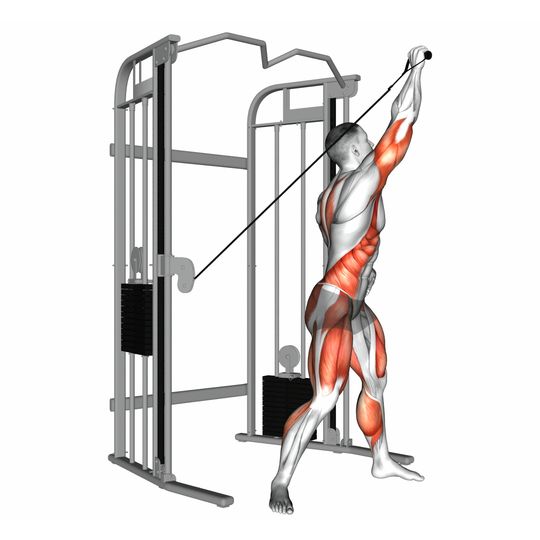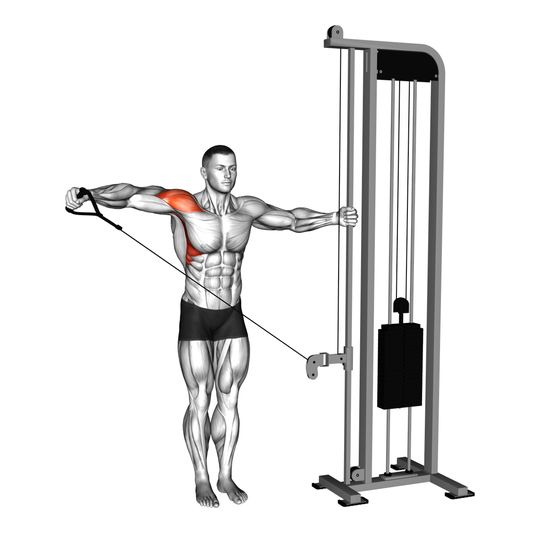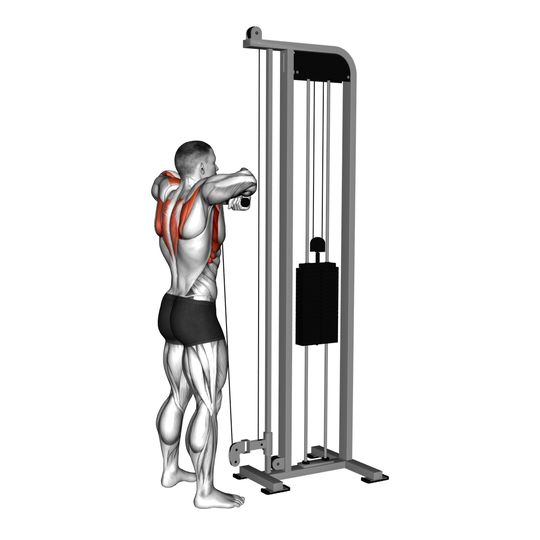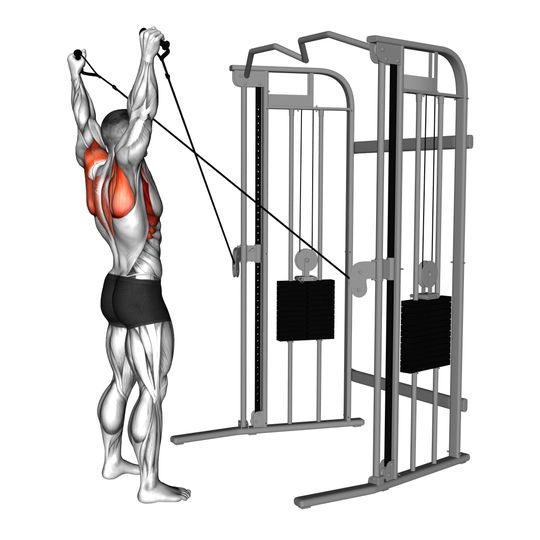


Stand beside a low cable and lift the handle out to your side in a controlled arc to work the lateral deltoid of the shoulder.
How to do the Cable Lateral Raise#
- Set the cable pulley to its lowest position and attach a single handle.
- Hold the handle with the arm at your side and a small bend in the elbow so the handle rests near the outside of your thigh.
- Brace your core and keep your torso still throughout the movement.
- Lift your arm out to the side in a smooth arc until your hand is slightly above shoulder level.
- Lower the handle back to the starting position under control and repeat for the desired reps.
Muscles worked#
The cable lateral raise is a side delt exercise. The lateral head of the deltoid lifts the arm out to the side, and because the cable pulls from the floor and slightly across the body, it resists the arm from the first inch instead of only once the arm is well away from the thigh. That gives the side delt a full range of tension a dumbbell cannot, and it is why lifters describe the cable version as burning from rep one.
The upper traps and the supraspinatus of the rotator cuff assist as the arm rises, and the front delt joins in if the hand drifts forward. The traps become the main mover if you shrug, which is the most common way the exercise goes wrong. The core and the free hand on the machine keep the torso still, so this is one arm at a time with nothing else moving.
- Primary: Side delts (Lateral Deltoid)
- Secondary: Traps (Trapezius)
Common mistakes#
- Using body momentum or swinging the torso to lift the weight.
- Shrugging the shoulder so the traps do the work instead of the deltoid.
- Bending the elbow excessively and turning the motion into a row.
- Dropping the arm quickly on the descent instead of controlling it.
Why it works#
Side delts are what make shoulders look wide, and the cable trains them better than most alternatives because of its resistance curve. A dumbbell is almost weightless at the bottom of the rep and heaviest at the top; the low cable is loaded at the bottom, where the side delt is stretched, and stays loaded through the middle. More of the rep is working, which means more growth per set.
It is also easier to do correctly. The cable pulls the arm along a consistent path, so there is less temptation to swing, and one arm at a time lets you find and fix the side that lags, which is common after years of pressing.
Sets, reps and setup#
Three to four sets of 12-20 reps per arm with 45-60 seconds of rest, two or three times a week. Side delts recover fast and grow with volume, so ten to twenty hard sets a week across all lateral raise variations is a reasonable target. Take the last set to failure; the weights are light enough that there is no downside.
- Setup
- Pulley at the lowest setting with a single handle, standing side-on with the working arm on the far side so the cable runs across the front of your body. Hold the frame with the other hand, lean slightly away, and raise the arm to shoulder height with a soft elbow and the pinky slightly higher than the thumb. Lower over two seconds and stop just before the handle touches the thigh.
- Progression
- Add one increment on the stack when you hit twenty clean reps on every set, then work back up from twelve. If the trap rises before the arm reaches horizontal, drop a plate and pull the shoulder down before each rep. Slower eccentrics and pauses at the top are better progressions than heavier weights.
Variations#
- Dumbbell Lateral Raise Both arms at once with free weights, easier to load but almost no tension at the bottom.
- Machine Lateral Raise Pads on the upper arms and a fixed arc, so you can go to failure safely.
- Single Arm Cable Lateral Raise Cable set behind the body, shifting more load onto the rear part of the side delt.
- Incline Dumbbell Lateral Raise Lying sideways on an incline bench, which loads the dumbbell at the bottom much like the cable.
Cable lateral raise vs dumbbell lateral raise#
The dumbbell lateral raise is the default because every gym has dumbbells and both arms work at once. Its problem is the resistance curve: the weight does almost nothing until the arm is 30 degrees or so away from the body, and the hardest point is at the top where the traps take over. Most people end up swinging heavier dumbbells than they can control.
The cable is loaded at the bottom and through the middle, so the side delt works through the whole rep with a lighter weight, and one arm at a time makes cheating obvious. It takes twice as long, and that is its only real disadvantage.
Common questions#
What muscles does the cable lateral raise work?
The side delts do the lifting, with help from the supraspinatus and upper traps. The front delt joins in if the arm drifts forward, and the traps take over if you shrug, which is what you want to avoid.
Should the cable be in front of or behind the body?
Behind works well for most people because it pulls the arm back into line with the shoulder and keeps the front delt out of it. Across the front gives more tension at the very bottom. Keep whichever you feel in the side delt.
Why are cable lateral raises harder than dumbbells?
Because the cable resists the arm at the bottom of the rep where a dumbbell hangs weightless. You will use a lighter weight than your dumbbell raise, often half, and feel it more.
How high should you raise the arm?
To shoulder height, with the hand roughly level with the shoulder joint. Going higher brings the traps in and adds nothing for the side delt; stopping well short cuts off the top of the range.