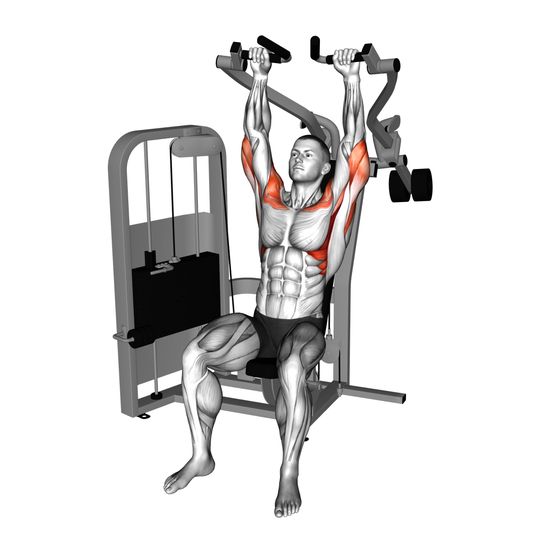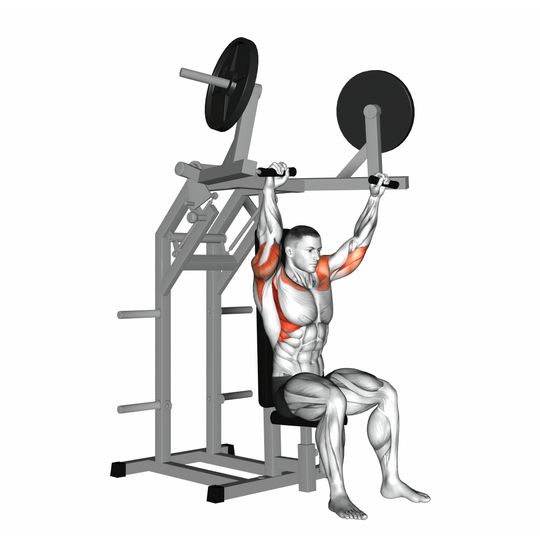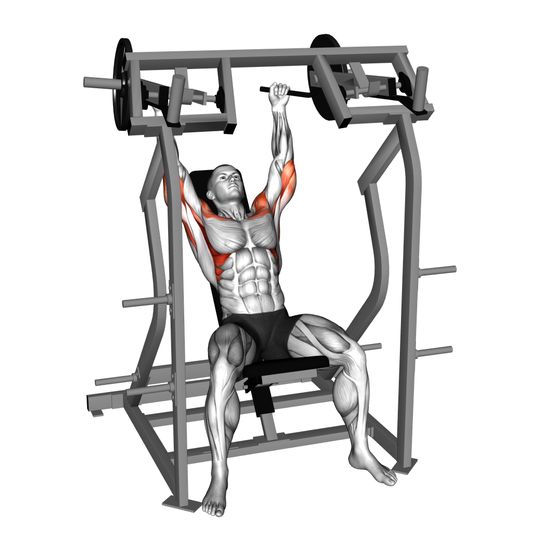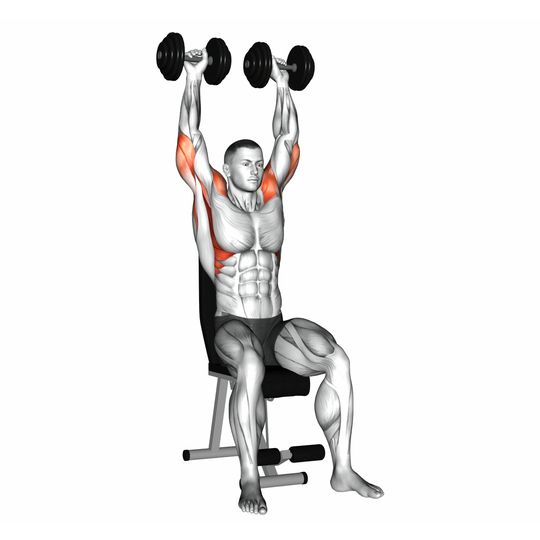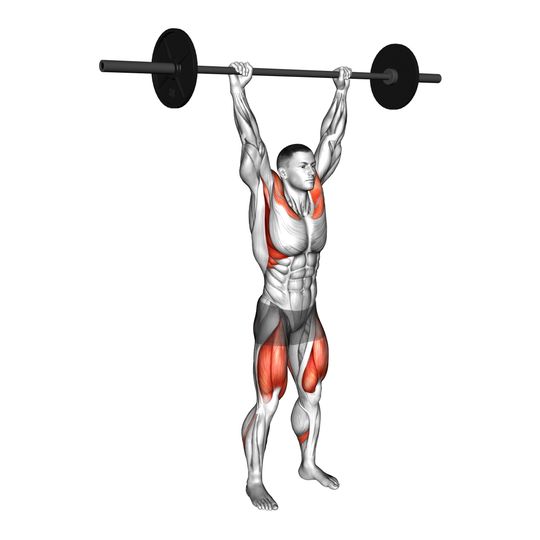


Sit in a leverage lateral-raise machine and lift your upper arms out to the sides to work the shoulder muscles. The movement abducts the arms at the shoulder while the machine provides guided resistance.
How to do the Machine Lateral Raise#
- Adjust the seat and weight, then sit so the machine pad contacts the outside of your upper arms.
- Brace your core and keep your chest upright throughout the movement.
- Drive your upper arms outward and upward until they reach about shoulder height.
- Hold that top position for one short count.
- Lower the arms slowly and under control back to the starting position.
Muscles worked#
The machine lateral raise trains the side delts, the lateral head of the deltoid, which is the muscle that lifts the arm straight out to the side and is responsible for shoulder width. Because the pads press against the upper arm rather than the hand, the load is applied close to the shoulder joint, and the side delt is challenged evenly from the bottom of the movement to the top instead of only near the finish.
The upper traps assist as the arms pass shoulder height and the shoulder blade starts to rotate upward, which is why lifting too high turns the exercise into a shrug. The supraspinatus of the rotator cuff starts the movement from the very bottom, and the front delts contribute a little if the arms drift forward. The forearms and grip are almost entirely removed, which is the machine's main advantage.
- Primary: Side delts (Lateral Deltoid)
- Secondary: Traps (Trapezius)
Common mistakes#
- Leaning back or using body momentum to help lift the weight.
- Pulling with the hands instead of lifting from the elbows/upper arms.
- Shrugging the shoulders or lifting well above shoulder level.
- Dropping the weight quickly on the way down.
- Seat set incorrectly so the pad does not sit on the upper arms
Why it works#
On a dumbbell lateral raise there is almost no resistance at the bottom and all of it at the top, and the wrists, forearms and grip get involved in holding the weight steady. The machine fixes both problems. The cam gives an even load through the whole arc, the pads on the upper arm remove the hands from the equation, and the fixed path makes it very hard to cheat with a swing.
That makes it the best lateral raise for taking the side delts to failure. You can go straight into drop sets by moving the pin, hold the top position under real tension, and use partial reps from the bottom when the full range is gone. For a muscle that responds to high volume and high effort, that is exactly what you want.
Sets, reps and setup#
Three to four sets of 12-20 reps with 45-60 seconds of rest, two or three times a week. Finish the last set with a drop set or six to eight partial reps from the bottom. Side delts tolerate a lot of volume, so err toward more sets rather than heavier weight.
- Setup
- Adjust the seat so the pivot of the machine arms lines up with your shoulder joint and the pads sit just above the elbow on the outside of the upper arm. Sit tall against the back pad, keep a slight bend in the elbows, and lift the arms out to the sides until they are level with the shoulders. Pause for a second, then lower over two seconds without letting the pads rest at the bottom.
- Progression
- Add reps up to 20 before adding a plate, then drop back to 12. If your shoulders start rising toward your ears or you lean to one side to lift the arm, the weight is ahead of you. When you stall, lengthen the pause at the top or slow the eccentric rather than pushing load.
Variations#
- Dumbbell Lateral Raise The free-weight version, with most of the load arriving at the top and the grip involved.
- Cable Lateral Raise A low pulley loads the bottom of the range, closer to the machine's even resistance.
- Seated Dumbbell Lateral Raise Sitting removes leg drive and body swing, making the dumbbell version stricter.
- Incline Dumbbell Lateral Raise Lying on your side on an incline bench, which loads the side delt in its stretched position.
- Barbell Upright Row A compound alternative that trains the side delts along with the traps and biceps.
Machine lateral raise vs dumbbell lateral raise#
The dumbbell lateral raise is available in every gym and lets you fine-tune the arm angle, but its resistance profile is poor. The weight is nearly effortless at your sides and maximal at the top, so the side delt only works hard in the last third of the rep, and momentum is easy to sneak in.
The machine gives a steady load from the bottom up, takes the grip out and makes cheating difficult. It is the better choice for high-effort, high-volume side delt work. Dumbbells still have a place for the stretched position and for training away from a machine, but if both are available, the machine deserves the priority slot.
Common questions#
What muscles does the machine lateral raise work?
The side delts do almost all of the work, with the supraspinatus helping to start the movement from the bottom and the upper traps assisting as the arms approach shoulder height. The front delts contribute slightly if the arms drift forward, and the grip is essentially removed.
Is the lateral raise machine better than dumbbells?
For growing the side delts, it usually is. The machine loads the muscle evenly through the whole range, removes the forearms and grip, and makes it hard to swing the weight. Dumbbells remain useful for the stretched position and when no machine is available.
Where should the pads sit on a lateral raise machine?
On the outside of the upper arm, just above the elbow, with the machine's pivot lined up with your shoulder joint. If the pads sit at the forearm you will push with the hands and feel it in the wrists; if the pivot is above the shoulder the arc will feel wrong and the traps will take over.
How high should I raise my arms on a lateral raise?
To shoulder height, where the upper arms are roughly parallel to the floor. Above that the shoulder blade rotates and the upper traps take over. Stop at parallel, hold for a second, and lower slowly.
How many reps should I do on the lateral raise machine?
Twelve to twenty for three or four sets, two or three times a week. The side delt is a small muscle that grows with volume and effort rather than heavy loads, so finish at least one set with partials or a drop set.