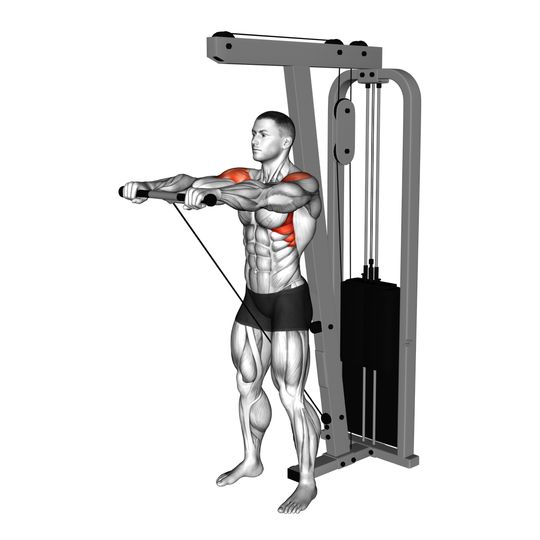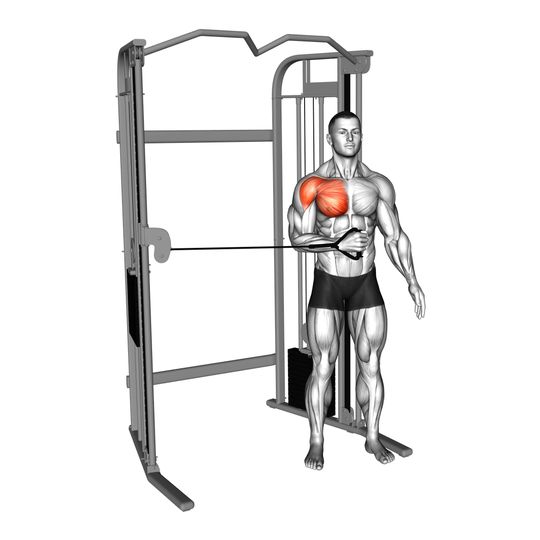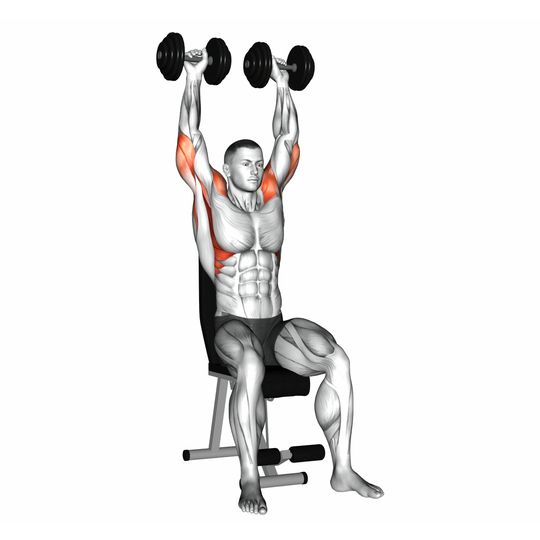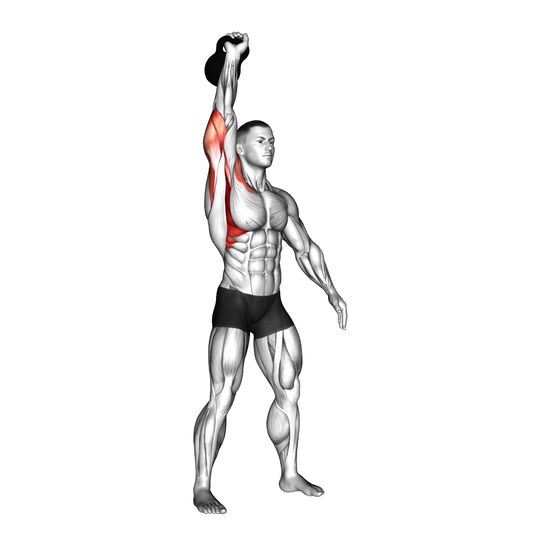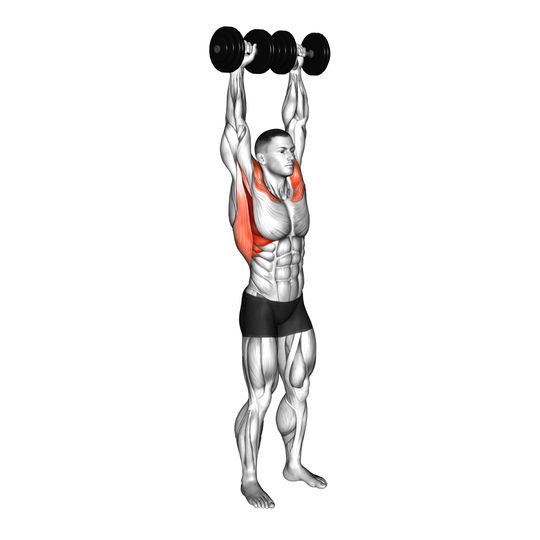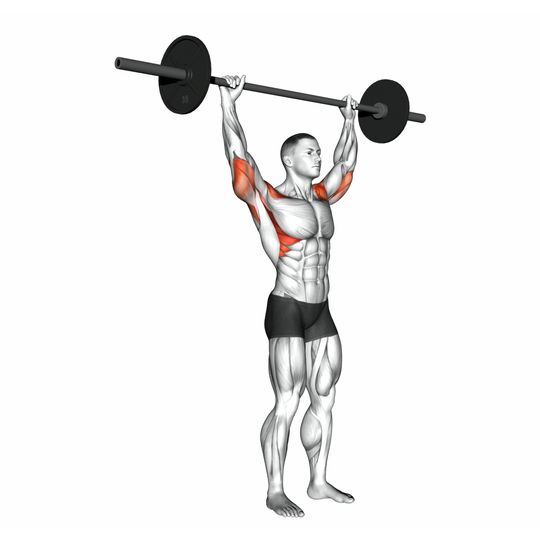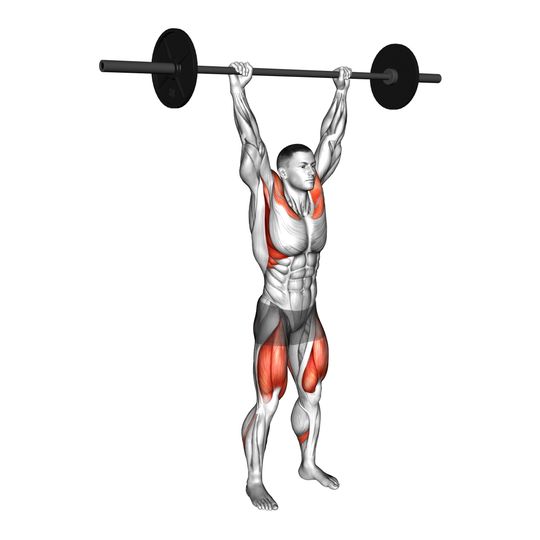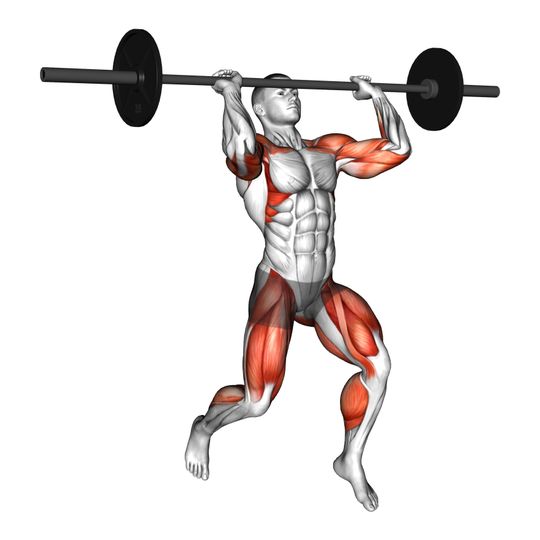


Perform a vertical pressing motion with cable handles to work the shoulder muscles (deltoids).
How to do the Cable Overhead Press#
- Set both cable pulleys to the lowest position and select an appropriate weight.
- Take a handle in each hand and raise them to shoulder level, positioning your elbows beneath the handles.
- Press the handles straight upward until your arms are nearly extended, exhaling as you push.
- Lower the handles back down to shoulder height in a controlled manner while inhaling.
Muscles worked#
- Primary: Front delts (Anterior Deltoid), Side delts (Lateral Deltoid)
- Secondary: Triceps (Triceps Brachii), Traps (Trapezius), Upper back (Rhomboids & Middle Trapezius), Abs (Rectus Abdominis)
Why it works#
A barbell overhead press is easiest at the bottom, where your legs and torso help, and hardest just above the forehead. Cables invert part of that: the stack pulls with the same force the whole way, so the delts stay loaded at the start of the rep and still have to work at lockout, where a barbell press begins to stack the weight over the joint and coast.
It is also the friendliest overhead press to a cranky shoulder. Handles let each hand choose a neutral or angled path instead of being locked to a bar, nothing has to pass in front of your face, the stack moves in two-and-a-half kilo steps, and if a rep fails you simply let go — which means you can train the movement hard without a spotter or a rack.
Sets, reps and setup#
Three to four sets of 8-15 reps with 60-90 seconds of rest. Treat it as your main pressing movement if barbells bother your shoulders, or as the accessory that follows barbell and dumbbell work if they do not.
- Setup
- Set the handles at roughly shoulder height with the cables running behind your arms, stand tall with a staggered stance, ribs pulled down and glutes tight. Press straight up until your biceps are beside your ears, then lower until your hands are back at shoulder level without letting the stack rest.
- Progression
- Add reps from 8 to 12 or 15 across all sets, then add one plate. If your lower back starts arching to finish the rep, brace harder and drop the load rather than pressing through it.
Variations#
- Overhead Press (Barbell) The heaviest version and the one to test strength on, but it demands the most shoulder and thoracic mobility.
- Overhead Press (Dumbbell) Independent arms and a free hand path, with more stability demand than cables at the top.
- Seated Shoulder Press (Machine) Back supported and the path fixed, which makes it the easiest overhead press to push to failure.
- Arnold Press (Dumbbell) Adds rotation on the way up, which brings the front delt through a longer range.
- Push Press (Dumbbell) Uses leg drive to move a heavier load through the top half of the press.
Cable overhead press vs barbell overhead press#
The barbell wins on load. You can press more weight, progress in small plate jumps, and it is the standard by which overhead strength is measured. It also asks for the mobility to keep a bar over the middle of your feet, and it is the version most likely to irritate a shoulder that already hurts.
The cable wins on tension and on joint comfort. Constant resistance through the whole range, a hand path you can choose, and no bar in front of your face. As a strength test it is a poor substitute; as a way to accumulate quality pressing volume for the delts, it is often the better tool.
Common questions#
What muscles does the cable overhead press work?
The front and side delts do most of the pressing, with the triceps finishing the rep. The upper traps and upper back help stabilise the load, and the abs and glutes work to stop your lower back arching.
How many sets and reps should I do?
Three to four sets of 8-15 reps. Cables are not the tool for heavy triples — use the rep range where you can hold position and still feel the delts working at lockout.
Cable or barbell overhead press for shoulders?
Barbell for maximum strength, cable for constant tension and shoulder comfort. If your shoulders tolerate a barbell, press with it and use cables as an accessory; if they do not, cables can carry the whole job.
Can the cable press replace the barbell overhead press?
For muscle growth, yes — the delts respond to tension and effort, not to a specific implement. For a one-rep max or a strength standard, no: those numbers are measured with a barbell.